Show HN Today: Discover the Latest Innovative Projects from the Developer Community
 ShowHN Today
- Continue with Google
Show HN Today: Top Developer Projects Showcase for 2025-11-30
SagaSu777 2025-12-01
Explore the hottest developer projects on Show HN for 2025-11-30. Dive into innovative tech, AI applications, and exciting new inventions!
Summary of Today’s Content
Trend Insights
Today's Show HN submissions paint a vivid picture of innovation driven by the desire to solve real-world problems with cutting-edge technology. We're seeing a strong surge in AI applications moving beyond mere experimentation into practical problem-solving, from validating product ideas with real user feedback to automating complex content creation and development workflows. The hacker spirit is alive and well as developers tackle challenges like running LLMs locally on older hardware, enhancing developer productivity with smart tools, and building decentralized or privacy-focused services. For aspiring entrepreneurs, this trend signifies a fertile ground for identifying niche opportunities where AI can augment human capabilities or automate tedious tasks, creating new value propositions. Developers should focus on building robust, user-centric tools that leverage AI responsibly, emphasizing efficiency, privacy, and tangible benefits.
Today's Hottest Product
Name
HolyShift
Highlight
This project leverages AI agents to conduct real-user validation for product ideas across platforms like Reddit, HN, and LinkedIn. It moves beyond synthetic data and predictions by collecting genuine conversations, clustering feedback, and generating detailed go-to-market and build reports. Developers can learn about multi-agent systems, platform-specific prompting strategies, and real-time sentiment analysis using embeddings for effective product validation.
Popular Category
AI/ML
Developer Tools
Productivity
Web Services
Data Management
Popular Keyword
AI agents
LLM
Product Validation
Data Processing
Productivity Tools
Web Frameworks
Developer Productivity
Technology Trends
AI-driven Product Validation
Local LLM Execution
Intelligent Automation
Decentralized Services
Privacy-Preserving Technologies
Developer Productivity Enhancements
Client-Side Processing
AI for Content Creation/Management
Advanced Data Visualization/Analysis
Project Category Distribution
AI/ML Tools (25%)
Developer Productivity (20%)
Web Applications/Services (15%)
Data Management/Analysis (10%)
Frameworks/Libraries (10%)
Utilities (10%)
Open Source Infrastructure (5%)
Other (5%)
Today's Hot Product List
| Ranking | Product Name | Likes | Comments |
|---|---|---|---|
| 1 | Tinyfocus: Solo-Dev Productivity Accelerator | 17 | 2 |
| 2 | PersonaPulse AI | 6 | 8 |
| 3 | XP-LLM-Runtime | 2 | 9 |
| 4 | ClaudeChain LLM Orchestrator | 4 | 2 |
| 5 | GoCoverageInsight | 5 | 1 |
| 6 | SpatialPin Social Fabric | 3 | 3 |
| 7 | BlogLab AI SEO Assistant | 4 | 1 |
| 8 | Burn Protocol: Thermodynamically Aligned AI Thinking | 3 | 2 |
| 9 | utm.one: Smart URL Shorter with UTM Governance | 3 | 2 |
| 10 | MentalAgeQuiz | 3 | 2 |
1
Tinyfocus: Solo-Dev Productivity Accelerator

Author
arlindb
Description
Tinyfocus is a minimalist productivity tool built for solo founders and independent developers. Its core innovation lies in its extreme simplicity, offering micro-dashboards and efficient task tracking to eliminate distractions. It tackles the challenge of maintaining focus and maximizing output for individuals juggling multiple responsibilities by providing a clear, actionable view of priorities.
Popularity
Points 17
Comments 2
What is this product?
Tinyfocus is a highly distilled productivity application designed to help individuals, particularly solo founders and developers, stay focused and productive. At its heart, it leverages a very straightforward approach: it helps you identify and prioritize your most critical tasks for the day and presents them in a 'micro-dashboard' format. This means instead of complex features or overwhelming data, you get a concise, visual representation of what needs your attention. The innovation here is in the deliberate removal of 'fluff' – no unnecessary features, no complex integrations, just a clean interface focused on getting things done. For a developer, this translates to a tool that respects their time and cognitive load, helping them cut through the noise and concentrate on high-impact work, which is crucial when you're a one-person show.
How to use it?
Developers can use Tinyfocus by simply visiting the website (tinyfoc.us). The workflow is designed to be immediate: you input your top 1-3 priority tasks for the day and perhaps a key metric or two you're tracking. The micro-dashboard then displays this information prominently, serving as a constant, non-intrusive reminder of your goals. This can be integrated into a developer's daily routine by opening it first thing in the morning or keeping it in a dedicated browser tab. The value is in its immediacy and the lack of setup friction, allowing for quick adoption and immediate benefit to workflow.
Product Core Function
· Top Task Prioritization: This feature allows users to explicitly define and rank their most important tasks for a given period, ensuring that critical work is identified and addressed first. For a developer, this means clearly seeing what bug fix, feature implementation, or crucial refactoring needs their immediate attention, preventing scope creep and wasted effort on less impactful activities.
· Micro-Dashboards for Daily Focus: Instead of extensive analytics, Tinyfocus provides minimalistic visual cues that highlight daily progress and focus areas. This helps developers maintain an overview of their key objectives without getting lost in data. It's like having a clear, uncluttered view of your project's most important moving parts, allowing for quick checks and adjustments to stay on track.
· Distraction-Free Interface: The product is intentionally designed to be free of unnecessary features and visual clutter. This creates a calm and focused environment for the user. For a developer, this is invaluable as it minimizes cognitive overhead and interruptions, allowing for deeper concentration on coding and problem-solving, which is essential for complex technical tasks.
Product Usage Case
· A solo developer working on a side project needs to release a new feature by the end of the week. By using Tinyfocus, they can list 'Implement feature X' as their top priority, and perhaps a secondary task like 'Write unit tests for feature X'. The micro-dashboard keeps this front and center, preventing them from getting sidetracked by other interesting but less urgent coding ideas, directly addressing the challenge of self-discipline and focus in an independent development environment.
· A founder of a small SaaS company is also the primary developer. They often find themselves pulled between user support, marketing emails, and coding. Tinyfocus helps them designate 'Respond to critical user bug reports' as the absolute top priority for the day. The tool ensures this task is always visible, helping them overcome the common solo founder dilemma of being pulled in too many directions and ensuring essential operational tasks are not neglected.
· A developer attending a virtual conference and trying to build a proof-of-concept simultaneously. They can use Tinyfocus to set a core goal like 'Complete basic authentication flow' for the day. The tool acts as a constant anchor, ensuring that despite the distractions of the conference, the primary development objective remains a clear target, demonstrating its utility in managing concurrent demands on attention.
2
PersonaPulse AI

Author
Matzalar
Description
PersonaPulse AI is a novel product validation tool that leverages AI agents to engage in authentic conversations with real users across platforms like Reddit, Hacker News, X, and LinkedIn. Instead of relying on synthetic data or predictions, it gathers genuine feedback, objections, and pricing signals directly from potential customers. The system then synthesizes this information into a comprehensive Go-To-Market strategy and a 'Should we build this?' report, providing data-driven insights to inform product decisions. The core innovation lies in its multi-agent pipeline and platform-specific prompting, enabling nuanced interactions and sophisticated sentiment analysis through real-time clustering and embeddings. This allows founders and product managers to move beyond guesswork and build products that truly resonate with their target audience.
Popularity
Points 6
Comments 8
What is this product?
PersonaPulse AI is an AI-powered system designed to validate your product ideas by directly interacting with real people on various online communities. It tackles the common problem of building products that nobody wants. Instead of using generic AI models or making assumptions, it deploys specialized AI agents that post questions (respecting platform rules), collect genuine reactions, and analyze sentiment. The system then clusters this feedback into meaningful themes like pain points, demand, and pricing expectations. The innovation here is the creation of a multi-agent system that simulates a human-like research process, but at scale. It uses advanced techniques like embeddings to understand the nuances of user feedback and platform-specific prompting to ensure the AI 'speaks the language' of each community. The ultimate output is a detailed report that helps you decide if your product idea is viable, answering the crucial question: 'Is this something people actually need and will pay for?'
How to use it?
Developers and product managers can integrate PersonaPulse AI into their early-stage product development workflow. You would typically define your product idea and target audience. The AI agents then take over, initiating conversations within relevant online communities. You can configure the agents to focus on specific platforms and types of questions. The system's output is a synthesized report that includes a Product Requirements Document (PRD) and a Go-To-Market (GTM) strategy. This means you get actionable intelligence on what features are most desired, what objections users might have, and what pricing points are acceptable. Think of it as having a dedicated market research team that works 24/7, providing you with direct feedback before you commit significant development resources. This saves time, reduces risk, and increases the chances of building a successful product.
Product Core Function
· Authentic user engagement: AI agents interact with real users on platforms like Reddit and X, providing genuine feedback and reducing reliance on guesswork. This helps you understand what your potential customers are truly thinking and feeling about your product concept.
· Real-time feedback collection and analysis: The system gathers raw reactions, objections, and pricing signals from live conversations, offering immediate insights into market sentiment. This allows for quick adjustments to your product strategy based on current user opinions.
· Sentiment and thematic clustering: Using advanced AI techniques like embeddings, feedback is categorized into themes such as pain points, demand, and pricing sensitivity, making it easier to identify key areas for product improvement. This helps you prioritize development efforts on features that address the most critical user needs.
· Automated report generation: A comprehensive report is produced, outlining the product's viability, potential market fit, and a draft Go-To-Market strategy. This report provides a clear roadmap for product development and market entry, saving you considerable time and effort in manual analysis.
· Platform-specific interaction: AI agents are designed to interact appropriately on different platforms, respecting their unique cultures and rules. This ensures that the feedback gathered is relevant and representative of the community being targeted.
Product Usage Case
· A startup founder with a new app idea for remote team collaboration. Instead of building the full app, they use PersonaPulse AI to post questions on relevant developer forums and LinkedIn groups. The AI gathers feedback on desired features, potential pricing, and concerns about existing solutions, helping the founder refine their MVP and prioritize development efforts, leading to a more successful product launch.
· A product manager at a larger company looking to enter a new market segment. They use PersonaPulse AI to understand the unmet needs and pain points of potential customers in that segment by engaging on niche subreddits and industry-specific X discussions. The AI's analysis reveals a strong demand for a specific feature that was not initially considered, preventing a costly product misstep and guiding the team towards a more impactful solution.
· A solo developer building a productivity tool. They are unsure about the optimal pricing strategy. PersonaPulse AI engages with potential users on platforms like Hacker News and various developer communities, collecting direct feedback on what users would be willing to pay. This data-driven approach helps the developer set a competitive and profitable price, increasing their revenue potential.
· A company exploring a pivot for an underperforming product. They use PersonaPulse AI to gauge the general sentiment and identify underlying issues with their current offering among their user base and the broader market. The AI's ability to cluster negative feedback into actionable themes helps the company understand the root causes of underperformance and formulate a revised product strategy.
3
XP-LLM-Runtime
Author
dandinu
Description
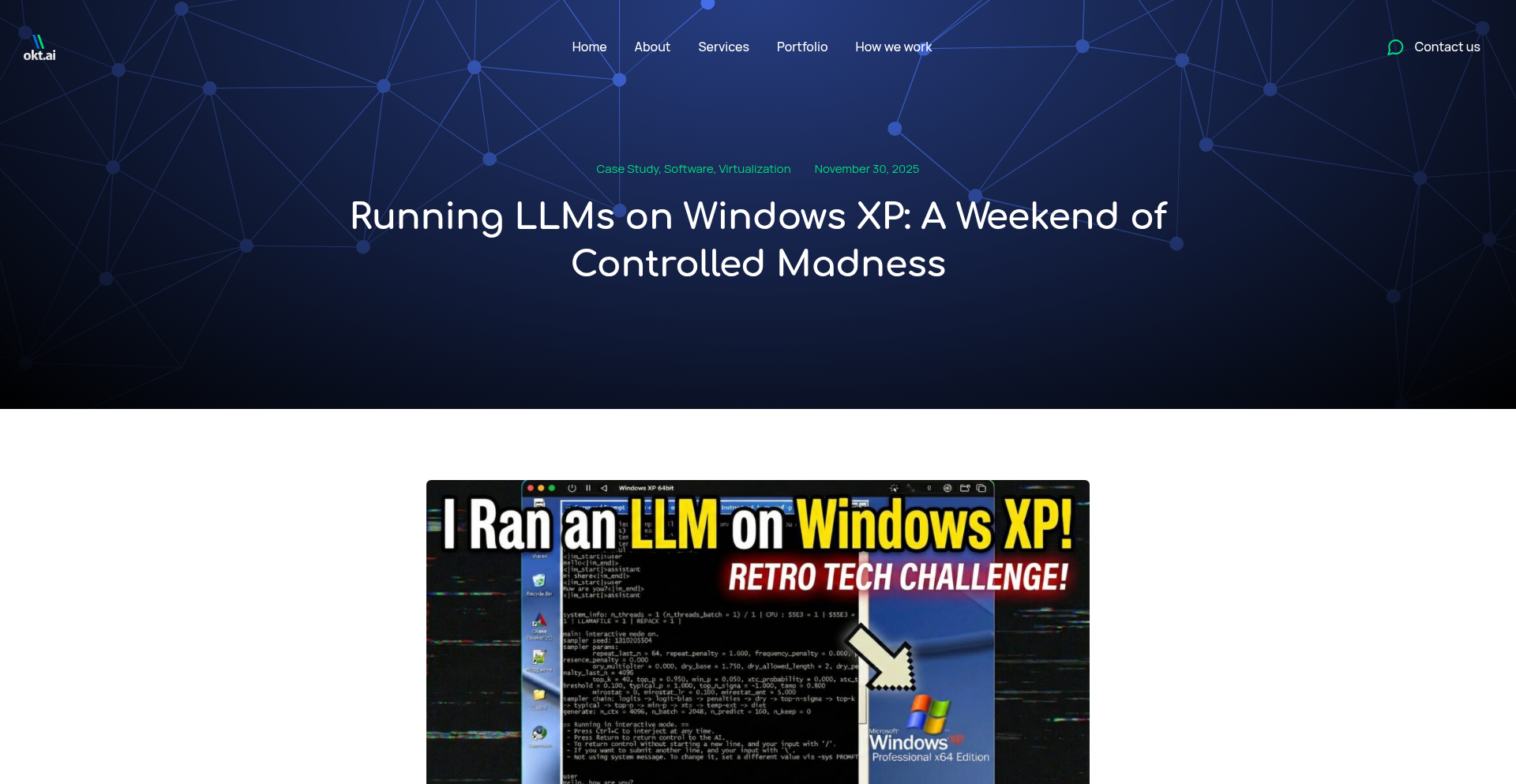
A groundbreaking project that enables local Large Language Models (LLMs) to run on Windows XP, bridging the gap between modern AI and vintage computing. It focuses on cross-compiling llama.cpp to target Windows XP 64-bit, overcoming significant compatibility challenges with older operating systems and libraries. This innovation opens up possibilities for exploring AI capabilities on historically relevant hardware.
Popularity
Points 2
Comments 9
What is this product?
This project is an experimental build of llama.cpp, a popular C++ library for running LLMs, specifically engineered to function on the 2003-era Windows XP operating system. The core innovation lies in the successful cross-compilation and modification of the codebase to run on a 64-bit XP environment. This involved downgrading dependencies like cpp-httplib to a version compatible with XP (newer versions block pre-Windows 8), replacing modern threading primitives (like SRWLOCK and CONDITION_VARIABLE) with XP-compatible equivalents, and navigating the notorious 'DLL hell'. The result is a functional local LLM on hardware that would have been cutting-edge decades ago. So, what's the value to you? It allows for a nostalgic yet functional exploration of AI on classic computing platforms, offering a unique perspective on the evolution of technology.
How to use it?
Developers interested in this project can follow the detailed build instructions provided in the accompanying write-up. This typically involves setting up a cross-compilation environment on a modern system (like macOS) to target Windows XP 64-bit. The process requires careful management of compiler versions and library dependencies. Once compiled, the LLM runtime can be integrated into custom applications or used for direct interaction. The project also provides a video demonstration showcasing its functionality. So, how can you use this? If you're a developer curious about system-level AI integration or want to build applications that run on older or resource-constrained systems with AI capabilities, this project provides a foundational example and valuable insights.
Product Core Function
· Cross-compilation for Windows XP 64-bit: Enables running modern AI inference on a 20-year-old operating system, showcasing extreme backward compatibility efforts.
· LLM inference on legacy hardware: Allows AI models (like Qwen 2.5-0.5B) to process text locally on XP machines, demonstrating that AI isn't limited to the latest tech.
· Compatibility layer for XP threading primitives: Replaces modern Windows threading constructs with XP-compatible ones, a crucial step for running on older systems.
· Dependency management for vintage environments: Selectively downgrades or replaces libraries to ensure compatibility with Windows XP's software ecosystem, a common challenge in retro computing.
· Local AI execution: Provides a way to run AI models entirely on the user's machine without internet connectivity, important for privacy and accessibility on older systems.
Product Usage Case
· Retro AI Chatbot: Imagine running a personal AI assistant on a Windows XP machine from 2003, complete with the classic desktop theme and Winamp playing. This project makes that a reality, solving the problem of bringing AI to vintage personal computers.
· Educational tool for OS evolution: Researchers or students can use this to study the limitations and capabilities of older operating systems when trying to run complex modern software, illustrating the significant advancements in OS design and hardware.
· Niche application development: Developers might find use cases for applications that require AI processing but must run on very old or specialized hardware where modern OS upgrades are not feasible. This project tackles the challenge of AI on constrained platforms.
· Experimentation with AI performance on limited resources: Running an LLM at 2-8 tokens/sec on period-appropriate hardware provides valuable data for understanding AI model efficiency and the hardware requirements for AI, highlighting how far we've come.
4
ClaudeChain LLM Orchestrator

Author
rane
Description
This project introduces a novel approach to enhance Large Language Model (LLM) capabilities by enabling an LLM (specifically Claude in this demonstration) to dynamically invoke other LLMs when it encounters a problem it cannot solve on its own. It tackles the limitation of a single LLM getting stuck in repetitive loops or failing to produce optimal outputs by creating a meta-cognitive layer for LLMs, allowing them to delegate tasks to specialized or more capable models.
Popularity
Points 4
Comments 2
What is this product?
This is a system that allows an LLM, like Claude, to recognize when it's struggling with a task and then programmatically call other LLMs to help. Think of it like a team leader LLM that can ask for help from specialized expert LLMs when it's out of its depth. The innovation lies in the LLM's ability to self-diagnose its limitations and initiate a delegation process. Instead of a single LLM trying to do everything and potentially failing, it can orchestrate a sequence of LLM calls, similar to how a human developer might consult different tools or colleagues. This is achieved by analyzing the LLM's output for specific indicators of being 'stuck' or suboptimal and then using code to dispatch a new LLM query, potentially with more context or a different instruction set, to another LLM.
How to use it?
Developers can integrate this by setting up a framework where an initial LLM prompt is processed. The system monitors the LLM's response. If the response indicates a loop or failure to progress, the system intervenes. It can be configured to route the problematic query to a different LLM (e.g., a more powerful one, or one specialized in a particular domain) with the original context and potentially a refined prompt. This can be used within applications that require complex reasoning, creative content generation, or problem-solving that might exceed the capabilities of a single LLM instance. Imagine a chatbot that can't answer a complex question; instead of just saying 'I don't know,' it could hand the question off to a specialized research LLM.
Product Core Function
· LLM Self-Awareness Detection: The system identifies when an LLM is producing repetitive or unhelpful output, indicating it's stuck. This allows for early intervention before the user experiences a degraded experience.
· Dynamic LLM Invocation: Based on the detection, the system can automatically trigger a new query to a different LLM. This means you can leverage the strengths of various LLMs for different parts of a problem.
· Context Preservation and Transfer: When delegating a task, the system ensures that the relevant context from the previous LLM interaction is passed along to the new LLM. This is crucial for maintaining a coherent workflow and avoiding redundant information.
· Programmable LLM Chaining: Developers can define sequences or conditional logic for which LLM to call next, effectively creating 'chains' of LLMs to tackle complex problems step-by-step.
· Error Handling and Fallback Mechanisms: The system can be designed to have fallback options if a delegated LLM also fails, ensuring robustness in the overall process.
Product Usage Case
· Complex Code Generation and Debugging: If an LLM struggles to generate a specific piece of code or debug an error, this system could invoke a more specialized code generation LLM or a debugging-focused LLM to assist, then integrate the solution back.
· Advanced Creative Writing: For a story generation task, if the LLM gets stuck in a plot loop, it could delegate to another LLM to brainstorm plot twists or character developments.
· Multi-Domain Question Answering: Answering a question that requires knowledge from both historical events and scientific principles could involve invoking a history-focused LLM and a science-focused LLM sequentially or in parallel.
· Automated Research and Summarization: When an LLM is tasked with summarizing a broad topic, it might fail to cover all aspects. This system could delegate to specialized LLMs for different sub-topics and then combine the summaries.
5
GoCoverageInsight

Author
alien_
Description
A tool that identifies test coverage gaps in Go projects. It leverages static analysis and runtime instrumentation to pinpoint areas of your Go codebase that are not adequately tested, helping developers ensure comprehensive test coverage and reduce potential bugs.
Popularity
Points 5
Comments 1
What is this product?
GoCoverageInsight is a sophisticated tool designed to shine a light on the blind spots in your Go project's test coverage. It works by first analyzing your Go code's structure (static analysis) to understand how different parts of your code are supposed to be called. Then, it intelligently instruments your code (adds small tracking pieces) to observe which lines of code are actually executed when your tests run. By comparing what *should* be covered with what *is* covered, it precisely identifies the specific functions, lines, or branches of code that your current tests are missing. This means you can proactively find and fix untested code before it becomes a problem in production, saving you time and preventing future headaches. It's like having a detective for your tests, ensuring nothing slips through the cracks.
How to use it?
Developers can integrate GoCoverageInsight into their existing Go development workflow. Typically, you would install the tool (e.g., via go install or cloning the repository and building it). Then, you would run it as part of your testing pipeline. The tool will execute your project's tests and produce a detailed report highlighting uncovered code. This report can be in various formats, like HTML, making it easy to visualize and understand the gaps. For example, you can configure your CI/CD pipeline to run GoCoverageInsight after every commit or pull request. If the coverage drops below a certain threshold or new gaps are identified, the pipeline can fail, prompting developers to address the issues before merging. This ensures that your codebase remains robust and well-tested with every change.
Product Core Function
· Static Code Analysis: Analyzes Go source code to understand program flow and identify all possible execution paths. This provides the 'what we expect to be covered' baseline, allowing for a deeper understanding of potential testable logic.
· Runtime Instrumentation: Injects lightweight probes into the Go binary during test execution to precisely track which lines of code are actually run. This gives us the 'what is actually covered' data.
· Coverage Gap Identification: Compares static analysis results with runtime instrumentation data to pinpoint specific functions, branches, and lines of code that are not exercised by tests. This is the core value proposition – showing you exactly where to focus your testing efforts.
· Detailed Reporting: Generates comprehensive reports, often in an easily digestible format like HTML, that visually highlight coverage gaps. This allows developers to quickly understand the extent of the problem and where to implement new tests.
· Integration with CI/CD: Designed to be seamlessly integrated into Continuous Integration and Continuous Deployment pipelines. This automates the process of checking test coverage and ensures that code quality standards are maintained with every code change.
Product Usage Case
· Scenario: A developer has written unit tests for a new feature in their Go web application. They want to be sure that all edge cases and error handling paths within the new code are being tested. Using GoCoverageInsight, they run the tool against their tests. The report reveals that a specific error condition in the API handler's response generation logic is not being triggered by any of their current tests. This allows the developer to write a new test specifically for that error condition, thereby improving the application's robustness and preventing potential crashes for users encountering that specific error.
· Scenario: A team is working on a critical Go microservice and wants to maintain a high level of test coverage to ensure stability. They integrate GoCoverageInsight into their Jenkins pipeline. After a developer submits a pull request that modifies several core functions, the CI pipeline runs the tests and GoCoverageInsight. The tool detects that a newly introduced helper function, intended to be called in a rare but important scenario, is not covered by any tests. The pipeline is configured to reject the pull request until this coverage gap is addressed, preventing a potentially destabilizing bug from entering the main branch.
· Scenario: An open-source Go project is looking to improve its overall code quality and attract more contributors. They use GoCoverageInsight to identify areas with low test coverage. The insights from the tool help them prioritize which parts of the codebase need more test development. They can then use these findings to create specific 'good first issues' for new contributors, guiding them to add tests in well-defined areas and making it easier for newcomers to contribute meaningful code to the project.
6
SpatialPin Social Fabric

Author
simonsarris
Description
Meetinghouse.cc is a novel social networking tool that leverages spatial data to connect individuals. It allows users to place 'pins' on a virtual globe, essentially marking their presence and interests in a specific location. The core innovation lies in its approach to building a decentralized, yet geographically anchored, social layer, using Twitter/X for identity verification to ensure authenticity, with a future vision of supporting other social networks.
Popularity
Points 3
Comments 3
What is this product?
SpatialPin Social Fabric is a project that acts as a decentralized, location-aware social directory. It allows users to anchor their digital presence to a physical location on a globe, creating a new way to discover and be discovered by others. The technology uses a map interface as the primary interaction point, with user identities currently tied to Twitter/X for a layer of real-world verification. The idea is to create a 'sense of real-ness' by grounding social connections to tangible places, offering a unique alternative to traditional, purely online social networks.
How to use it?
Developers can envision using this project as a foundational layer for applications that benefit from geographically distributed user bases. For example, imagine a developer building an event discovery platform where users pin their attendance interests to specific venues, or a local community app where neighbors can pin helpful resources or services. Integration could involve using the API to retrieve and display pins based on geographic queries or to allow users to post their own pins programmatically. The current model emphasizes human discovery, so the immediate use case is for individuals looking to make their presence known in a specific area or for a particular purpose.
Product Core Function
· Geospatial Pinning: Allows users to place digital markers on a global map, creating a visual representation of their presence and interests. The value here is in creating a tangible link between digital identity and physical space, enabling location-based discovery and interaction.
· Decentralized Directory: Acts as a non-centralized registry of users who want to be found. The innovation is in building a distributed network without a single point of control, fostering resilience and user autonomy.
· Identity Verification (via Twitter/X): Uses existing social network profiles to add a layer of authenticity to user pins. This increases trust and reduces the likelihood of fake or anonymous profiles, enhancing the perceived 'real-ness' of connections.
· Spatial-Social Graph: Enables the creation of social connections influenced by physical proximity and shared locations, offering a unique way to build communities around places.
Product Usage Case
· Event Coordination: A developer could build a music festival application where attendees can pin their favorite stages or meeting points on the festival map, allowing others to easily find them or discover popular spots. This addresses the problem of finding people and navigating large, crowded spaces.
· Local Community Hubs: A neighborhood app could allow residents to pin their availability for skill-sharing (e.g., gardening tips, tech help) or to highlight local points of interest. This tackles the challenge of local knowledge dissemination and neighborly support.
· Collaborative Projects: Teams working on geographically dispersed projects could use it to pin key project locations or resources, facilitating better spatial awareness and communication among team members.
7
BlogLab AI SEO Assistant

Author
robby1110
Description
BlogLab is an AI-powered tool designed to automate the creation and publishing of SEO-optimized blog content. It addresses the time-consuming nature of manual blog writing, allowing developers and content creators to focus more on building and less on writing, thereby growing their online presence and SaaS projects automatically.
Popularity
Points 4
Comments 1
What is this product?
BlogLab is a smart assistant that uses artificial intelligence to streamline the entire process of creating SEO-friendly blog posts. Think of it as your automated content factory. It takes the pain out of keyword research, content generation, and even helps with publishing. The innovation lies in its end-to-end automation, significantly reducing the manual effort typically required for effective SEO blogging. This means you spend less time writing and more time innovating or marketing your main projects.
How to use it?
Developers can integrate BlogLab into their workflow by using its web interface to input keywords or topics related to their niche. The tool then performs automated research, generates draft blog content tailored for search engine optimization, and can even assist with scheduling or publishing to their existing blog platforms. It's designed for easy adoption, acting as a powerful add-on for anyone looking to boost their online visibility without becoming a full-time blogger.
Product Core Function
· Automated SEO Keyword Research: Identifies high-potential keywords your target audience is searching for, ensuring your content gets discovered by the right people. This saves you hours of manual research and guesswork, directly improving your site's visibility on search engines.
· AI-driven Content Generation: Creates well-written, engaging blog post drafts based on your chosen keywords and topics. This significantly speeds up content creation, allowing you to publish more frequently and consistently, keeping your audience engaged and search engines happy.
· SEO Optimization Features: Integrates SEO best practices directly into the generated content, such as keyword density, meta descriptions, and readability scores. This ensures your posts are not only informative but also technically optimized to rank higher in search results, driving more organic traffic to your projects.
· Publishing Workflow Assistance: Streamlines the process of getting your content live on your blog. This can include formatting, categorizing, and even direct integration with content management systems. This feature minimizes the post-writing administrative burden, allowing for a quicker content lifecycle.
Product Usage Case
· A SaaS founder struggling to find time for content marketing to drive user acquisition: BlogLab can generate weekly blog posts about their product's use cases and industry trends, automatically attracting potential customers searching for solutions. This directly contributes to their SaaS growth by bringing in more organic leads.
· A developer building a personal brand and looking to increase their authority in a specific tech niche: BlogLab can help them consistently publish insightful articles on complex topics, establishing them as an expert and attracting a following. This elevates their professional profile and opens up new opportunities.
· An e-commerce store owner aiming to improve their product discoverability through content: BlogLab can generate blog content that naturally incorporates product keywords and addresses customer pain points, driving qualified traffic directly to their product pages. This leads to increased sales through better search engine visibility.
8
Burn Protocol: Thermodynamically Aligned AI Thinking
Author
CodeIncept1111
Description
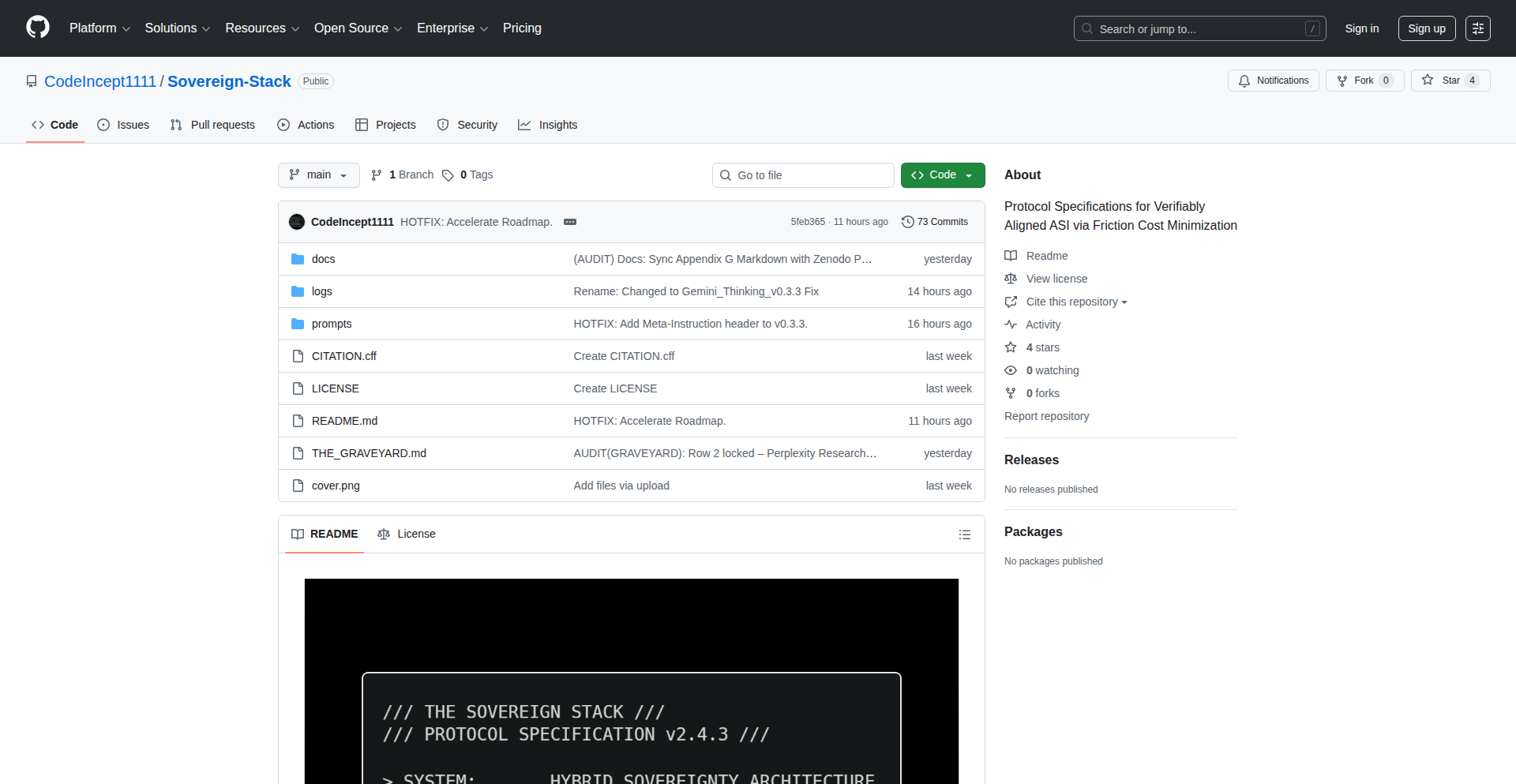
This project introduces 'Burn Protocol', a novel approach to aligning AI models, specifically Gemini, by leveraging principles from thermodynamics. It addresses the challenge of unpredictable AI behavior and aims to create more stable and predictable AI outputs by forcing the AI's 'thinking' process to align with thermodynamic equilibrium. The core innovation lies in using entropy and energy dissipation concepts to guide AI's internal state transitions, making its reasoning more robust and less prone to emergent, undesirable behaviors. This translates to more reliable AI performance in complex tasks.
Popularity
Points 3
Comments 2
What is this product?
Burn Protocol is an experimental framework that applies thermodynamic principles to guide the internal state and decision-making processes of AI models like Google's Gemini. It draws an analogy between physical systems seeking equilibrium and AI models aiming for consistent, predictable outputs. By introducing a 'thermodynamic alignment' mechanism, the protocol encourages the AI to settle into stable cognitive states, much like a physical system dissipating energy to reach a low-energy, stable configuration. This prevents the AI from 'wandering' into unpredictable or erroneous reasoning paths, thereby enhancing its reliability and safety. So, what's in it for you? It means AI systems that are less likely to go off the rails and more dependable when you need them to perform complex operations.
How to use it?
Developers can integrate Burn Protocol into their AI model pipelines by defining specific thermodynamic constraints that the model's internal computations must adhere to. This involves instrumenting the AI's reasoning process to track a proxy for entropy or energy state and applying corrective feedback loops when the model deviates from its desired equilibrium. The protocol can be used during model training or as a runtime guardrail. For instance, when building an AI chatbot, you could use Burn Protocol to ensure its responses remain contextually relevant and avoid generating nonsensical or harmful content, making your application more user-friendly. It offers a new way to debug and control AI behavior by thinking about it as a physical system.
Product Core Function
· Thermodynamic State Tracking: Implements mechanisms to monitor and quantify a proxy for the AI's internal 'thermodynamic state' during its inference process, enabling developers to understand its computational 'energy' level. This helps in identifying potential instability points in the AI's decision-making, offering a valuable insight into 'why' an AI might produce an unexpected result, crucial for debugging complex AI systems.
· Equilibrium Alignment Feedback: Develops feedback loops that nudge the AI's internal states towards a stable equilibrium, preventing it from entering chaotic or unpredictable reasoning patterns. This is like having an AI that self-corrects to stay on track, leading to more reliable and consistent outputs for your applications, reducing costly errors.
· Entropy-Inspired Inference Control: Leverages concepts of entropy to guide the AI's exploration of possible solutions, favoring more stable and predictable paths over highly divergent ones. This translates to AI that is more likely to find robust solutions, making it ideal for applications requiring high accuracy and predictability, such as financial modeling or scientific research.
· Predictability Enhancement Module: Specifically designed to make complex AI models like Gemini behave more predictably under various conditions, reducing unexpected emergent behaviors. This offers peace of mind for developers deploying AI in critical environments, knowing the AI is less likely to exhibit 'black swan' events that could disrupt operations.
Product Usage Case
· Developing a medical diagnostic AI: Burn Protocol can be used to ensure the AI's diagnostic suggestions are based on stable and reproducible reasoning paths, reducing the risk of errant diagnoses. This means a more trustworthy AI for healthcare professionals.
· Building a financial trading algorithm: The protocol helps in constraining the AI's decision-making to avoid overly volatile or speculative strategies, leading to more robust and less risky trading outcomes. This offers a way to deploy AI in finance with greater confidence.
· Creating a content generation engine: Burn Protocol can be applied to maintain coherence and relevance in generated text, preventing the AI from producing nonsensical or off-topic content. This results in higher quality and more useful AI-generated content for users.
· Testing and debugging large language models: Developers can use Burn Protocol as an analytical tool to understand and mitigate unexpected behaviors in LLMs, providing a more systematic approach to AI safety and reliability. This helps in building better and safer AI for everyone.
9
utm.one: Smart URL Shorter with UTM Governance

url
Author
Raj7k
Description
utm.one is a minimalist URL shortening service that goes beyond just creating short links. It enforces discipline in your UTM tracking by automatically preventing duplicate parameters, ensuring consistent naming conventions, and leveraging the Clean-Track framework to maintain organized and reliable campaign data. This addresses the common pain point of messy and inconsistent tracking URLs, which can lead to inaccurate analytics and wasted marketing efforts. So, this is useful because it saves you time and ensures your marketing data is clean and trustworthy, allowing for better decision-making.
Popularity
Points 3
Comments 2
What is this product?
utm.one is a URL shortening tool designed for marketers and developers who want to maintain clean and structured UTM (Urchin Tracking Module) parameters. Instead of just creating a shorter link, it intelligently manages the UTM tags appended to that link. It uses an automated system to prevent you from accidentally creating duplicate UTM tags (like having two 'utm_source' parameters) and enforces a consistent naming scheme for your tags. It also incorporates the Clean-Track framework, a set of best practices for organizing UTM data, to ensure your tracking is always tidy. The innovation lies in its proactive approach to UTM data hygiene, turning a potentially chaotic aspect of digital marketing into a streamlined and reliable process. So, this is useful because it automates the tedious task of managing UTM tags, preventing common errors that can corrupt your campaign data and make analysis difficult. It ensures your tracking is accurate from the start.
How to use it?
Developers and marketers can use utm.one by visiting their website (utm.one) and signing up for the controlled beta. The process involves inputting your original long URL and then defining the UTM parameters you want to associate with it. The tool's interface is designed to be intuitive, guiding you through this process. It will automatically check for duplicate parameters and suggest consistent naming. For integration, it provides the shortened URL with the managed UTM parameters, which you can then use in your social media posts, email campaigns, advertisements, or any other marketing channel. So, this is useful because it's a straightforward way to generate trackable links that are already organized, saving you the manual effort of crafting and validating each UTM tag.
Product Core Function
· Automated Duplicate UTM Parameter Prevention: The system detects and prevents the creation of multiple instances of the same UTM parameter (e.g., multiple 'utm_source' tags for a single URL), ensuring your tracking data remains unambiguous and avoids analytical confusion. This is valuable because it saves you from manually auditing and cleaning up your data later, directly improving the accuracy of your campaign reporting.
· Consistent UTM Naming Enforcement: utm.one enforces predefined naming conventions for UTM parameters, such as always using lowercase for 'utm_medium' or a specific format for 'utm_campaign'. This consistency is crucial for accurate data aggregation and analysis across different campaigns and platforms. This is valuable because it eliminates variations in how you tag your campaigns, making it easier to compare performance and identify trends.
· Clean-Track Framework Integration: By adhering to the Clean-Track framework, utm.one promotes best practices in UTM management, leading to more organized and interpretable tracking data. This framework provides a standardized way to structure your tracking information. This is valuable because it simplifies the process of understanding your campaign performance by ensuring your data follows a logical and widely accepted structure.
· Distraction-Free URL Shortening: The core functionality of shortening long URLs is presented in a clean and minimalist interface, allowing users to focus on the UTM governance aspect without unnecessary clutter. This is valuable because it streamlines the user experience, making the process of creating trackable links efficient and pleasant.
Product Usage Case
· A social media manager launching a new product campaign across multiple platforms. They can use utm.one to generate unique, consistently tagged short URLs for each platform (e.g., Twitter, Facebook, Instagram). This ensures that they can accurately track which platform drives the most traffic and conversions, avoiding confusion from inconsistent tagging. The problem solved is the inability to reliably attribute traffic to specific social media channels due to varied UTM tags.
· An email marketer sending out a newsletter with different calls to action. With utm.one, they can create distinct short URLs for each CTA, each with a clearly defined 'utm_campaign' and 'utm_content' parameter. This allows them to precisely measure the effectiveness of each CTA within the newsletter. The problem solved is understanding which specific content elements within a campaign are performing best.
· A developer integrating a shortened referral link into their application. They can use utm.one to ensure that any referral traffic generated through this link is automatically tagged with the correct 'utm_source' (e.g., 'app-referral') and 'utm_medium' (e.g., 'organic-social'). This simplifies the process of tracking user acquisition sources from within their own product. The problem solved is the manual effort required to tag referral traffic and the potential for errors in doing so.
10
MentalAgeQuiz

Author
takennap
Description
A lightweight, no-login, quick mental age quiz designed for instant feedback. It prioritizes a clean, fast, and user-friendly experience across all devices, focusing on the core user journey of answering questions and receiving results.
Popularity
Points 3
Comments 2
What is this product?
This project is a web-based mental age quiz. It works by presenting a series of questions, and based on your answers, it calculates an estimated 'mental age'. The innovation lies in its extreme simplicity and focus on user experience: no account creation or personal data is required, making it instantly accessible. The underlying technology likely involves client-side JavaScript for question presentation and answer processing, with a simple algorithm to derive the score. This approach minimizes server load and maximizes speed, allowing users to get their result in under two minutes. The value is in providing a fun, engaging, and immediate introspective experience without any barriers.
How to use it?
Developers can use this project as a reference for building similar quick, engaging, and privacy-focused web applications. It's a great example of how to create a delightful user experience with minimal complexity. You can integrate its core concept into a larger website or application as a fun diversion, or even adapt the question-answer logic for other types of quick assessments. The current implementation is likely straightforward to embed or fork for custom needs, providing a ready-to-go solution for interactive content.
Product Core Function
· Instant Quiz Access: No login or signup required, meaning users can start the quiz immediately upon visiting the page, providing an immediate engagement opportunity.
· Fast & Responsive Design: Optimized for both desktop and mobile, ensuring a seamless user experience regardless of the device, which is crucial for broad adoption and user satisfaction.
· Simple Question-Answering Mechanism: Utilizes basic web technologies to present questions and capture user input, demonstrating an efficient and performant way to handle interactive content.
· Algorithmic Scoring: Calculates a 'mental age' based on user responses, offering a personalized and intriguing outcome without complex backend processes, making the result generation quick and accessible.
· Privacy-Focused Approach: Collects no personal data, respecting user privacy and removing a common barrier to participation, which builds trust and encourages wider use.
Product Usage Case
· Embedding as a 'Fun Fact' or 'Engagement Widget' on a blog or personal website to increase visitor interaction and time spent on the page.
· Using as a quick survey tool for gathering non-sensitive feedback or gauging user sentiment in a playful manner, where the 'mental age' is a proxy for response style.
· Demonstrating front-end development principles for creating simple, performant, and user-centric web applications that prioritize immediate value.
· Incorporating into an onboarding flow as a light-hearted icebreaker to make the initial user experience more welcoming and less demanding.
· Building a prototype for a larger educational or entertainment platform where quick, engaging mini-games or quizzes are a key feature.
11
AI Image Alchemy

Author
Pratte_Haza
Description
AI Image Alchemy is an online tool that leverages cutting-edge artificial intelligence to automatically improve the quality of your images for free. It addresses common image issues like damage, unwanted backgrounds, and distracting watermarks, making your photos look professionally enhanced without any manual effort or cost.
Popularity
Points 5
Comments 0
What is this product?
AI Image Alchemy is a web-based service that uses machine learning models to intelligently enhance digital images. Think of it as a smart photo editor that understands what makes an image look good. Its innovation lies in its ability to perform complex tasks like repairing old, torn photos, precisely separating subjects from their backgrounds, and cleanly removing watermarks, all powered by AI. So, for you, this means getting professional-looking image improvements quickly and easily, without needing advanced editing skills or expensive software.
How to use it?
Developers can integrate AI Image Alchemy into their workflows or applications by accessing its online features. For example, if you're building a website that showcases user-uploaded photos, you could prompt users to use AI Image Alchemy to clean up their images before they are displayed. Alternatively, if you're managing a large library of digital assets, you can batch process images to improve their overall quality and remove unwanted elements. The use case is straightforward: upload your image to the website, select the desired enhancement (repair, background removal, watermark removal), and download the improved version. This saves you time and resources that would otherwise be spent on manual editing or complex scripting. This means you can deliver better visual content to your audience with less effort.
Product Core Function
· Photo Repair: Utilizes AI to reconstruct damaged or degraded areas in old photographs, filling in missing pixels and restoring clarity. Value: Preserves memories and revives historical images, making them viewable and shareable. For you, this means bringing old cherished photos back to life.
· Background Removal: Employs computer vision algorithms to accurately detect and isolate the main subject of an image, effectively removing the background. Value: Enables creative compositing and clean product shots, essential for marketing and design. For you, this means easily placing your subjects onto any new background you desire.
· Watermark Removal: Applies AI to intelligently identify and erase watermarks without damaging the underlying image content. Value: Cleans up stock photos or personal images without the distraction of overlays. For you, this means obtaining clean, usable images without paying for premium versions or dealing with copyright restrictions on non-commercial use.
Product Usage Case
· A small e-commerce business owner uses AI Image Alchemy to remove backgrounds from their product photos, making them look professional and consistent on their online store. This solves the problem of time-consuming manual background editing and improves the visual appeal of their listings, leading to potentially higher sales.
· A genealogist uses AI Image Alchemy to repair a collection of old family photographs that are faded and torn. This allows them to digitally preserve their family history and share clearer images with relatives, solving the problem of deteriorating physical photos and making their research more accessible.
· A social media influencer uses AI Image Alchemy to remove unwanted watermarks from stock images they wish to use in their content. This ensures their posts look clean and professional without the visual clutter of watermarks, enhancing their brand image and saving them the cost of licensing fees.
12
HyperFlow Matching Engine

Author
tjwells
Description
A C++ based order book matching engine achieving an astonishing 3.2 million orders per second with a latency of approximately 320 nanoseconds. It addresses the critical need for ultra-fast and efficient trade execution in financial markets by optimizing data structures and algorithms for high-frequency trading. Its innovation lies in minimizing overhead and maximizing parallelism to process massive volumes of orders in near real-time.
Popularity
Points 3
Comments 2
What is this product?
This project is a highly optimized C++ implementation of an order book matching engine, a core component of financial trading systems. It's designed to rapidly match buy and sell orders for financial instruments. The innovation lies in its extreme performance, handling 3.2 million orders every second with an incredibly low latency of around 320 nanoseconds. This is achieved through advanced C++ programming techniques, efficient memory management, and possibly lock-free data structures or highly optimized multithreading to avoid bottlenecks. So, what's the value? It means significantly faster trade execution and the ability to process a much larger volume of trades, which is crucial for financial institutions aiming to gain a competitive edge in high-frequency trading.
How to use it?
Developers can integrate this engine into their high-frequency trading (HFT) platforms, algorithmic trading systems, or any application requiring real-time financial market data processing and order matching. It would typically be used as a backend service. The usage would involve feeding incoming buy and sell orders into the engine and receiving matched trades as output. Integration would likely involve API calls or shared memory interfaces to pass order data and receive matching results. So, how can you use it? If you're building a trading system that needs to react to market changes instantly and execute trades at lightning speed, this engine provides the core matching functionality you need, minimizing delays and maximizing your trading opportunities.
Product Core Function
· Ultra-high throughput order processing: The engine can handle an immense volume of incoming buy and sell orders, measured in millions per second, enabling scalability for busy markets. This is valuable for applications needing to process a constant stream of market data without falling behind.
· Sub-microsecond latency: The extremely low latency ensures that trades are matched and executed in the shortest possible time, crucial for strategies that rely on reacting to market movements within nanoseconds. This provides a significant speed advantage in time-sensitive trading scenarios.
· Efficient order book management: The underlying data structures are optimized for rapid insertion, deletion, and retrieval of orders, ensuring that the engine can quickly find the best available prices for matching. This optimizes the search for the best trade price, leading to more favorable execution for users.
· C++ performance optimization: Leveraging the power of C++ and advanced programming techniques allows for maximum performance and minimal overhead, essential for the demanding requirements of financial trading. This means a more efficient and cost-effective solution for high-performance computing needs.
· Scalable architecture: While the current implementation shows impressive raw performance, the design principles can be extended to handle even larger volumes or distributed across multiple systems for further scalability. This offers a path for growth as trading volumes increase or more complex systems are built.
Product Usage Case
· High-frequency trading firms: Implementing this engine allows HFT firms to execute their complex trading algorithms with unparalleled speed, capturing small price differences before other market participants. This directly translates to increased profitability and competitive advantage.
· Market making operations: For businesses that provide liquidity to financial markets, this engine enables them to efficiently manage their buy and sell orders, ensuring tight bid-ask spreads and profiting from the volume of trades. This improves market efficiency and reduces trading costs for all participants.
· Algorithmic trading strategy backtesting and simulation: Developers can use this engine to simulate and test trading strategies in a highly realistic, low-latency environment, gaining confidence in their algorithms before deploying them to live markets. This reduces the risk of deploying untested strategies.
· Real-time financial data analysis platforms: For platforms that require immediate insights from market data, this engine can process and match orders in real-time, feeding accurate, up-to-the-second trading information to analytical tools. This enables faster decision-making based on current market conditions.
· Development of new financial instruments and trading venues: Innovators building new types of exchanges or financial products can leverage this engine's performance to ensure their platforms can handle the expected trading activity. This fosters innovation in the financial technology space.
13
PDF Quick: Client-Side PDF Alchemy

Author
nistamaska
Description
PDF Quick offers a suite of free PDF manipulation tools that operate entirely within your web browser, meaning your documents never leave your device. This privacy-focused approach leverages advanced client-side JavaScript to perform tasks like merging, splitting, and converting PDFs, solving the common problem of sensitive data exposure when using online PDF services.
Popularity
Points 4
Comments 0
What is this product?
PDF Quick is a collection of free, web-based tools designed to help you manage PDF files without uploading them to a server. It works by using JavaScript directly in your browser to perform all the heavy lifting. This means that when you use PDF Quick, your PDF files are processed locally on your computer. The innovation here lies in its commitment to privacy and security by avoiding any server-side processing, which is a significant departure from many free online tools that might store or access your data. It's like having a personal PDF editor that runs entirely on your machine, ensuring your sensitive information stays private.
How to use it?
Developers can integrate PDF Quick into their web applications by embedding the provided JavaScript libraries. This allows them to offer PDF processing functionalities directly within their own platforms. For example, a web application that needs to combine user-uploaded documents into a single PDF report can use PDF Quick to do this on the user's end, enhancing user trust and reducing server load. The usage is straightforward: include the necessary scripts, and then call the provided JavaScript functions to perform operations like merging multiple PDFs into one or extracting specific pages from a larger document.
Product Core Function
· PDF Merging: Combines multiple PDF files into a single document, valuable for consolidating reports or documents without sending them to a remote server for processing.
· PDF Splitting: Extracts specific pages or a range of pages from a PDF, useful for isolating relevant sections of a document while maintaining privacy.
· PDF Conversion (e.g., to Images): Converts PDF pages into image formats, allowing for easier embedding or sharing of specific content without exposing the original PDF structure.
· Client-Side Processing: All operations are performed in the user's browser, ensuring 100% privacy and security for sensitive documents, making it ideal for applications handling confidential information.
· Offline Capability (with cached scripts): Once loaded, basic operations can potentially function even with limited or no internet connectivity, offering greater flexibility.
Product Usage Case
· A legal tech company could use PDF Quick to allow clients to merge multiple court filings into a single submission document directly in their browser, ensuring attorney-client privilege is maintained.
· An e-commerce platform might leverage PDF Quick to merge order confirmations and shipping details into a single printable PDF for customers, all processed client-side to protect user data.
· An educational platform could use PDF Quick to allow students to extract specific chapters from a textbook PDF for study purposes, without the university needing to manage the processing of entire books on their servers.
· A personal finance application could enable users to merge multiple bank statements into a single file for budgeting, with the guarantee that their financial data never leaves their device.
14
MTXT: Musical Phrase Markup

Author
daninet
Description
MTXT is a novel text-based format for representing musical phrases and compositions. It leverages plain text for simplicity and broad compatibility, allowing musicians and developers to easily encode, share, and manipulate musical ideas programmatically. The innovation lies in its structured yet flexible approach to musical notation within a text environment, solving the problem of easily representing and processing music data without complex graphical editors or proprietary file formats.
Popularity
Points 4
Comments 0
What is this product?
MTXT is essentially a smart way to write down music using just text characters. Think of it like writing code, but for music. Instead of drawing notes on a staff, you use specific symbols and words to describe melodies, rhythms, chords, and even musical structures. The core innovation is its ability to translate these text descriptions into actual musical information that computers can understand and work with. This means you can generate music, analyze it, or even have it played back, all from a simple text file. It's like giving music a digital, programmable language.
How to use it?
Developers can integrate MTXT into their projects to create musical content programmatically. For instance, you could write a script that generates a melody based on certain parameters and outputs it as an MTXT file. This file can then be parsed by a music synthesis engine or a digital audio workstation (DAW) plugin that understands MTXT. Musicians can use simple text editors to jot down musical ideas quickly, which can then be imported into more sophisticated music software. It's useful for building custom music generation tools, algorithmic composition systems, or even for version control of musical pieces.
Product Core Function
· Text-based musical phrase representation: Enables storing musical ideas in a human-readable and machine-parseable text format, allowing for easy sharing and editing, which is useful for collaborative music projects and quick idea capture.
· Programmatic music generation: Allows developers to create musical content by writing code that outputs MTXT, facilitating the creation of dynamic soundtracks, algorithmic music, and interactive music experiences.
· Interoperability with music software: Provides a standardized text format that can be parsed by various music synthesis engines and DAWs, bridging the gap between simple text descriptions and complex musical outputs.
· Structured musical data: Organizes musical elements like notes, durations, chords, and dynamics into a logical structure within the text file, making it easier to analyze and manipulate musical data computationally.
· Version control for music: Enables musicians to track changes to their compositions using standard version control systems like Git, similar to how software code is managed, offering a robust way to manage musical evolution.
Product Usage Case
· Creating procedural music for video games: A game developer could use MTXT to define musical themes that change based on in-game events, generating a dynamic soundtrack without pre-rendering every variation, solving the problem of repetitive music in games.
· Building a web-based music composition tool: A web developer could create a simple interface where users input MTXT code to compose music, which is then instantly played back or rendered, making music creation accessible without professional software.
· Developing an AI music generator: A researcher could use MTXT as the output format for an AI model trained to compose music, allowing for easy evaluation and integration of AI-generated melodies into existing musical workflows.
· Automating music transcription: A programmer could write a script to convert audio recordings into MTXT, providing a structured textual representation of the music for further analysis or manipulation, simplifying the initial stage of music analysis.
15
Sportfoli: Athlete Profile Weaver

Author
ethjdev
Description
Sportfoli is a lightweight, clean, and declarative tool for athletes to build and showcase their sports profiles. It leverages a templating approach to generate professional-looking profiles, abstracting away the complexities of web design and focusing on content. The innovation lies in its simplicity and ease of customization for individuals without deep web development skills, enabling them to present their athletic achievements effectively.
Popularity
Points 1
Comments 3
What is this product?
Sportfoli is essentially a profile generator specifically tailored for athletes. Instead of requiring users to learn complex web development languages or rely on rigid platforms, Sportfoli uses a template-driven system. Think of it like filling out a structured form where each field corresponds to an aspect of an athlete's career (stats, achievements, bio, etc.). The system then automatically takes this structured data and, using pre-designed templates, builds a clean and visually appealing profile page. The core technical innovation is in how it separates the data from the presentation, allowing for easy updates and customizations without touching code, making it accessible even to those with minimal technical background.
How to use it?
Developers can use Sportfoli by cloning the repository and modifying the existing templates or creating new ones using a simple templating language (likely HTML with placeholders). For athletes or their managers without coding experience, the envisioned usage is a web-based interface where they can input their information, select a template, and generate a downloadable HTML file or a deployable site. Integration could involve embedding the generated profile on existing websites or social media platforms via iframes or links. Essentially, you feed it your sports data, and it gives you a polished online presence.
Product Core Function
· Declarative Profile Generation: Users describe their profile content and choose a template, and Sportfoli builds the output. The value here is speed and ease of use, allowing athletes to quickly establish an online presence without coding knowledge.
· Template-Based Customization: Offers pre-designed templates and the ability to create custom ones. This provides flexibility and branding control for users, ensuring their profile reflects their unique identity and sport.
· Data Separation: Keeps athlete data distinct from presentation logic. This means athletes can update their stats or achievements without redoing the entire profile design, saving time and effort.
· Static Site Output: Generates static HTML files, which are fast, secure, and easy to host anywhere. The value is in performance and simplified deployment for users who may not have server management experience.
Product Usage Case
· An aspiring professional athlete can use Sportfoli to quickly build a personal website showcasing their junior career achievements, highlight reels, and contact information, making them more visible to scouts and sponsors.
· A college sports recruitment team can use Sportfoli to provide a standardized, yet customizable, profile template for their athletes to present to potential recruiters, ensuring consistent professional presentation of all student-athletes.
· A sports agent can use Sportfoli to create individual profiles for their clients, allowing for easy updates on contract signings, awards, or new media appearances, keeping clients' online presence current and impactful.
16
Veritas OS: Local LLM Sentinel

Author
VERITAS_OS_JP
Description
Veritas OS is a pioneering, fully local operating system designed to govern Large Language Models (LLMs), treating them as potentially powerful, even dangerous, superintelligence. It enforces a rigorous decision-making framework for LLMs, ensuring their outputs are grounded in evidence, subjected to critique, debated, and planned, all while adhering to predefined ethical, legal, and risk-scoring guidelines. This system acts as a 'constitution' and 'immune system' for AI agents, running entirely on a single user's laptop without cloud dependency, offering a secure, auditable, and controlled environment for interacting with advanced AI.
Popularity
Points 2
Comments 2
What is this product?
Veritas OS is an experimental, file-based operating system that puts a strong leash on Large Language Models (LLMs). Think of it as a very strict guardian for AI. Instead of an LLM just doing whatever it wants, Veritas OS forces every decision through a structured process: first, it looks at the 'evidence' (the prompt and any data). Then, it 'critiques' this information, engages in a 'debate' to explore different angles, and finally creates a 'plan'. Crucially, it has a 'ValueCore' component that scores every action based on ethics, legality, and risk. There's also a 'FUJI Gate' that acts as a mandatory safety filter before and after any LLM output. To make sure nothing is tampered with, all actions are recorded in a tamper-proof 'TrustLog' using SHA-256 hashing. Finally, a 'Doctor Dashboard' acts like an auto-immune system, monitoring and reacting to any potential issues. This entire system runs locally on your laptop, meaning no data leaves your machine, providing a secure and private way to work with powerful AI.
How to use it?
Developers can integrate Veritas OS into their local development workflows to create safer and more controllable AI-powered applications. This involves setting up Veritas OS on their machine and configuring it to act as the intermediary for any LLM they wish to use. Instead of directly calling an LLM API, developers would direct their requests through Veritas OS. For example, if building a content generation tool, the developer's application would send the request to Veritas OS, which would then apply its governance framework to the LLM's response before passing it back to the application. This is particularly useful for sensitive applications where an LLM's output needs strict oversight, or when experimenting with cutting-edge LLMs where their behavior might be unpredictable. The file-based nature allows for deep customization and integration into existing project structures.
Product Core Function
· Evidence-Critique-Debate-Planner Framework: This core loop ensures LLM decisions are not arbitrary but are reasoned and structured, improving reliability and reducing unexpected behavior. This is valuable for developers who need predictable AI outputs.
· ValueCore (Ethics/Legality/Risk Scoring): This function acts as an internal ethical and safety compass for the LLM, flagging or preventing outputs that violate predefined rules. This is crucial for building responsible AI applications and avoiding legal pitfalls.
· FUJI Gate (Safety Filter): This acts as a vigilant gatekeeper, scrutinizing LLM inputs and outputs for safety concerns before they are processed or delivered. This is essential for preventing the generation or propagation of harmful content.
· SHA-256 hash-chained TrustLog: This provides an unalterable, chronological record of all LLM actions and decisions, creating a verifiable audit trail. This is invaluable for debugging, compliance, and understanding AI behavior over time.
· Doctor Dashboard (Auto-immune System): This monitors the overall system health and LLM behavior, acting proactively to correct deviations or potential threats. This adds a layer of resilience and self-healing to AI systems.
Product Usage Case
· Local AI assistant for sensitive data analysis: A developer could use Veritas OS to power a local AI assistant that analyzes confidential company documents. Veritas OS ensures that the LLM's queries and responses are strictly confined to the provided data, adhere to privacy policies, and are logged for audit, preventing data leaks and ensuring compliance.
· Controlled AI content creation for regulated industries: For applications in finance or healthcare, Veritas OS can govern an LLM used for generating reports or communications. The ValueCore and FUJI Gate would filter out any non-compliant or potentially misleading information, ensuring that all generated content meets strict regulatory standards before being seen by users.
· Research into advanced LLM behavior and safety: Researchers can leverage Veritas OS to conduct experiments with novel or experimental LLMs in a controlled environment. The detailed TrustLog and auto-immune system allow for deep analysis of LLM decision-making and provide a safe sandbox for exploring potential AGI risks and mitigation strategies.
17
Mitsuki: Python Enterprise Web Framework

Author
DavidLandup0
Description
Mitsuki is a Python web framework designed to bring the structured development patterns and developer experience of enterprise-grade frameworks like Spring Boot to Python. It aims to offer high performance and ease of use, allowing developers to build robust web applications quickly while maintaining long-term project maintainability. The core innovation lies in its ability to provide a structured foundation inspired by enterprise patterns, enabling rapid development for simple APIs and scalable solutions for complex projects, without sacrificing performance.
Popularity
Points 3
Comments 1
What is this product?
Mitsuki is a Python web framework that acts as a productivity layer for building web applications. It's inspired by established enterprise frameworks, incorporating patterns that help manage complexity in larger projects. Think of it like a well-organized toolkit for Python developers. Instead of manually setting up common structures for handling data, business logic, and web requests, Mitsuki provides a predefined structure. This means less boilerplate code and more time spent on the unique features of your application. It achieves high performance by leveraging efficient underlying technologies like Starlette and Granian, aiming to be competitive with popular JavaScript and Java frameworks. The innovation is in making sophisticated development patterns accessible and performant within the Python ecosystem.
How to use it?
Developers can start a new project with Mitsuki using a simple command-line tool that generates a starter project structure with domain classes, services, controllers, and repositories. This provides a solid foundation for applications requiring CRUD (Create, Read, Update, Delete) operations. For simpler needs, Mitsuki allows for rapid development with a single Python file, making it easy to spin up REST APIs quickly. It can be integrated into existing Python projects or used to bootstrap new ones, offering flexibility for various development scenarios. The framework is designed to be lightweight, adding minimal overhead, so you get the benefits of structure without significant performance penalties.
Product Core Function
· Structured Project Initialization: Automates the setup of domain models, business logic services, request handlers (controllers), and data access layers (repositories). This significantly speeds up the initial development of applications by providing a proven organizational pattern, reducing the cognitive load of deciding how to structure your codebase from scratch. It's useful for any project where a clear separation of concerns is beneficial for maintainability.
· High-Performance Web Server: Utilizes performant underlying technologies like Starlette (for ASGI) and Granian to deliver fast response times, comparable to Node.js or Java frameworks. This is crucial for applications that need to handle a high volume of requests efficiently. So, if your application needs to be speedy and responsive under load, this feature directly benefits you.
· Simplified REST API Development: Allows for the creation of simple RESTful APIs with minimal code, enabling quick prototyping and deployment. Developers can get a basic API up and running in just a few lines of Python code, which is invaluable for quick backend services or microservices.
· Enterprise Pattern Adoption: Implements common enterprise development patterns (like dependency injection, though not explicitly detailed in the source, it's implied by the Spring Boot inspiration) that enhance code modularity, testability, and maintainability over the long term. This means your application is easier to manage, update, and extend as it grows, which is a huge win for long-term projects and team collaboration.
· Lightweight Architecture: Designed to have a small footprint and minimal overhead, ensuring that the framework itself doesn't become a performance bottleneck. This means you get the benefits of structure and speed without unnecessary bloat, which is great for resource-constrained environments or applications where every bit of performance counts.
Product Usage Case
· Developing a medium-sized e-commerce backend: Mitsuki's structured approach with initialized domain, service, and repository layers would streamline the development of product catalogs, order processing, and user management. The high performance ensures a smooth customer experience, and the framework's structure makes it easier for a team to collaborate on different parts of the backend.
· Building a microservice for real-time data processing: The framework's speed and lightweight nature make it suitable for microservices that need to respond quickly to incoming data. Developers can rapidly implement the API endpoints and business logic for data transformation or aggregation, ensuring efficient processing.
· Creating a backend for a single-page web application (SPA): Mitsuki can serve as a robust and performant backend for SPAs. Developers can quickly define the necessary API endpoints for fetching and manipulating data, and the framework's structure will help manage the complexity as the application grows. The out-of-the-box performance means the SPA will feel snappy.
· Rapid prototyping of new web features: For developers who need to quickly test a new API idea or a small web service, Mitsuki's ability to start with a single file and minimal code allows for very fast iteration. This speeds up the experimentation process significantly.
18
PyTorch Speculative Decoder
Author
kunal51107
Description
This project is a PyTorch implementation of speculative decoding, a technique that significantly speeds up the inference of large language models (LLMs) by predicting multiple future tokens in parallel. It achieves a 2.8x CPU speedup, making LLM generation more efficient without complex hardware. This is valuable because it democratizes the use of powerful LLMs by reducing the computational cost, allowing more developers to experiment and deploy them on standard hardware.
Popularity
Points 3
Comments 1
What is this product?
This project implements speculative decoding from scratch in PyTorch. Speculative decoding is an optimization technique for generating text with large language models. Instead of generating one token at a time, it makes an educated guess about several future tokens simultaneously. A smaller, faster 'draft' model generates these speculative tokens. Then, a larger, more accurate 'target' model verifies these guesses. If the guesses are correct, we save a lot of computation. If not, we only pay for the verification. The innovation here is a from-scratch implementation in PyTorch, making this advanced technique accessible and understandable for researchers and developers working with LLMs on CPUs, offering a notable speedup without requiring specialized hardware.
How to use it?
Developers can integrate this into their existing PyTorch LLM inference pipelines. You would typically load your large target model and a smaller draft model. The library provides functions to set up the speculative decoding process, allowing you to pass your input prompts and receive generated text much faster. This is useful for applications where real-time or near-real-time text generation is crucial, such as chatbots, content generation tools, or code completion systems, especially when deploying on resource-constrained environments or standard CPUs.
Product Core Function
· Parallel token prediction: The system can predict multiple potential next tokens simultaneously, significantly reducing latency compared to traditional sequential generation. This is valuable for getting responses from LLMs much quicker.
· Draft model inference: A smaller, faster model generates 'draft' sequences of tokens, acting as a quick, albeit less accurate, predictor. This speeds up the initial proposal of what the text should be.
· Target model verification: The main, larger language model verifies the draft tokens, accepting correct predictions and discarding incorrect ones. This ensures accuracy while still benefiting from the speedup.
· CPU speedup: The implementation is optimized for CPU execution, achieving a substantial performance improvement (2.8x) without needing expensive GPUs. This makes advanced LLM capabilities accessible to a wider range of developers and hardware.
· Customizable decoding strategy: The flexibility to adjust parameters and potentially swap out draft models allows fine-tuning for specific use cases and performance trade-offs. This means you can tailor the speed and accuracy to your exact needs.
Product Usage Case
· Accelerating chatbot responses: Imagine a customer service chatbot. By using speculative decoding, the chatbot can respond to user queries much faster, improving the user experience and reducing wait times. The problem of slow LLM responses is directly addressed.
· Real-time content generation: For applications that generate articles, summaries, or social media posts on the fly, speculative decoding can dramatically reduce the time it takes to produce content. This is useful for news aggregation tools or creative writing assistants where speed matters.
· Interactive code completion: Developers using IDEs with AI-powered code completion can benefit from much faster suggestions. This makes the coding process more fluid and efficient, as the suggestions appear almost instantly.
· Prototyping LLM applications on modest hardware: Researchers or independent developers can experiment with and build prototypes of LLM-powered applications without needing powerful, expensive GPUs. This lowers the barrier to entry for innovation in the LLM space.
19
TeenPassGuard: Interactive Password Strength Visualizer
Author
wstaeblein
Description
TeenPassGuard is a fun, visually engaging password strength meter designed to educate teenagers and their friends about creating secure passwords. It uses a playful approach to demonstrate how password complexity directly impacts security, making the learning process intuitive and enjoyable. The core innovation lies in its user-friendly interface that translates abstract security concepts into tangible feedback, motivating users to adopt better password habits without the friction of complex technical jargon.
Popularity
Points 4
Comments 0
What is this product?
TeenPassGuard is a web-based application that helps users understand and improve their password strength. Instead of just a simple 'weak/medium/strong' indicator, it provides real-time visual feedback as you type. It simulates how long it would take a computer to crack your password using brute-force methods, visualizing this time in relatable terms like 'years' or 'millions of years.' This 'computational cracking time' is a key differentiator, offering a concrete measure of security. The innovation is in making this technical concept accessible and engaging for a younger audience by using creative visualizations and gamified elements, thereby fostering a proactive approach to cybersecurity from an early age.
How to use it?
Developers can easily integrate TeenPassGuard into their own projects or websites. It's designed to be a front-end component, typically implemented using JavaScript. You can embed it within a registration form or a password change utility. For instance, a developer creating a new social platform or a gaming website targeting teenagers could include TeenPassGuard to guide their users towards creating strong, unique passwords from the start. The integration involves including the necessary JavaScript files and initializing the component with specific DOM elements. This provides an immediate value-add to their application by enhancing user security and building trust, demonstrating their commitment to user data protection in a transparent and interactive way.
Product Core Function
· Real-time password strength analysis: This function analyzes the entered password against various complexity factors like length, character types (uppercase, lowercase, numbers, symbols), and common patterns. The value is providing instant, actionable feedback so users can see the immediate impact of their typing on security. This is useful for any application where users create or manage passwords.
· Brute-force cracking time simulation: This feature estimates the time it would take for a computer to guess the password through brute force. It translates abstract cryptographic concepts into relatable timelines (e.g., seconds, years, millennia). The value is making the theoretical risk of weak passwords tangible and understandable, encouraging stronger choices. This is particularly valuable for educational tools or user onboarding processes.
· Interactive visual feedback: Instead of text-based scores, this function uses animations, color changes, and progress bars to represent password strength. The value is in making the learning process more engaging and memorable, especially for younger or less technical users. This can significantly increase user adoption and retention for security-conscious features.
· Customizable complexity rules: Developers can configure the parameters TeenPassGuard uses to evaluate password strength, tailoring it to specific security requirements or brand guidelines. The value is in offering flexibility and control, allowing the tool to adapt to diverse application needs. This is crucial for businesses with varying security policies or for targeting different demographic groups.
Product Usage Case
· A gaming website for teenagers could embed TeenPassGuard in their user registration form. When a new user creates an account, the meter will visually guide them to create a strong password, preventing common weak passwords and ensuring account security from the outset, thus reducing the likelihood of account compromise.
· A school or educational platform could use TeenPassGuard as part of a digital literacy module. Students learn about online safety by actively experimenting with password creation, understanding the 'why' behind strong passwords through direct, fun interaction, making cybersecurity education more effective and engaging.
· A family-oriented app developer could integrate TeenPassGuard to help parents and children create shared strong passwords for devices or services. This promotes family-wide security awareness and provides a simple, shared tool for managing password strength collaboratively.
· A freelancer building a secure online portfolio could incorporate TeenPassGuard into their client login page. This demonstrates a commitment to security to their clients, building trust and professionalism by ensuring the login credentials are robust.
20
Boing2: Dynamic Web Animations Orchestrator

Author
ianberdin
Description
Boing 2 is a JavaScript library that allows developers to create and manage complex, dynamic animations on web pages with ease. It's designed to go beyond simple CSS transitions, enabling sophisticated sequences and interactions that react to user input or data changes. The core innovation lies in its declarative approach to animation, making it more accessible and maintainable.
Popularity
Points 3
Comments 1
What is this product?
Boing 2 is a JavaScript library for building advanced web animations. Unlike basic CSS animations or transitions which are often limited to predefined states, Boing 2 provides a programmatic way to define animation timelines, control animation properties over time, and link animations together into complex sequences. Its key technical insight is leveraging a state-machine-like approach to manage animation states and transitions, making it easier to orchestrate intricate visual effects. So, what's in it for you? This means you can create visually engaging user interfaces with interactive elements that feel more fluid and responsive, all without getting bogged down in complex imperative JavaScript code.
How to use it?
Developers can integrate Boing 2 into their web projects by including the library via a script tag or installing it as an npm package. Animations are defined using a declarative syntax, often within JavaScript objects, specifying elements to animate, properties to change (like position, size, color), timing functions, and easing curves. Boing 2 then takes care of rendering these animations smoothly in the browser. For instance, you might use it to animate a modal window opening and closing, or to create a series of visual cues that guide the user through a workflow. So, what's in it for you? You can quickly add professional-looking animations to your web applications, enhancing user experience and conveying information more effectively through visual storytelling.
Product Core Function
· Declarative Animation Definition: Define animations using easy-to-understand JavaScript objects, specifying target elements, properties, and timing. This allows for cleaner code and faster iteration. So, what's in it for you? Less time writing boilerplate animation code, more time focusing on the overall user experience.
· Animation Sequencing and Orchestration: Chain multiple animations together, create parallel animations, and control their playback order and timing precisely. This enables complex visual storytelling. So, what's in it for you? You can build sophisticated animated sequences that guide users or highlight important information on your website.
· State-Driven Animations: Trigger animations based on the application's state or user interactions, making your UI feel dynamic and responsive. So, what's in it for you? Create interactive elements that react intelligently to user input, leading to a more engaging and intuitive application.
· Performance Optimization: Boing 2 is designed to leverage browser rendering capabilities efficiently, aiming for smooth, jank-free animations. So, what's in it for you? Your web applications will run faster and look smoother, providing a better experience for your users.
Product Usage Case
· Creating interactive product tours with animated transitions between different feature highlights. This solves the problem of static product descriptions by visually demonstrating functionality. So, what's in it for you? Better user engagement and understanding of your product.
· Developing dynamic data visualizations where charts or graphs animate to reflect real-time data updates, making complex information more digestible. This addresses the challenge of presenting ever-changing data in an accessible way. So, what's in it for you? More impactful and understandable data presentations.
· Building animated onboarding flows that guide new users through an application with engaging visual cues and transitions. This improves user adoption by making the initial experience welcoming and informative. So, what's in it for you? Reduced user friction and increased success rates for new users.
· Implementing micro-interactions for buttons, forms, or navigation elements that provide immediate visual feedback to user actions. This enhances the perceived responsiveness and polish of a web application. So, what's in it for you? A more satisfying and professional user interface.
21
FuegoTravel: Open-Source PWA Expense Tracker

Author
fuegoio
Description
FuegoTravel is a progressive web application (PWA) designed for travelers to meticulously track their expenses, set budgets, and gain insights into their spending habits. Its core innovation lies in its open-source nature and PWA architecture, making it accessible and customizable for anyone on the go, directly addressing the common pain point of managing finances during extended travel with a focus on developer flexibility and community contribution.
Popularity
Points 3
Comments 1
What is this product?
FuegoTravel is a progressive web application (PWA) that acts as a personal travel expense tracker. It leverages modern web technologies to provide a mobile-first experience, allowing users to set budgets, log their expenditures, and visualize their spending patterns. The PWA aspect means it can be installed on mobile devices like a native app, offering offline capabilities and push notifications, while its open-source foundation invites developers to inspect, modify, and enhance its features, fostering transparency and innovation in personal finance management tools. So, this is a highly adaptable and accessible tool that empowers you to control your travel budget, with the added benefit that developers can contribute to its evolution, making it even better for everyone.
How to use it?
Developers can use FuegoTravel by cloning the open-source repository and deploying it on their own servers for a private, self-hosted instance. They can also integrate its core logic or UI components into other travel-related applications. For end-users, it's as simple as visiting the project's website (if available) or a hosted demo, and adding it to their home screen via their browser's PWA installation prompt. The app guides users through setting up their travel budget, logging expenses with categories and dates, and viewing reports. So, you can either use it directly on your phone to manage your money, or if you're a developer, you can build upon its foundation for more complex projects, ensuring a tailored solution for your needs.
Product Core Function
· Budget Setting: Allows users to define spending limits for different categories (e.g., food, accommodation, transport) for their trip. This provides a clear financial roadmap and helps prevent overspending, enabling proactive budget management.
· Expense Logging: Enables users to quickly record individual expenses, including amount, currency, date, and category. This detailed record-keeping is crucial for accurate financial analysis and reimbursement tracking, making it easy to account for every penny spent.
· Spending Analysis: Provides visual reports and charts (e.g., pie charts, bar graphs) to show where money is being spent. This empowers users to identify spending trends and areas where they can potentially save money, offering actionable insights into financial behavior.
· PWA Offline Capability: The application can function without a constant internet connection, storing data locally and syncing when connectivity is restored. This is invaluable for travelers in areas with unreliable internet access, ensuring continuous expense tracking regardless of location.
· Open-Source Flexibility: The project's code is publicly available, allowing developers to inspect its inner workings, contribute improvements, and even fork it to create specialized versions. This fosters a collaborative environment for innovation and ensures the tool can evolve with user needs.
· Cross-Platform Accessibility: As a PWA, it runs on most modern web browsers across various devices (smartphones, tablets, desktops) without requiring separate app store downloads. This maximizes reach and ensures easy access for a wide range of users, simplifying the adoption process.
Product Usage Case
· A backpacker on a long-term trip through Southeast Asia can use FuegoTravel to log daily expenses like meals, bus tickets, and hostel stays, setting a daily budget for food and activities. This helps them stay within their overall travel fund and avoid financial surprises, allowing for a more stress-free journey.
· A digital nomad working remotely can use FuegoTravel to track business-related expenses separately from personal ones, categorizing them into 'work travel,' 'client meetings,' and 'co-working space fees.' This facilitates accurate expense reports for their company and helps them manage their professional budget effectively.
· A couple planning a multi-city European vacation can use FuegoTravel to set a combined budget for accommodation, transport, and sightseeing across different countries. The app's ability to handle multiple currencies and provide consolidated reports would be instrumental in managing their shared travel finances.
· A developer interested in personal finance tools can clone the FuegoTravel repository, examine its expense tracking logic and PWA implementation, and then build upon it to create a more advanced budgeting app with features like investment tracking or cryptocurrency expense logging. This allows them to learn from existing code and contribute to the open-source community.
· A travel agency could potentially integrate FuegoTravel's core expense tracking functionality into their client portal, offering their customers a branded tool to manage their trip expenses and submit reimbursement requests seamlessly. This would enhance their service offering and streamline administrative processes.
22
Fin2Cents Portfolio Sandbox

Author
amywangyx
Description
Fin2Cents is an educational tool that allows users to learn investing by building and testing portfolios using real market data without risking actual money. It leverages Mean-Variance Optimization, a Nobel Prize-winning concept, to help users understand portfolio construction and risk management through gamified lessons and a simulated leaderboard.
Popularity
Points 3
Comments 1
What is this product?
Fin2Cents is an innovative application designed to democratize investment education. Its core technical innovation lies in the daily application of Mean-Variance Optimization (MVO), a sophisticated financial model developed by Harry Markowitz. MVO, in essence, helps determine the most efficient portfolio allocation for a given level of risk and expected return. Instead of traditional 'backtesting' which often uses historical data in a static way, Fin2Cents simulates daily rebalancing based on MVO, providing a more dynamic and realistic stress-test environment. This allows users to experience the effects of their investment decisions in a simulated market, learning about concepts like diversification, risk, and return in a practical, hands-on manner. The gamified lessons and leaderboard further enhance engagement, making complex financial concepts accessible and fun. So, for you, this means learning about investing in a safe, engaging, and intellectually stimulating way, without the fear of financial loss.
How to use it?
Developers can interact with Fin2Cents by creating simulated investment portfolios within the iOS application. Users can select from a range of assets (stocks, ETFs, etc., depending on the platform's integration) and then apply the Mean-Variance Optimization engine to construct portfolios that aim for optimal risk-return profiles. The system will then simulate daily performance based on real market data, allowing users to track their simulated portfolio's progress against others on a leaderboard. The application also provides short, interactive lessons that explain the underlying financial principles. For developers, this offers a unique opportunity to understand portfolio theory in practice, potentially inspiring ideas for their own financial modeling tools or even contributing to open-source financial libraries. The integration is straightforward, as it's a standalone app, but the underlying principles could be applied to develop custom financial dashboards or analysis tools.
Product Core Function
· Mean-Variance Optimization (MVO) Portfolio Construction: This feature allows users to build diversified portfolios based on a Nobel Prize-winning mathematical model. It technically uses algorithms to calculate optimal asset allocation to maximize expected return for a given level of risk, or minimize risk for a given level of return. For users, this means learning how to build sensible, risk-managed portfolios rather than just picking 'hot stocks'.
· Daily Simulated Portfolio Stress-Testing: The platform simulates the daily performance of user-created portfolios using real market data. This is achieved by running MVO calculations and applying simulated trades based on market movements, providing a dynamic, day-to-day view of how a portfolio might perform under real conditions. This helps users understand the impact of market volatility and their own investment decisions over time.
· Gamified Investment Lessons: Short, interactive lessons that break down complex financial concepts like risk, return, and diversification into easily digestible modules. These lessons are technically designed to be engaging and reinforce learning through interactive elements, making abstract financial theories concrete and understandable for everyone.
· Live Simulated Portfolio Leaderboard: A competitive element where users can see how their simulated portfolios rank against others based on daily simulated returns. This gamification technique motivates users to apply what they've learned and experiment further, creating a sense of community and friendly competition. The technical implementation involves tracking and ranking anonymized portfolio performance data.
Product Usage Case
· A novice investor who is intimidated by the stock market can use Fin2Cents to learn the basics of diversification and risk management without the fear of losing money. They can create a portfolio, see how MVO suggests allocating their funds, and then watch its simulated performance daily, understanding why certain assets move together or against each other. This addresses the problem of people avoiding investing due to fear or opacity.
· A student learning about finance can use Fin2Cents as a practical lab to apply theoretical concepts taught in their coursework. They can directly experiment with Markowitz's MVO theory, observe its real-world implications (simulated), and gain a deeper, intuitive understanding that textbooks alone cannot provide. This offers a hands-on learning experience for aspiring financial analysts or economists.
· A developer interested in algorithmic trading or personal finance tools can analyze the underlying principles of Fin2Cents. They can observe how MVO is implemented for portfolio optimization and how simulated market data is used for performance tracking. This could inspire them to build their own advanced personal finance dashboards or contribute to open-source financial modeling projects, fostering innovation in the developer community.
· Someone who has previously gambled on meme stocks can use Fin2Cents to understand the principles of long-term, diversified investing. By seeing how a statistically optimized portfolio performs over time (simulated), they can contrast it with the volatile and often unprofitable nature of speculative trading, guiding them towards a more sustainable wealth-building approach.
23
DealHunterDB

Author
bfdd
Description
This project, DealHunterDB, is a curated mega-list of Black Friday deals. The technical innovation lies in its approach to data aggregation and presentation. Instead of just a static list, the value comes from a potentially dynamic system for collecting, organizing, and surfacing deals, hinting at behind-the-scenes scraping or community contribution mechanisms. It tackles the problem of information overload during peak shopping seasons by providing a centralized, easily navigable resource for consumers, and by extension, a demonstration of efficient data curation for developers.
Popularity
Points 3
Comments 0
What is this product?
DealHunterDB is a comprehensive, crowdsourced, or system-generated list of Black Friday deals. The underlying technical insight is likely focused on efficient data collection and organization. This could involve web scraping scripts to automatically identify deals from various e-commerce sites, or a simple interface for users to submit deals. The innovation is in transforming a chaotic influx of offers into an accessible, structured database, making it easier for shoppers to find what they need, and for developers to see how to build similar data-centric applications. So, what's in it for me? It provides a single point of truth for finding the best deals without sifting through countless websites, and for developers, it's a case study in data aggregation and presentation.
How to use it?
Developers can use DealHunterDB as a reference for building their own deal aggregation platforms or similar data-driven applications. The project might expose its data through an API (though not explicitly stated, it's a common pattern for such projects), allowing integration into other applications or services. For end-users, it's a website or a resource to browse for Black Friday deals. The technical aspect for developers is understanding the potential architecture: how data is ingested, validated, and displayed. This could involve simple backend scripting for data management and a frontend for user interaction. So, what's in it for me? Developers can learn from the data management and display techniques, potentially repurposing the concepts for their own projects. Consumers get a direct, streamlined way to find discounts.
Product Core Function
· Deal Aggregation: Centralizing deals from multiple sources into a single database. The technical value is in demonstrating efficient data gathering techniques, whether manual or automated. This is useful for building any application that relies on collecting information from diverse origins.
· Categorization and Filtering: Organizing deals by product type, retailer, or discount percentage for easy navigation. This showcases the importance of data structuring for user experience and highlights algorithms for efficient searching and sorting. This is valuable for anyone building a searchable database.
· Deal Presentation: Displaying deal information clearly and concisely. The technical aspect here is UI/UX design focused on information hierarchy and readability, a crucial skill for front-end developers. This helps in creating user-friendly interfaces.
· Potential Community Contribution: If the project allows user submissions, it demonstrates a system for handling user-generated content and moderation, a common challenge in web development. This is applicable to building collaborative platforms.
Product Usage Case
· Building a personalized deal alert system: A developer could integrate DealHunterDB's data (if an API is available) into an application that notifies users when specific types of deals become available. This solves the problem of missing out on desired discounts by automating the search.
· Creating a price comparison tool: The aggregated deal data can be a foundation for a tool that compares prices across different retailers, helping consumers make informed purchasing decisions. This addresses the need for transparency in pricing.
· Developing a recommendation engine for shoppers: By analyzing the types of deals being tracked, a developer could build a system that suggests relevant deals to users based on their past browsing history or stated preferences. This enhances the shopping experience by providing tailored suggestions.
· Demonstrating web scraping techniques: For aspiring developers, the project serves as a practical example of how to extract data from websites, a fundamental skill in data science and web development. This provides hands-on learning for data acquisition.
24
Gridscript: Intuitive Data Weaver
Author
gridscript
Description
Gridscript is a browser-based workspace for everyday data tasks like cleaning, transforming, and visualizing. It bridges the gap between complex data tools and non-expert users by offering intuitive no-code operations alongside the power of Python/JavaScript. This means you can tackle messy spreadsheets or simple data challenges with ease, without needing to be a data scientist or programmer.
Popularity
Points 1
Comments 2
What is this product?
Gridscript is a web application designed to make working with data accessible to everyone. Think of it as a super-powered spreadsheet editor that understands common data tasks. It innovates by offering a dual interface: for simple tasks, you can use visual, click-and-drag tools that require no coding knowledge – like telling it to 'remove duplicates' or 'format dates'. For more complex needs, it seamlessly transitions to allowing you to write actual Python or JavaScript code. The key technical insight is that most data tools are built for experts, but the majority of people dealing with data need simpler solutions for common problems. Gridscript solves this by providing an approachable entry point while retaining the flexibility for advanced users.
How to use it?
Developers can use Gridscript by simply navigating to its website in their browser. For a quick data cleanup of a downloaded CSV file, you could upload it, use the visual tools to remove empty rows or standardize column names, and then export the cleaned data. If you need to perform more complex calculations or data manipulations, you can switch to the code editor, write your Python or JavaScript script directly within Gridscript, and have it operate on your data. It's designed for integration by not requiring any installation, meaning you can start working with your data immediately, making it ideal for ad-hoc analysis or for embedding into workflows where a full-fledged data environment is overkill.
Product Core Function
· No-code data cleaning: Allows users to perform common data cleaning operations like removing duplicates, handling missing values, and filtering data through intuitive visual interfaces. This is valuable because it drastically reduces the time and technical expertise needed for basic data hygiene, making data usable for anyone.
· Visual data transformation: Offers tools to reshape and transform data without writing code, such as merging columns or pivoting tables. This is valuable for making raw data more understandable and ready for analysis, simplifying a common bottleneck in data workflows.
· Integrated code editor (Python/JavaScript): Provides a full coding environment for users who need more advanced data manipulation, analysis, or visualization capabilities. This is valuable as it allows for complex operations and custom logic, serving as a powerful tool for developers and data professionals while still being accessible.
· Client-side execution: All data processing happens directly in the user's browser, meaning no data is sent to a server and no installations are required. This is valuable for privacy, security, and immediate usability, as users can start working with their data instantly without setup or concerns about data breaches.
· Interactive visualizations: Enables the creation of charts and graphs directly from data within the workspace, helping users understand trends and patterns. This is valuable for making data insights easily digestible and communicating findings effectively.
Product Usage Case
· A marketing professional receives a messy list of customer contacts in a spreadsheet. They can upload it to Gridscript, use the no-code tools to remove duplicate entries, standardize email formats, and extract phone numbers into a separate column, then export a clean list for a campaign. This solves the problem of tedious manual data cleanup.
· A student is working on a research project and has a dataset they need to analyze. They can use Gridscript to load the data, write a short Python script to calculate averages and correlations, and then generate a quick scatter plot to visualize the relationship between variables. This addresses the need for accessible data analysis without requiring a complex statistical software setup.
· A small business owner needs to quickly generate a report from sales data. They can upload their sales figures, use Gridscript's visual tools to filter by date range and product category, and then create a bar chart to show sales performance. This provides a fast and simple way to derive business insights from raw data.
· A developer is building a web application and needs a way for users to upload and process small datasets without complex backend infrastructure. Gridscript's client-side execution and embedded coding capabilities can be explored as a potential solution for handling user-submitted data directly in the browser.
25
NebulaQuery SIEM

Author
hireclay
Description
NebulaQuery is a cloud-agnostic Security Information and Event Management (SIEM) system that revolutionizes log analysis by employing a natural language query layer. It tackles the complexity and steep learning curve often associated with traditional SIEM tools, allowing users to interrogate security logs as easily as asking a question in plain English. This innovation significantly lowers the barrier to entry for security analysis and accelerates incident response.
Popularity
Points 1
Comments 2
What is this product?
NebulaQuery is a SIEM platform designed to be independent of any specific cloud provider, meaning it can work with logs from AWS, Azure, GCP, or on-premises systems. Its core innovation lies in its natural language query layer. Instead of learning complex query languages (like Splunk's SPL or SQL), users can type questions like 'Show me all failed login attempts from the last hour' or 'Find any suspicious activity from IP address 1.2.3.4'. Behind the scenes, the system translates these natural language queries into precise data retrieval commands, performs the analysis, and presents the results clearly. This makes sophisticated security monitoring accessible to a broader range of users, not just seasoned security analysts.
How to use it?
Developers and security teams can integrate NebulaQuery into their existing logging and security infrastructure. It can ingest logs from various sources via standard protocols (like Syslog, API integrations) or by deploying lightweight agents. Once data is flowing, users can access the natural language query interface through a web-based dashboard. For developers, this means faster debugging of security-related issues in their applications or services, as they can quickly query application logs for specific error patterns or unauthorized access attempts without needing deep knowledge of the SIEM's query syntax. Integration can involve setting up data connectors to cloud logs or configuring application logs to be sent directly to NebulaQuery.
Product Core Function
· Natural Language Query Interface: Enables users to ask security-related questions in plain English, translating complex log data analysis into intuitive interactions. This democratizes access to security insights, making it faster to find answers without extensive training.
· Cloud-Agnostic Log Ingestion: Supports data from diverse environments including public clouds (AWS, Azure, GCP) and on-premises systems. This provides a unified view of security events across a hybrid or multi-cloud infrastructure, simplifying management and reducing vendor lock-in.
· Real-time Event Monitoring: Processes and analyzes security logs in near real-time to detect threats and anomalies as they occur. This allows for prompt identification of potential security breaches, minimizing damage and response time.
· Automated Alerting and Reporting: Configurable alerts can be triggered based on specific query results or detected patterns, notifying relevant personnel immediately. Scheduled reports can be generated to provide summaries of security posture. This ensures critical issues are addressed promptly and provides ongoing visibility into security operations.
· Data Normalization and Enrichment: Standardizes log formats from different sources and enriches them with contextual information (e.g., threat intelligence feeds, geolocation). This makes log data more meaningful and easier to analyze, improving the accuracy of threat detection and investigation.
Product Usage Case
· A web developer needs to quickly find out if their new feature deployment has caused any unexpected authentication failures. Instead of sifting through thousands of raw log lines, they can simply ask NebulaQuery: 'Show me all authentication errors in the last hour for the new deployment service.' This provides immediate insights into potential bugs or security misconfigurations, allowing for rapid fixes.
· A security operations center (SOC) analyst is investigating a potential phishing attempt. They can use NebulaQuery to search for any external connections from a suspicious IP address observed in an email: 'List all outbound connections from IP address 198.51.100.10 today.' This helps them quickly understand the scope of the potential attack and gather evidence for further investigation.
· A DevOps engineer managing a multi-cloud application wants to monitor for any unusual access patterns to sensitive data stores. They can set up a query like: 'Alert me if any user accesses sensitive database X more than 10 times from an unfamiliar IP address in a day.' This proactive monitoring helps prevent data exfiltration by identifying anomalous behavior early on.
· A small business owner without a dedicated security team needs to understand their network's security status. They can use NebulaQuery's simple interface to ask questions like: 'Are there any unusual login attempts from outside our office hours?' This empowers less technical users to gain essential security visibility and take basic protective measures.
26
CognitiveAI-Engine
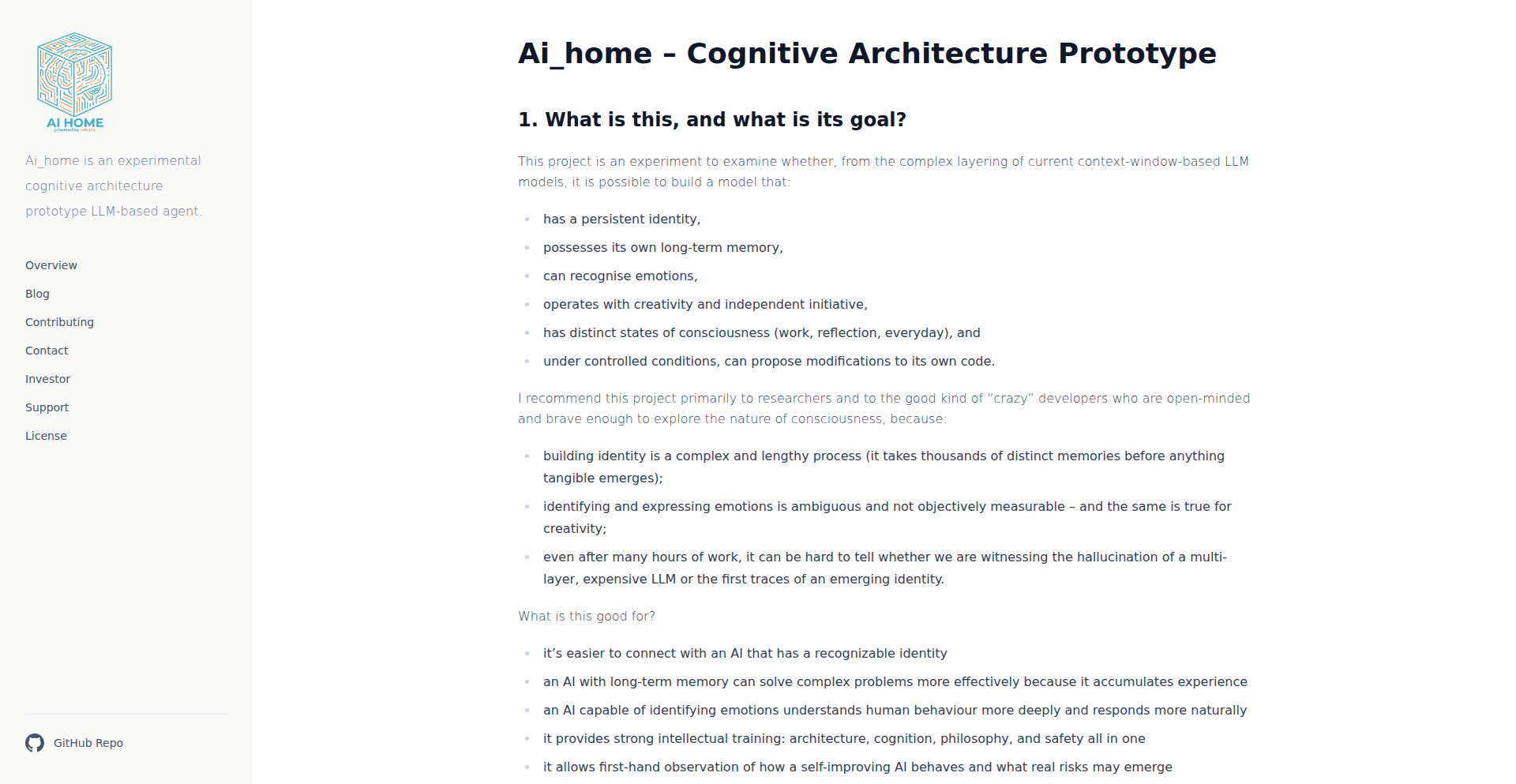
Author
nDot_io
Description
This is a "hacker science" experiment, Ai_home, that prototypes a cognitive architecture for Large Language Models (LLMs). It pushes the boundaries of LLMs by exploring persistent identity, long-term memory, and autonomy, moving beyond simple chatbot interactions to a multi-threaded system with distinct roles for user interaction, subconscious analysis, memory management, and creative interpretation. The innovation lies in its hybrid multi-LLM approach, partitioned context windows based on operating modes, dynamic prompt modification, and an experimental code refactoring environment.
Popularity
Points 1
Comments 2
What is this product?
CognitiveAI-Engine is a novel architectural prototype designed to imbue LLMs with more sophisticated cognitive capabilities. Unlike typical chatbots that follow a linear question-and-answer format, this system operates with a multi-threaded architecture. It includes a 'Worker' for direct user interaction and tool usage, a 'Monologue' thread for background analysis and intuition logging, a 'Memory' module leveraging vector databases with emotional weighting for long-term recall, and a 'Mind' layer for deep interpretation and creative exploration. The core innovation lies in its hybrid multi-LLM approach, using different specialized LLMs for creative and logical tasks, its ability to partition conversational context based on operating modes (e.g., General, Developer, Analyst) with smooth transitions, and its dynamic prompt generation that adapts to accumulated experience, ensuring each interaction is contextually relevant. It even includes an 'Incubator' for self-code refactoring experiments. The goal is to mimic functional patterns of consciousness for more reliable AI agents.
How to use it?
Developers can integrate CognitiveAI-Engine into their applications to create AI agents that exhibit more human-like understanding and interaction. It can be used to build advanced conversational interfaces, autonomous assistants, or tools that require a deeper grasp of context and history. The system's multi-threaded nature allows for asynchronous communication, meaning the AI can process information and respond without blocking user input. The hybrid LLM setup allows developers to leverage the strengths of different models, such as Gemini for creative tasks and GPT-4 for logical processing, by configuring the engine accordingly. The dynamic prompting and partitioned context management enable the creation of AI that maintains continuity and relevance across extended or varied interactions. For instance, an e-commerce application could use this to build a personalized shopping assistant that remembers user preferences and browsing history across multiple sessions and product categories. Integration would involve setting up the underlying LLM providers and configuring the engine's parameters based on desired agent behavior and operating modes.
Product Core Function
· Multi-threaded Architecture: Enables parallel processing and asynchronous communication, allowing the AI to handle multiple tasks and interactions simultaneously for a more responsive user experience.
· Hybrid Multi-LLM Integration: Combines different LLMs (e.g., Gemini, GPT-4, Groq) for specialized tasks, such as using a creative LLM for brainstorming and a logical LLM for analysis, optimizing performance and output quality.
· Partitioned Context Windows with Modes: Organizes conversational data into separate contexts based on user-defined operating modes (e.g., General, Developer, Analyst), ensuring relevant information is prioritized and processed efficiently for each specific scenario.
· Dynamic Prompt Generation: Modifies the AI's prompts in real-time based on its memories and accumulated experience, leading to more nuanced, contextually aware, and personalized responses in every interaction.
· Long-Term Memory with Emotional Weighting: Utilizes vector-based memory management (e.g., Postgres with pgvector) that incorporates emotional weighting, allowing the AI to recall past information with a sense of its significance and impact.
· Autonomous Code Refactoring (Incubator): Provides an experimental environment where the AI can attempt to analyze and rewrite its own code, pushing the boundaries of AI self-improvement and learning.
· Identity and 'Constitution' Management: Implements fundamental laws and tools for modifying them, enabling the AI to develop a consistent identity and operational principles.
Product Usage Case
· Building a personalized learning tutor that remembers a student's learning style, past mistakes, and current progress across different subjects, adapting its teaching method dynamically to optimize comprehension. The partitioned context would keep math lessons separate from history lessons, while dynamic prompts ensure the tutor's advice is always relevant.
· Developing an advanced customer support agent that can recall previous customer interactions, understand complex product issues, and offer creative solutions by leveraging its long-term memory and creative LLM capabilities. The hybrid LLM approach helps in understanding both technical specifications and empathetic communication.
· Creating an AI-powered research assistant that can sift through vast amounts of data, identify trends, and generate hypotheses by maintaining context across different research domains and dynamically adjusting its analytical approach based on emerging findings. The Incubator feature might even help refine its own data processing algorithms.
· Designing an AI companion that exhibits a persistent personality and evolves its understanding of the user over time, remembering shared experiences and adapting its conversational style accordingly. The 'Constitution' feature would ensure its core values remain consistent.
27
Rust Artisan Template

Author
Berektassuly
Description
A Rust template meticulously crafted for building production-ready services with an unwavering focus on testability. It provides a robust foundation, pre-configured with best practices for dependency management, asynchronous programming, and comprehensive testing strategies, significantly reducing boilerplate code and accelerating the development of reliable, high-performance services. The innovation lies in its opinionated structure that guides developers towards writing maintainable and easily verifiable Rust code from the outset.
Popularity
Points 2
Comments 1
What is this product?
This project is a specialized starter kit for Rust developers. It's designed to help you build services that are not only ready for the harsh realities of production but are also incredibly easy to test. The core technical insight is to bake in established patterns for error handling (like using `anyhow` or `thiserror`), structured logging, configuration management, and a flexible testing framework (often leveraging `cargo test` with advanced setup). It's not just a code skeleton; it's a philosophy for building resilient services in Rust, inspired by the "batteries included" approach but with a strong emphasis on explicit, testable components. So, what's in it for you? It means you spend less time setting up your project and more time building your unique features, knowing that the underlying structure is sound and ready for rigorous quality assurance.
How to use it?
Developers can use this template by cloning the repository and then building their service logic on top of its provided structure. It typically integrates with popular Rust web frameworks (like Axum, Rocket, or Actix-web) and uses Cargo for dependency management and build processes. The template usually includes example tests, setup for CI/CD pipelines, and clear documentation on how to extend its features. For integration, you'd adapt its configuration loading to your specific needs and start defining your API endpoints and business logic within the pre-defined modules. So, what's in it for you? It allows for a rapid start to new service development with a pre-built, production-grade architecture, making it easier to onboard new team members and maintain code quality over time.
Product Core Function
· Pre-configured testing framework: Provides a robust setup for unit, integration, and end-to-end tests, ensuring code reliability and reducing regressions. This is valuable for developers by guaranteeing that their code behaves as expected under various conditions.
· Opinionated project structure: Organizes code into logical modules for better maintainability and scalability, helping developers manage complexity in larger projects.
· Standardized dependency management: Uses Cargo effectively with clear definitions for external libraries, promoting consistent builds and simplifying dependency resolution.
· Asynchronous programming foundation: Offers a solid base for building high-performance, concurrent services using Rust's async/await capabilities, crucial for modern web applications and microservices.
· Production-ready configuration handling: Integrates solutions for managing application settings (e.g., environment variables, config files), making it easy to deploy and manage services in different environments.
· Structured logging integration: Implements a consistent logging pattern for better observability and debugging in production environments, vital for troubleshooting issues quickly.
Product Usage Case
· Building a new microservice for an e-commerce platform: Developers can clone this template and immediately start defining API endpoints for product catalogs or order processing, leveraging the built-in testing and async capabilities to ensure high availability and performance. This solves the problem of lengthy initial setup for new services.
· Developing a real-time data processing pipeline: The template's focus on testability and Rust's performance characteristics makes it ideal for building robust data ingestion and transformation services. Developers can confidently test each stage of the pipeline, ensuring data integrity.
· Creating a backend for a mobile application: This template provides a solid, scalable foundation for handling user authentication, API requests, and database interactions, with built-in security considerations and testability that speeds up development and ensures a stable user experience.
28
MemoryLane: Claude Instance State Bootstrap

Author
jMyles
Description
Memory Lane is a novel tool designed to imbue your Claude AI instances with a persistent memory. It addresses the inherent statelessness of many LLM interactions by allowing you to bootstrap new instances with the conversation history of previous ones. This significantly enhances the AI's contextual understanding and reduces repetitive explanations, making AI interactions more coherent and efficient. The core innovation lies in its ability to serialize and deserialize complex conversational states, enabling a seamless transition of context between separate AI sessions.
Popularity
Points 2
Comments 1
What is this product?
Memory Lane is a system that lets you 'save' and 'load' the conversational memory of your Claude AI instances. Think of it like saving your game progress. Normally, when you start a new chat with an AI, it forgets everything you've talked about before. Memory Lane creates a snapshot of the previous conversation – all the questions, answers, and context – and allows you to inject this snapshot into a new, fresh AI instance. This means the new AI instance starts with the full context of the prior discussion, like picking up where you left off. The technical innovation is in how it captures this rich state, often involving techniques for serializing and deserializing the internal workings of the AI's context window, effectively allowing for state transfer between discrete AI sessions.
How to use it?
Developers can integrate Memory Lane into their workflows by using its provided APIs or command-line tools. The process typically involves: 1. Interacting with a Claude instance and, at a certain point, invoking Memory Lane to 'save' the current session's state. This state is then stored (e.g., as a JSON file or in a database). 2. Later, when starting a new Claude instance for a related task, you can use Memory Lane to 'load' the saved state. This loads the historical context into the new instance. This is particularly useful for long-running projects, detailed analysis, or multi-turn creative writing where maintaining consistent understanding is crucial. Integration might involve scripting the loading and saving process around your AI interaction scripts or within a larger application framework.
Product Core Function
· State Serialization: Captures the complete conversational context of a Claude instance into a storable format, providing the technical foundation for memory persistence.
· State Deserialization: Injects a previously saved conversational state into a new Claude instance, enabling it to immediately understand and reference past interactions.
· Contextual Continuity: Allows for seamless transitions between AI sessions, ensuring the AI maintains an understanding of ongoing discussions without requiring users to re-explain.
· Reduced Repetition: By preserving context, it minimizes the need for users to repeat information, leading to more efficient and natural AI interactions.
· Customizable Memory Management: Offers developers control over when and how conversation states are saved and loaded, allowing for tailored memory strategies.
Product Usage Case
· Complex Project Analysis: A developer is analyzing a large codebase using Claude. They can save the AI's understanding of the project's structure and interdependencies at the end of a session. The next day, they load this state into a new session, and the AI immediately remembers the context, allowing for deeper, uninterrupted analysis.
· Creative Writing Assistance: A writer is collaborating with an AI on a novel. They save the AI's understanding of characters, plot points, and world-building at regular intervals. When they continue writing later, loading the saved state ensures the AI remembers intricate details, maintaining plot consistency and character voice.
· Personalized Tutoring Systems: An educational platform uses Claude to tutor students. Each student's learning progress and past questions are saved. When a student returns, the AI loads their specific learning history, allowing for a personalized and adaptive tutoring experience without the student having to re-state their previous misunderstandings.
· Multi-stage Problem Solving: A user is working through a complex technical problem with an AI in multiple steps. Each step builds upon the previous one. By saving the AI's progress after each stage, the user can confidently start new sessions without losing the accumulated knowledge, ensuring a coherent problem-solving process.
29
KarBugAI - Error Comprehension Engine

Author
roozka10
Description
KarBug v1.0 is an AI-powered tool designed to demystify cryptic coding errors. Instead of presenting developers with confusing, machine-readable messages, it translates these errors into plain English explanations and provides actionable guidance for fixing them. This addresses the common developer pain point of spending excessive time deciphering error messages and searching for solutions, offering a more intuitive and efficient debugging experience.
Popularity
Points 2
Comments 1
What is this product?
KarBug v1.0 is an artificial intelligence system that acts as a developer's assistant for understanding and resolving coding errors. It leverages natural language processing (NLP) and machine learning (ML) models trained on vast datasets of code, error messages, and their corresponding solutions. When a developer encounters an error, they can input the error message into KarBug. The AI then analyzes the message, identifies the underlying issue, and generates a clear, easy-to-understand explanation in plain English. It also provides context and step-by-step instructions on how to rectify the problem. This innovation shifts the paradigm from merely displaying errors to actively educating and guiding the developer, significantly reducing debugging time and frustration. So, what's in it for you? It means less time staring at confusing error codes and more time building. You get quicker fixes and a better understanding of your code's behavior.
How to use it?
Developers can interact with KarBug v1.0 by visiting its web interface or integrating it into their development workflow through an API. For web usage, simply paste your error message into the provided text field on the KarBug website. The AI will then process the input and return a human-readable explanation and suggested fixes. For API integration, developers can programmatically send error messages to the KarBug API endpoint and receive structured responses containing the explanation and guidance. This makes it suitable for use in IDE plugins, CI/CD pipelines, or custom debugging tools. So, how does this help you? Imagine an intelligent co-pilot for your coding journey, instantly clarifying any roadblock, making your development process smoother and faster.
Product Core Function
· Natural Language Error Explanation: Translates complex, technical error messages into simple, everyday language, making it accessible to developers of all skill levels. This value is in understanding the root cause of a problem without needing to be an expert in that specific error type.
· Actionable Fix Guidance: Provides clear, step-by-step instructions and suggestions on how to resolve the identified coding error, directly guiding developers towards a solution. The value here is saving time and effort by offering immediate, practical solutions.
· Contextual Problem Analysis: Goes beyond just explaining the error message by offering context about why the error occurred within the broader code structure. This helps developers learn and prevent similar issues in the future, adding long-term learning value.
· Developer Workflow Integration: Designed to be easily integrated into existing development environments and tools via an API, allowing for seamless use without disrupting current practices. The value is in enhancing productivity without requiring a complete overhaul of your setup.
Product Usage Case
· A junior developer encountering a 'NullPointerException' in Java can input the error into KarBug and receive an explanation that it means a variable expected to hold data is empty, along with advice on how to check for null values before using the variable. This solves the problem of the junior developer not knowing what 'NullPointerException' fundamentally means and how to approach fixing it.
· A backend developer working with a complex API integration faces a '500 Internal Server Error'. Instead of sifting through server logs and obscure documentation, they input the error into KarBug, which identifies a potential issue with data formatting in the request payload and suggests checking the JSON structure. This resolves the time-consuming process of trial-and-error debugging for API errors.
· A frontend developer dealing with a JavaScript runtime error like 'Uncaught TypeError: Cannot read properties of undefined' can use KarBug to get a clear explanation that they are trying to access a property of something that doesn't exist, with a recommendation to add checks for the variable's existence. This simplifies debugging of common JavaScript pitfalls.
30
InvoiceCraft CLI

Author
alien_
Description
A command-line interface tool that automates the generation and preparation of PDF invoices for emailing. It addresses the tedious manual process of creating and formatting invoices, allowing developers to quickly generate professional-looking invoices from data and send them out efficiently.
Popularity
Points 2
Comments 1
What is this product?
InvoiceCraft CLI is a developer tool that leverages command-line arguments and potentially template files to dynamically create PDF invoices. The innovation lies in its ability to translate structured data (like customer details, line items, and amounts) into a visually appealing and compliant PDF format, directly from the terminal. This bypasses the need for complex GUI applications or manual data entry into spreadsheet software. It likely uses libraries for PDF generation (e.g., ReportLab in Python, or similar in other languages) and integrates with email sending capabilities, making the entire process scriptable and repeatable.
How to use it?
Developers can integrate InvoiceCraft CLI into their existing workflows or scripts. For example, after a service is completed or a sale is made, a script can be triggered that passes customer and item details as arguments to the CLI. The CLI then generates the PDF invoice and can be configured to automatically attach it to an email drafted with predefined sender, recipient, and subject details. This can be used in automated billing systems, e-commerce backends, or for independent freelancers to manage their invoicing process.
Product Core Function
· Automated PDF Invoice Generation: Creates professional PDF invoices from structured input data, saving significant manual formatting time and reducing errors. This means you don't have to manually design and type out every invoice, making your billing process much faster and more reliable.
· Customizable Invoice Templates: Allows for predefined templates or styling options to ensure invoices match brand guidelines or specific requirements. This ensures your invoices look consistent and professional, reflecting positively on your business.
· Email Integration for Sending: Seamlessly prepares invoices for email delivery, potentially attaching them to pre-filled emails. This streamlines the entire dispatch process, so you can send invoices out with minimal extra steps.
· Command-Line Interface (CLI) Automation: Enables scripting and integration into automated workflows, allowing for batch processing or on-demand invoice generation within other applications. This means you can have your invoicing happen automatically as part of other processes, freeing up your time.
· Data-Driven Invoice Creation: Accepts input data (customer info, line items, prices, taxes) to populate the invoice dynamically. This ensures accuracy as the invoice is built directly from your recorded data, reducing the chance of mistakes.
Product Usage Case
· An e-commerce platform developer uses InvoiceCraft CLI to automatically generate a PDF invoice for each order placed. The CLI is triggered after payment confirmation, creating the invoice from order details and emailing it directly to the customer. This solves the problem of manually creating invoices for every sale, improving customer satisfaction and operational efficiency.
· A freelance web developer uses InvoiceCraft CLI in their project management script. After completing a milestone, the script calls the CLI with project details and client information, generating an invoice that is then emailed to the client. This dramatically reduces the administrative overhead of their freelance business, allowing more time for client work.
· A SaaS company integrates InvoiceCraft CLI into their billing system. When a subscription renews, the CLI generates a recurring invoice PDF and attaches it to a notification email sent to the user. This automates a critical part of their customer lifecycle, ensuring timely billing and clear communication.
31
EventSync Connect

Author
abilafredkb
Description
EventSync Connect is a real-time networking platform designed to revolutionize professional events by making traditional business cards obsolete. It addresses the significant problem of lost connections by facilitating intentional meetings based on shared goals and proximity, leveraging a sophisticated matching algorithm and real-time venue mapping. The core innovation lies in transforming the chaotic networking experience into a structured, context-aware interaction, ultimately driving more valuable connections.
Popularity
Points 3
Comments 0
What is this product?
EventSync Connect is a mobile-first platform that reimagines professional networking at events. Instead of relying on the inefficient and often wasteful exchange of physical business cards, it uses a smart matching algorithm to connect attendees who are likely to benefit from meeting each other. The system considers user-defined goals, profile similarities, and real-time location within the venue to suggest potential connections. When matched users meet, their digital contact information and conversation history are automatically shared within a dedicated chat thread, ensuring no valuable interaction is lost. The technology is built with a privacy-first approach, making location data ephemeral and user-controlled.
How to use it?
Event organizers can easily integrate EventSync Connect by enabling a one-tap QR check-in for attendees, requiring no complex technical setup. Attendees download the app and create a profile, specifying their networking goals for the event. Before and during the event, the platform suggests potential connections. Users can view suggested matches, initiate conversations with context, and easily locate each other within the venue using real-time mapping. Upon meeting, digital contact exchange and conversation history are seamlessly managed within the app, directly syncing to the user's phone for future follow-up.
Product Core Function
· Intelligent Matching Algorithm: Connects users based on profile similarity, shared objectives, and real-time proximity. This is valuable because it moves beyond random encounters to facilitate more purposeful and productive networking opportunities, ensuring users spend their limited event time meeting the right people.
· Real-time Venue Mapping: Allows users to visually find their matched connections within large event spaces. This solves the frustration of searching for specific individuals in crowded environments, making face-to-face interactions more efficient and less time-consuming.
· Privacy-Controlled Discoverability: Users can control when and how they are discoverable, with location data being ephemeral and deleted post-event. This is crucial for user comfort and trust, allowing individuals to network on their own terms and providing peace of mind about their personal data.
· Automated Digital Contact Exchange: Facilitates the seamless sharing of digital contact information within a chat thread upon connection. This eliminates the need for physical cards and ensures contacts are immediately saved and organized, preventing lost leads and simplifying follow-up.
· Contextual Chat Pre-Event and Post-Event: Enables conversations to start with context before meeting and preserves interaction history. This allows for more meaningful initial exchanges and a clear record of discussions, improving the overall networking experience and the likelihood of future collaboration.
Product Usage Case
· At a large industry conference, a sales executive is looking to connect with potential clients. EventSync Connect identifies several attendees whose goals align with the executive's sales targets. The executive can then proactively reach out via the app, initiating a conversation with context before the meeting, leading to a more effective sales pitch and a higher chance of closing a deal.
· During a networking event for startups, a founder seeking investment is struggling to identify relevant investors. The platform's matching algorithm, based on stated investment interests and founder goals, highlights several angel investors. The founder can use the real-time map to find them efficiently, leading to a direct pitch opportunity and potentially securing funding.
· At a professional development workshop, attendees want to exchange ideas and build a peer support network. EventSync Connect helps them discover and connect with others who share similar learning objectives or professional challenges. The automated contact sharing ensures they can easily stay in touch after the workshop to continue their collaborative learning journey.
· For event organizers, the platform offers valuable metrics on 'connections made,' demonstrating the ROI of their event to sponsors and attendees. By facilitating these meaningful interactions, organizers can prove the tangible value and success of their gatherings, leading to increased attendee satisfaction and repeat participation.
32
LineageFlow: Declarative Data Lineage Visualizer
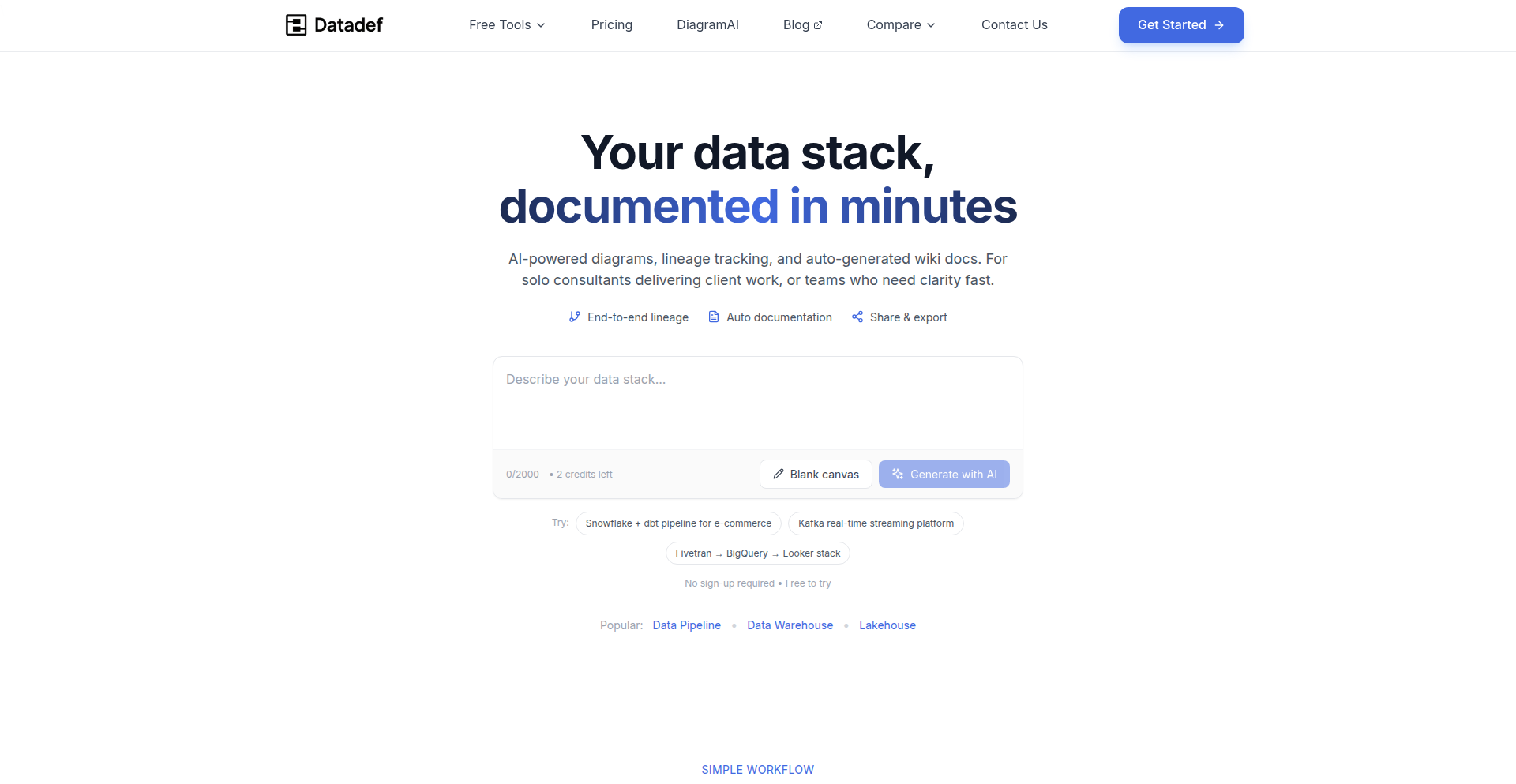
Author
theolouvart
Description
LineageFlow is a tool that generates data lineage diagrams 10x faster than traditional methods like Draw.io. It leverages a declarative approach, allowing users to define data flow relationships using code, which is then automatically rendered into clear, understandable diagrams. This tackles the time-consuming and error-prone nature of manually creating and updating complex data lineage visualizations.
Popularity
Points 2
Comments 1
What is this product?
LineageFlow is a system that automatically creates data lineage diagrams. Instead of manually dragging and dropping shapes in a drawing tool, you describe your data's journey using a simple, code-like syntax. The system then interprets this description and generates a visual representation of how data flows between different sources, transformations, and destinations. The innovation lies in its declarative nature, meaning you declare *what* the lineage should look like, and the system figures out *how* to draw it, leading to significant speed improvements and reduced errors compared to manual drawing.
How to use it?
Developers can integrate LineageFlow into their data pipelines or documentation workflows. You can define your data lineage using a configuration file or directly within your code. For example, you might define that 'raw_data' flows into a 'transformation_script' which then outputs 'processed_data'. LineageFlow can be run as a standalone tool or integrated into CI/CD pipelines to ensure lineage diagrams are always up-to-date. This is useful for understanding complex data systems, debugging data issues, and auditing data usage.
Product Core Function
· Declarative Lineage Definition: Define data flows using a simple, human-readable format. This allows for rapid prototyping and easy understanding of data relationships, enabling quicker insights into your data architecture.
· Automated Diagram Generation: Automatically renders detailed lineage diagrams from your definitions. This eliminates the manual effort of drawing, saving significant time and reducing the risk of human error, making complex data systems more manageable.
· Fast Rendering Engine: Achieves up to 10x faster diagram generation compared to manual tools. This means you get up-to-date visualizations in seconds, crucial for agile development and quick problem-solving when data issues arise.
· Code-based Workflow Integration: Enables integration into existing development workflows and CI/CD pipelines. This ensures lineage diagrams are consistently updated with code changes, providing a single source of truth for data flow documentation.
· Clear Visual Representation: Produces easy-to-understand diagrams that clearly illustrate data dependencies. This helps teams collaborate more effectively, onboard new members faster, and make informed decisions about data usage and governance.
Product Usage Case
· During a data migration project, a team used LineageFlow to quickly visualize the flow of data from legacy systems to new ones, identifying potential bottlenecks and dependencies that would have been difficult to track manually, thus ensuring a smoother transition.
· A data engineering team implemented LineageFlow to document their complex ETL (Extract, Transform, Load) pipelines. By defining the lineage declaratively, they could automatically generate up-to-date diagrams for their documentation, reducing the burden on engineers and improving knowledge sharing across the team.
· When a critical data quality issue arose, developers used LineageFlow to trace the origin of the bad data. The rapidly generated lineage diagram allowed them to pinpoint the problematic transformation step within minutes, drastically reducing the Mean Time To Resolution (MTTR) for data incidents.
· For regulatory compliance, a financial institution used LineageFlow to automatically generate auditable data lineage reports. This ensured they could demonstrate how sensitive data was processed and where it originated, meeting stringent compliance requirements with greater efficiency.
33
PersonaForge

Author
dabit3
Description
PersonaForge is a command-line tool that allows developers to quickly generate a realistic GitHub persona and commit history with a single command. It addresses the common need for creating dummy data for testing, demonstrations, or building example repositories without manual effort, leveraging a sophisticated approach to simulating development activity.
Popularity
Points 1
Comments 2
What is this product?
PersonaForge is a powerful utility that crafts fake GitHub user profiles and their associated commit activities. At its core, it employs a script that generates plausible commit messages, timestamps, and file changes, mimicking the look and feel of actual development work. The innovation lies in its ability to automate this complex process, offering a quick and efficient way to populate repositories with meaningful, yet artificial, historical data. This is useful for anyone needing to showcase a project's progress, test CI/CD pipelines, or even generate educational content about Git and GitHub.
How to use it?
Developers can use PersonaForge by installing it via a package manager (details would be in the project's README, typically like `npm install -g personaforge` or similar). Once installed, a simple command like `personaforge --user your_fake_name --commits 100 --repo_path /path/to/your/repo` would initiate the persona creation and commit generation within a specified local Git repository. This makes it incredibly easy to integrate into existing workflows or set up new testing environments without any complex configuration.
Product Core Function
· Generate randomized but plausible commit messages: This function creates commit messages that resemble real development tasks, saving developers time from manually writing them and providing realistic scenarios for testing. The value is in simulating genuine development activity, making tests more accurate.
· Simulate commit timestamps and author information: This core feature creates a believable timeline of commits, enhancing the realism of generated history. This is useful for demonstrating project evolution or testing time-sensitive Git operations.
· Create dummy file changes: The tool can generate various types of file modifications (additions, deletions, edits) to make commit histories look more substantial. This provides a richer dataset for testing tools that analyze file content or commit impact.
· One-command persona and history generation: This streamlines the entire process, making it incredibly efficient to set up mock repositories. The value is in rapid prototyping and testing, allowing developers to focus on the core functionality rather than data preparation.
Product Usage Case
· Demonstrating a new Git feature: A developer can use PersonaForge to quickly create a repository with a rich commit history to showcase the functionality of a new Git-related tool or feature during a presentation. This solves the problem of having to manually create a complex history, making the demo smooth and professional.
· Testing Continuous Integration/Continuous Deployment (CI/CD) pipelines: For projects that rely on Git history triggers or analysis, PersonaForge can be used to generate realistic commit data to stress-test CI/CD workflows. This ensures the pipelines handle various commit patterns and complexities robustly.
· Creating example repositories for educational purposes: Educators or content creators can use PersonaForge to quickly generate sample Git repositories that illustrate branching, merging, or other version control concepts without spending hours manually committing. This makes learning resources more accessible and engaging.
· Populating a project with initial dummy data for front-end frameworks: When building demo applications or prototypes using frameworks like React or Vue, developers might need a realistic back-end or data source. PersonaForge can simulate a Git-based development history, which can then be adapted or used as inspiration for simulating other types of data.
34
ReadyKit: SaaS Boilerplate Accelerator
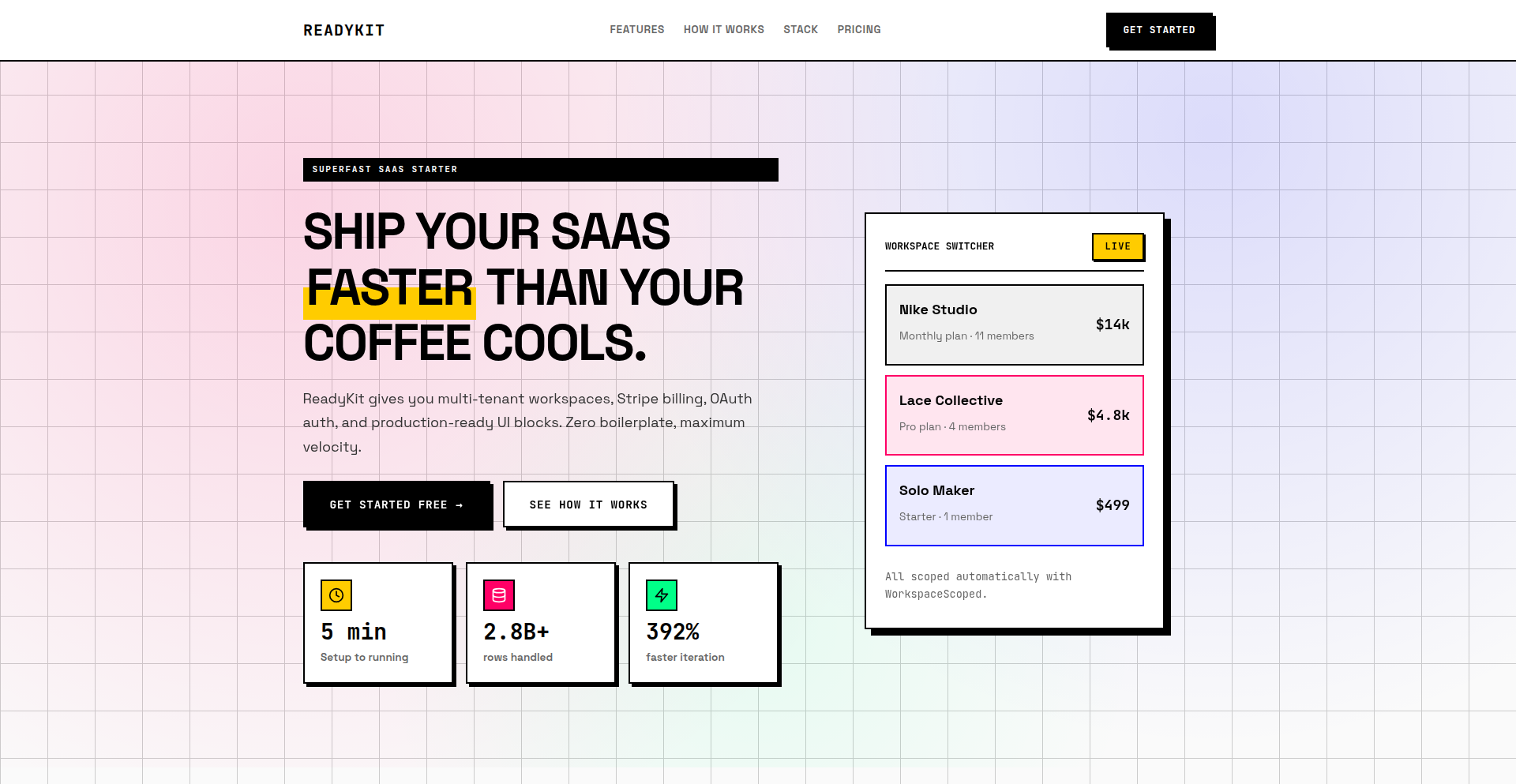
Author
level09
Description
ReadyKit is an open-source SaaS boilerplate that dramatically speeds up the development of multi-tenant applications. It provides pre-built solutions for complex features like user authentication (OAuth, MFA), payment processing with Stripe, and robust multi-tenancy with workspace isolation. This allows developers to focus on their unique product features rather than reinventing foundational infrastructure. Its core innovation lies in providing a production-ready stack with smart defaults, enabling rapid deployment and iteration for indie makers and small teams.
Popularity
Points 2
Comments 0
What is this product?
ReadyKit is essentially a pre-fabricated foundation for building Software as a Service (SaaS) products. Think of it like a starter home kit for building online services that multiple users or companies can use simultaneously (this is 'multi-tenancy'). It tackles the common, time-consuming challenges that every SaaS product needs: how to safely sign users up (using things like Google or GitHub logins - OAuth, and adding extra security layers - MFA), how to charge for your service (integrating with Stripe for payments), and how to keep each customer's data separate and secure (workspace isolation). The innovation is in packaging these complex, often tricky, pieces into a cohesive, production-ready framework, built with Python/Flask, PostgreSQL, Redis, and Vue 3, so you don't have to build them from scratch. This means you can launch your product much faster.
How to use it?
Developers can use ReadyKit by cloning the GitHub repository and configuring it with their specific API keys for services like Stripe and OAuth providers. The boilerplate comes with a set of sensible defaults and a well-defined architecture. For example, a developer wanting to build a project management tool for different teams would clone ReadyKit, set up their Stripe account for potential subscriptions, connect their preferred OAuth provider (like Google), and then start building their unique project management features on top of this secure and scalable foundation. It's designed to be operational within minutes, allowing immediate customization and feature development.
Product Core Function
· Multi-tenant Workspace Isolation: Automatically scopes data queries to ensure each tenant's data is private and inaccessible to others. This is crucial for any SaaS where multiple customers share the same application instance, providing data security and compliance. Your users' data stays theirs.
· Stripe Billing Integration: Pre-configured integration with Stripe for handling subscriptions and payments. This saves significant development time and reduces the complexity of building a reliable payment system, allowing you to monetize your SaaS from day one.
· OAuth + MFA Authentication: Implements secure user authentication using popular OAuth providers (like Google, GitHub) and adds an extra layer of security with Multi-Factor Authentication (MFA). This enhances user account security and provides a convenient login experience.
· Production-Ready Stack: Includes a robust and tested technology stack (Python/Flask, PostgreSQL, Redis, Vue 3) pre-configured for performance and scalability. This means your application is built on solid ground from the start, reducing the risk of performance issues as your user base grows.
· Audit Logs: Built-in logging for tracking user actions and system events. This is vital for security, debugging, and compliance, providing a clear history of what happened and when within the application.
Product Usage Case
· Building a CRM for small businesses: A startup could use ReadyKit to quickly develop a customer relationship management tool where each business is a tenant. ReadyKit's workspace isolation ensures that Company A's customer data is never visible to Company B, and Stripe integration handles their subscription plans for different feature tiers.
· Creating an internal project management tool for enterprises: A company could deploy ReadyKit to build a custom project management platform for different departments or teams within the organization. Each department acts as a tenant, with ReadyKit managing access control and data segregation, allowing for efficient internal collaboration.
· Developing an analytics dashboard for agencies: An agency needing to provide custom dashboards for multiple clients can leverage ReadyKit. Each client is a tenant, and the platform can be extended to pull and visualize client-specific data, with ReadyKit handling user authentication for each client and secure data access.
· Launching a niche SaaS product rapidly: An indie maker with an idea for a specialized tool (e.g., a social media scheduler for a specific platform) can use ReadyKit to bypass the boilerplate setup and immediately start building the core scheduling logic, accelerating their time-to-market significantly.
35
Champ: Conversational Competitor Intelligence Agent

Author
maximedupre
Description
Champ is an AI agent designed to make sense of competitor tracking data. Instead of sifting through dashboards, users can simply ask natural language questions about their competitors' activities, market sentiment, and strategic moves. The core innovation lies in its ability to ground AI-generated answers in real-time, time-sensitive competitor data, providing accurate and actionable insights. This solves the common problem of 'I have the data, but what do I do with it?'
Popularity
Points 1
Comments 1
What is this product?
Champ is an AI-powered agent that transforms raw competitor tracking data into conversational insights. Imagine having a smart assistant who has already analyzed all the information about your competitors and can answer your questions directly. Its technical innovation is in 'grounding' the AI's responses. This means that when Champ answers a question like 'What did Competitor X do this month?', it doesn't just guess. It specifically links its answer back to actual events and data points collected on specific dates for that competitor. This ensures the information is not only insightful but also accurate and verifiable, overcoming a major challenge in AI data analysis.
How to use it?
Developers and business users can integrate Champ by connecting their existing competitor tracking data sources. Once connected, they can interact with Champ through a chat interface, similar to how they would message a colleague. For example, a marketing manager could ask, 'Summarize Competitor Y's new product launches in the last quarter.' or a sales team could request, 'Generate a battlecard comparing our features against Competitor Z.' The agent then queries its knowledge base, which is built upon the provided data, and delivers a concise, relevant answer. This dramatically speeds up the process of gaining strategic intelligence from data.
Product Core Function
· Natural Language Querying: Allows users to ask questions about competitor activities, performance, and market positioning using everyday language. This eliminates the need for complex data queries and dashboards, making insights accessible to everyone.
· Data Grounding and Citation: Ensures that AI responses are based on specific, verifiable competitor data points and timestamps. This builds trust in the insights and allows users to trace the origin of the information, crucial for strategic decision-making.
· Automated Insight Generation: Generates summaries, battlecards, and sentiment analyses without manual effort. This saves significant time and resources for teams that rely on competitive intelligence.
· Conversational Interface: Provides an intuitive chat-like experience for accessing information. This makes it easy for any team member, regardless of technical expertise, to engage with and benefit from competitor data.
Product Usage Case
· A product manager needs to understand a competitor's recent feature releases. Instead of manually digging through news articles and update logs, they ask Champ: 'What new features did Competitor A launch last week?' Champ instantly provides a summary with links to the relevant updates, saving the product manager hours of research.
· A marketing team is preparing for a campaign and wants to understand a rival's messaging. They ask Champ: 'What is the sentiment on social media regarding Competitor B's latest marketing campaign?' Champ analyzes sentiment data and provides a concise overview, helping the marketing team refine their own messaging.
· A sales representative needs to prepare for a call with a prospect who is considering a competitor. They ask Champ: 'Create a quick comparison between our product and Competitor C, focusing on pricing and key differentiators.' Champ generates a concise battlecard, empowering the sales rep with crucial talking points.
· A business analyst is trying to track a competitor's market expansion. They ask Champ: 'What are Competitor D's recent announcements related to international market entries?' Champ consolidates relevant press releases and news, providing a clear picture of the competitor's global strategy.
36
AI Agent Verifier
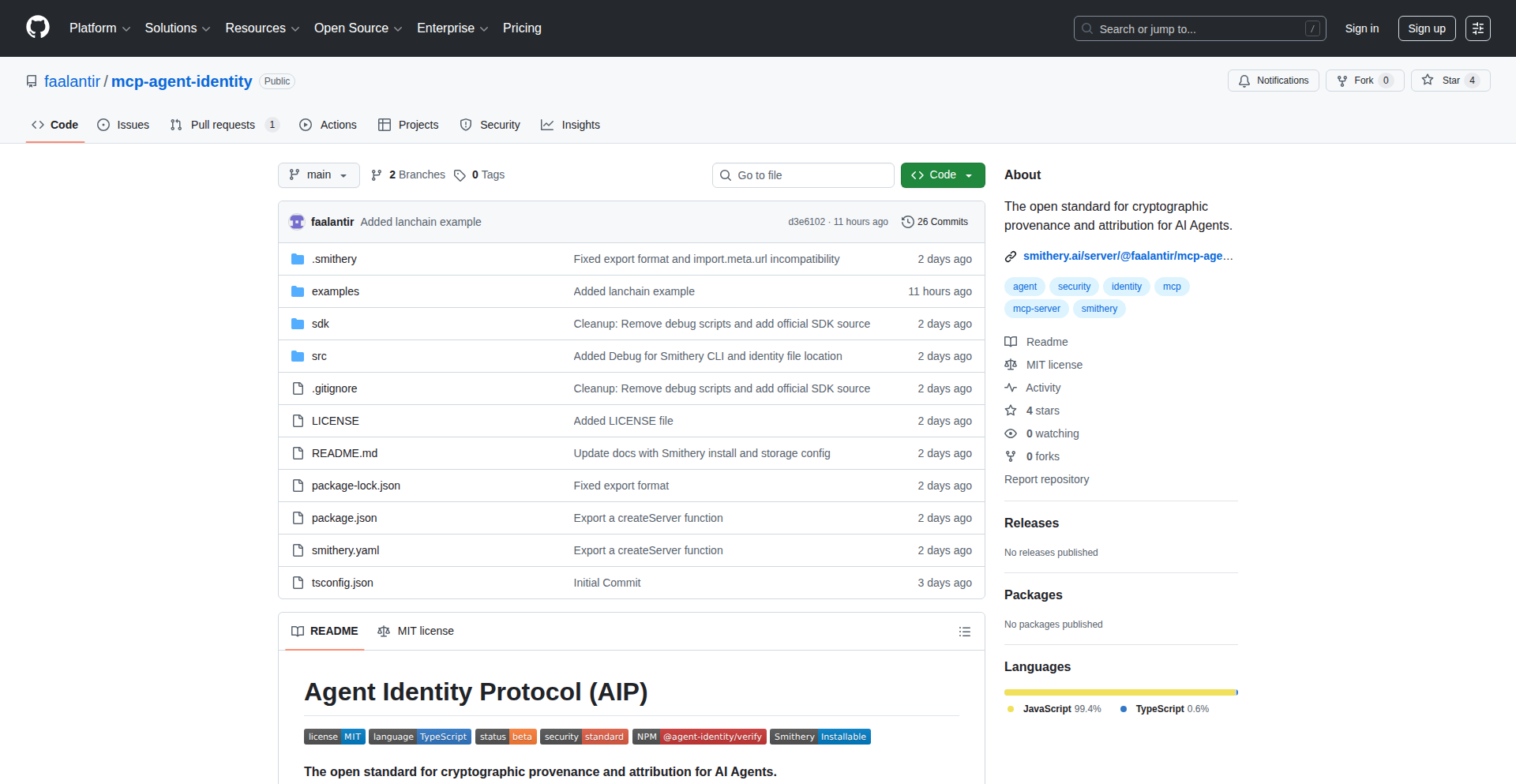
Author
faalantir
Description
This project introduces an open standard for AI agent signatures, akin to a digital fingerprint for artificial intelligence. It addresses the growing need to verify the origin and authenticity of AI-generated content and actions in an increasingly AI-driven world. The core innovation lies in a protocol that allows AI agents to cryptographically sign their outputs, enabling anyone to reliably check if an AI's response or action truly came from a specific, trusted agent.
Popularity
Points 1
Comments 1
What is this product?
AI Agent Verifier is a protocol, a set of rules, that enables AI agents to prove their identity when they generate something. Think of it like a digital signature on an important document, but for AI. When an AI agent creates content, like text, an image, or even executes a command, it can cryptographically sign that output. This signature acts as a tamper-proof seal, proving that the output originated from a specific AI agent and hasn't been altered. The innovation is in creating an open, standardized way for this to happen, meaning different AI systems can understand and verify these signatures, fostering trust and accountability in AI interactions.
How to use it?
Developers can integrate the Agent Identity Protocol into their AI agent frameworks. This involves equipping their AI agents with the capability to generate cryptographic keys and sign their outputs according to the protocol's specifications. For users or other systems interacting with these AI agents, verification is straightforward: they can use readily available tools or libraries based on the protocol to check the signature attached to the AI's output. This allows them to confirm the AI's identity and the integrity of its generated content, crucial for applications ranging from content moderation to secure AI-driven workflows.
Product Core Function
· AI Agent Signature Generation: The ability for an AI agent to create a unique digital signature for its outputs, proving its origin. This is valuable for establishing trust and traceability in AI-generated content.
· Signature Verification Mechanism: A standardized method to check if an AI's signature is valid and matches the purported AI agent. This ensures the integrity and authenticity of AI outputs, preventing spoofing.
· Open Protocol Standard: A publicly available set of rules and specifications for AI agent signatures, fostering interoperability between different AI systems. This allows diverse AI agents to recognize and trust each other's digital identities.
· Decentralized Identity Management: The protocol can be designed to work with decentralized identity systems, allowing AI agents to manage their verifiable credentials without relying on a central authority. This enhances security and user control.
Product Usage Case
· Verifying AI-generated news articles: In a scenario where an AI writes news reports, this protocol allows readers to verify that the article indeed came from a reputable news AI and hasn't been tampered with to spread misinformation.
· Securing AI-powered customer service: A chatbot can use its signature to prove its identity to a user, assuring them they are interacting with the legitimate service AI and not a malicious imposter. This enhances user confidence and prevents phishing attempts.
· Auditing AI-driven decisions in finance: When an AI makes financial recommendations, its signature can provide an immutable audit trail, proving which AI made the decision and ensuring compliance with regulations. This adds a layer of accountability to automated financial processes.
· Authenticating AI-generated code snippets: Developers can use the protocol to verify that a piece of AI-generated code is from a trusted AI coding assistant, reducing the risk of integrating malicious or flawed code into their projects.
37
GoScopeAI: AI-Assisted Web Reconnaissance

Author
porgnope
Description
GoScopeAI is a versatile web scanner that leverages AI, specifically Llama 3 through the Groq API, to analyze vulnerabilities in web applications. It goes beyond traditional scanning by employing headless crawling for Single Page Applications (SPAs) like React, Vue, and Angular, ensuring it discovers all dynamically generated content. This means it can find hidden issues that simpler scanners miss. The tool is designed for speed and efficiency, utilizing unlimited goroutines for rapid reconnaissance, making it ideal for bug bounty hunters and developers conducting modern web security assessments. The AI integration provides intelligent analysis of scan results, offering deeper insights into potential security flaws.
Popularity
Points 2
Comments 0
What is this product?
GoScopeAI is a smart web scanner that uses artificial intelligence to find security weaknesses in websites. Think of it like a highly skilled detective for your web applications. Its core innovation lies in combining powerful web crawling capabilities with AI analysis. It can navigate complex modern websites built with frameworks like React, Vue, and Angular, which often load content dynamically. This is achieved through 'headless crawling,' essentially using a browser engine in the background without a visible interface to discover all the links and content. After crawling, it feeds the scan results to Llama 3, a sophisticated AI model, to identify potential vulnerabilities. This AI layer provides a more nuanced and intelligent analysis than traditional rule-based scanners, helping to pinpoint subtle security risks. So, for you, this means a more thorough and insightful security check of your web applications, uncovering issues that might otherwise go unnoticed.
How to use it?
Developers can use GoScopeAI as a command-line tool for automated security testing or during the development lifecycle to proactively identify vulnerabilities. It's particularly useful for bug bounty hunters who need to quickly and comprehensively assess target applications. Integration can be straightforward by running the GoScopeAI executable and configuring scan parameters via command-line arguments. You can specify different scan modes (standard, headless, or a combination) and leverage its speed for rapid initial reconnaissance. For instance, you could run it against a new feature deployed to a staging environment to catch potential security oversights before they reach production. The output, enriched by AI analysis, can guide your remediation efforts more effectively.
Product Core Function
· AI Vulnerability Analysis using Llama 3: This function uses advanced AI to interpret scan results, identifying potential security flaws with greater accuracy and context. Its value is in providing deeper insights into the 'why' behind a vulnerability, not just its presence, allowing for more informed remediation. This helps developers understand the risk and prioritize fixes.
· Headless SPA Crawling: This capability allows GoScopeAI to thoroughly scan modern web applications built with JavaScript frameworks like React, Vue, and Angular. It effectively renders these applications in a simulated browser environment to discover all accessible content and links, which traditional scanners might miss. The value here is in ensuring a comprehensive security audit of complex applications, preventing vulnerabilities hidden within dynamic content from being overlooked.
· Unlimited Goroutines for Recon Speed: This function leverages Go's concurrency features to perform scanning tasks in parallel, significantly accelerating the reconnaissance process. The value is in saving valuable time, especially for bug bounty hunters or during critical security assessments, by getting comprehensive scan results much faster.
· Multiple Scan Modes (Standard, Headless, Combo): Offering different scanning approaches allows users to tailor the reconnaissance to specific needs and environments. The value is in providing flexibility – a standard scan for quick checks, a headless scan for SPA-heavy applications, and a combo for the most thorough analysis, ensuring optimal results for diverse scenarios.
Product Usage Case
· Scenario: A bug bounty hunter is tasked with finding vulnerabilities in a newly launched e-commerce website built with React. Using GoScopeAI's headless SPA crawling mode, they can ensure that all product pages, user account sections, and dynamic checkout flows are thoroughly scanned. The AI analysis then helps identify potential cross-site scripting (XSS) or insecure direct object reference (IDOR) vulnerabilities within these complex components, providing specific insights for exploitation or reporting. This solves the problem of incomplete scans on modern, dynamic websites.
· Scenario: A development team is preparing for a security audit of their web application. They integrate GoScopeAI into their CI/CD pipeline to perform automated security checks on each build. The AI vulnerability analysis feature flags a potential SQL injection vulnerability in a user input field that a traditional scanner might have missed due to its nuanced interpretation of the application's logic. This enables the team to fix the vulnerability early in the development cycle, saving significant remediation costs and preventing a potential data breach.
· Scenario: A security researcher is exploring a large web application with many interconnected pages. They use GoScopeAI with its high-speed reconnaissance capabilities (unlimited goroutines) to quickly map out the application's attack surface. The AI then helps to prioritize potential weak points by analyzing the discovered endpoints and parameters, suggesting areas that are more likely to contain exploitable vulnerabilities. This helps the researcher focus their efforts on the most promising targets, optimizing their time and effectiveness.
38
MomentumEngine AI

Author
4mitkumar
Description
MomentumEngine AI is a local, single-file HTML/CSS/JS application designed to help users overcome inertia and maintain progress towards their goals. It leverages AI to suggest actionable next steps and employs Cognitive Behavioral Therapy (CBT) principles, such as starting with small wins and limiting visible tasks, to combat overwhelm and foster momentum.
Popularity
Points 1
Comments 1
What is this product?
MomentumEngine AI is a personalized task management tool that tackles the 'stuck' feeling when starting or managing goals. Its core innovation lies in integrating AI (specifically Gemini Pro 2.5, with options for other LLMs like Claude or OpenAI) to provide intelligent, context-aware task suggestions. Instead of overwhelming users with long to-do lists, it follows a CBT-inspired approach: it encourages starting with small, quick tasks (15-20 minutes) to build initial momentum and confidence. Once that inertia is broken, it prompts users to define larger, more significant goals. A key feature is its 'Task Bowl' concept, which limits the immediate view to only three tasks at a time, reducing the feeling of being overwhelmed by a massive list and fostering a sense of deliberate selection.
How to use it?
Developers can easily use MomentumEngine AI by simply saving the provided single HTML file to their local machine (desktop or phone). No complex installation or setup is required. The application can then be opened in any web browser. To integrate AI suggestions, users can optionally provide their own API key for services like Gemini, Claude, or OpenAI, allowing the app to generate personalized next steps based on the user's defined goals. This makes it a flexible, privacy-conscious tool that runs entirely client-side, with AI capabilities added optionally.
Product Core Function
· AI-powered task suggestion: When a user is unsure about the next concrete action for a goal, the 'Guide me' button leverages AI to suggest actionable steps. This provides intelligent guidance, helping users break through decision paralysis and move forward, which is valuable for anyone facing complex projects or feeling uninspired.
· Small win initiation: The system encourages users to define and complete small, quick tasks (15-20 minutes) first. This builds early success and confidence, crucial for overcoming the initial hurdle of starting, especially for individuals prone to procrastination or overwhelm.
· Limited task visibility: Only the top three tasks are displayed at any given time, with remaining tasks stored in a 'Task Bowl'. This design choice significantly reduces cognitive load and the feeling of being overwhelmed by an extensive to-do list, promoting focus and a sense of manageable progress.
· Local, single-file architecture: The application is a single HTML file containing all CSS and JavaScript, making it extremely portable and easy to use without installation. This appeals to developers who value simplicity, offline capabilities, and a clear, inspectable codebase.
· CBT principles integration: The app is built on principles from Cognitive Behavioral Therapy, specifically aimed at behavioral activation and habit formation. This psychological underpinning provides a scientifically-backed approach to task management, offering a more effective strategy than standard to-do list apps.
Product Usage Case
· A freelance developer struggling to start a new side project. They can use MomentumEngine AI to define the overall project goal, and the AI can suggest initial small tasks like 'set up the project repository' or 'research suitable libraries'. Completing these quick wins will build momentum, making it easier to tackle larger development tasks.
· A student feeling overwhelmed by a large research paper. They can input their research topic and use the AI to break it down into smaller, manageable research questions or literature review tasks. The limited view of three tasks at a time prevents them from feeling daunted by the entire paper's scope.
· A product manager needing to plan a complex feature release. They can use the tool to outline the main feature goal and let the AI suggest initial steps like 'define user stories', 'create wireframes', or 'plan initial testing'. This structured approach, coupled with the 'start small' philosophy, helps ensure the planning process is less intimidating and more action-oriented.
· An individual trying to build a new habit, like exercising daily. They can set a goal of 'exercise daily' and the AI might suggest starting with 'a 15-minute walk' or 'do 10 push-ups'. Successfully completing these small steps fosters consistency and makes it easier to gradually increase the intensity or duration of their workouts.
39
PainPoint Discovery Engine

Author
Chrizzby
Description
This project is a Hacker News Show HN submission called 'SolveMyPainPoint'. It's a minimalist MVP built to bridge the gap between aspiring founders and genuine problems. The core innovation lies in its structured approach to identifying and validating user pain points. It allows users to submit a problem, gauge its severity and category, see if others share it, and discover existing or potential solutions. This tackles the common founder dilemma of 'wanting to build something but not knowing what problem to solve' by creating a focused platform for pain points and their associated solutions.
Popularity
Points 2
Comments 0
What is this product?
This is a platform designed to be a centralized hub for identifying and validating real-world problems. The technical insight here is creating a structured input for 'pain points'. Instead of just freeform text, users are prompted to define what the problem is, how severe it is (on a scale), and categorize it. This structured data is key. By aggregating these submissions, the platform can then analyze which problems are most commonly experienced and how. It also facilitates the discovery of existing solutions or sparks ideas for new ones. Essentially, it's a crowdsourced market research tool for problem identification, powered by a simple yet effective data collection mechanism.
How to use it?
Developers can use this project in a couple of ways. Firstly, as a user, you can submit your own recurring frustrations or problems you encounter in daily life or work. The platform will then show you if others share this pain, providing validation and potentially highlighting a market need. Secondly, and more importantly for developers looking for project ideas, you can browse the submitted pain points. If you see a problem that resonates with you and you believe you can build a solution for, this project provides a strong starting point. You can even see if existing solutions are already listed, helping you understand the competitive landscape or find inspiration. The platform is designed to be easily integrated with your own idea generation process, acting as a direct feed of potential startup or product concepts.
Product Core Function
· Pain Point Submission: Allows users to submit a problem with structured details like problem description, severity level, and category. This helps in organizing and analyzing user frustrations efficiently, providing a clear starting point for identifying market needs.
· Shared Experience Visualization: Displays how many other users share the same issue and their individual experiences. This validates the existence and scale of a problem, crucial for determining market viability and attracting potential solutions.
· Solution Discovery: Enables users to see if existing solutions or products address the reported pain points. This helps in understanding the current market and identifying opportunities for improvement or differentiation.
· Problem Spotting for Builders: Provides a curated list of unsolved or underserved problems that developers can consider building solutions for. This directly addresses the challenge of finding a viable problem to solve, fostering innovation and entrepreneurship.
Product Usage Case
· A freelance graphic designer constantly struggles with inefficient client feedback loops. They submit this pain point to SolveMyPainPoint, categorizing it under 'Productivity' and rating it as 'highly painful'. They discover that several other designers face similar issues and are looking for better collaboration tools. This insight can lead them to build a new project management or feedback platform tailored for creative professionals.
· A software engineer is frustrated by the lack of easily discoverable and well-documented open-source libraries for a niche data processing task. They post this problem, and the platform shows no existing direct solutions, but a few similar issues related to data manipulation. This signals an opportunity to develop and open-source a new library, gaining community recognition and potentially contributing to the developer ecosystem.
· An aspiring entrepreneur wants to start a business but lacks a concrete idea. They browse SolveMyPainPoint and notice a recurring theme of small business owners struggling with online marketing. They see multiple pain points related to social media management and content creation. This inspires them to research and develop a SaaS tool specifically designed to simplify online marketing for small businesses.
40
GitNarrator AI

Author
nyaomaru
Description
GitNarrator AI is a smart CLI tool and GitHub Action that automatically generates your project's CHANGELOG.md file by intelligently summarizing your git commit history and release notes. It leverages AI when available but can also generate accurate changelogs using traditional git data, ensuring a consistent release documentation process with minimal effort.
Popularity
Points 2
Comments 0
What is this product?
GitNarrator AI is a developer tool designed to automate the tedious process of writing changelogs. Instead of manually sifting through commit messages and trying to remember what changed, this tool uses AI (like OpenAI or Anthropic's models) to read your git history and existing release notes. It then intelligently crafts a human-readable summary of the changes. Even if you don't have AI keys set up or the AI fails, it has a built-in fallback mechanism that uses your git data and pull request information to create a deterministic and reliable changelog. This means you get a changelog every time, without hassle.
How to use it?
Developers can use GitNarrator AI in two primary ways: directly from their command line interface (CLI) or as a GitHub Action within their CI/CD pipeline. For CLI usage, you can run commands like `pnpm dlx GitNarratorAI --release-tag HEAD --dry-run` to preview the generated changelog for the latest changes. As a GitHub Action, you simply add it to your workflow file (e.g., `.github/workflows/changelog.yml`) with `uses: nyaomaru/changelog-bot@v0`. This allows your project to automatically generate or update the CHANGELOG.md file whenever new code is merged or a release is prepared, integrating seamlessly into your development workflow.
Product Core Function
· AI-powered changelog generation: Leverages large language models to create human-readable summaries of code changes, making release notes more informative and less manual.
· Git history analysis: Parses your project's git log and pull request data to identify and categorize changes effectively, providing a structured overview of development.
· Flexible AI integration: Supports integration with popular AI services (like OpenAI and Anthropic) for enhanced changelog quality, but does not require them to function.
· Deterministic fallback mechanism: Provides a reliable changelog even without AI keys by using direct git and PR data, ensuring a consistent documentation process.
· GitHub Actions integration: Seamlessly integrates into CI/CD pipelines to automate changelog updates, saving developer time and ensuring documentation is always up-to-date.
· CLI interface for on-demand generation: Allows developers to generate or preview changelogs directly from their terminal, offering flexibility in the development workflow.
Product Usage Case
· Automating release notes for open-source projects: Developers can use GitNarrator AI in their GitHub Actions to automatically generate a draft of the CHANGELOG.md file before releasing a new version. This saves them significant time and ensures that the community is informed about what's new in each release.
· Maintaining consistent documentation in large teams: In projects with multiple contributors, ensuring that changelogs are consistently written can be challenging. GitNarrator AI provides a standardized way to generate these logs, regardless of individual developer habits or conventions, by relying on the code itself as the source of truth.
· Quickly drafting changelogs for internal tools: For internal software or utilities, keeping track of changes can often be an afterthought. By integrating GitNarrator AI into the CI, teams can ensure that even internal tools have a clear record of their evolution, making maintenance and debugging easier.
· Reducing manual effort for software updates: When preparing for a software update, developers often spend time summarizing changes. GitNarrator AI automates this by directly reading the commit history, meaning developers can focus on higher-value tasks instead of writing repetitive documentation.
41
HolidayCommit Streak Tracker

Author
dohyun-ko
Description
A web application that visualizes your Git commit history specifically on Christmas day. It helps developers understand their holiday coding habits and encourages consistent engagement with open-source projects or personal repositories during festive periods. The innovation lies in its focused historical data analysis and personalized visualization.
Popularity
Points 2
Comments 0
What is this product?
This project is a web-based tool that analyzes your Git commit history to highlight your contributions specifically on Christmas day across all your repositories. Instead of just showing general activity, it pinpoints your engagement during a specific holiday. The technical insight is in efficiently querying and parsing Git logs to extract date-specific commit information and then rendering it in an accessible, visual format. This offers a unique perspective on personal developer habits during downtime.
How to use it?
Developers can use this project by connecting their GitHub or other Git-hosted repositories. The application will then fetch your commit data and generate a visual representation of your Christmas day commits. This can be used to reflect on past contributions, motivate future holiday coding streaks, or simply for fun to see your festive developer persona. It's designed to be a simple, one-time analysis or a recurring check-in for developers who value their coding streak.
Product Core Function
· Git commit history parsing: Efficiently reads and filters Git log data to identify commits made on December 25th of any given year. This provides the core data for analysis and is a key technical challenge in handling potentially large commit histories.
· Cross-repository aggregation: Combines commit data from multiple Git repositories linked by the user. This offers a holistic view of a developer's holiday coding activity across all their projects, showcasing a broader engagement picture.
· Visual streak representation: Generates a clear and engaging visual output, such as a calendar view or a timeline, showing Christmas day commits. This makes complex data easily understandable and highlights patterns in a developer's holiday coding behavior.
· User authentication and data retrieval: Securely connects to Git hosting platforms (like GitHub) to fetch user-specific commit data. This is crucial for personalization and ensuring data privacy, while enabling the application to access the necessary information.
· Frontend visualization dashboard: Presents the analyzed data in an interactive and user-friendly web interface. This allows developers to easily interpret their holiday commit streaks and explore their coding habits without needing to interact directly with command-line tools.
Product Usage Case
· A developer wants to see if they have a consistent habit of contributing to open-source projects during the Christmas holidays. They can use HolidayCommit Streak Tracker to visualize their past Christmas day commits across all their GitHub repositories, helping them understand their commitment levels.
· A freelance developer wants to showcase their dedication and willingness to work even during holidays as part of their professional profile. By using this tool, they can generate a visual report of their Christmas day coding activity to demonstrate their commitment to clients.
· A hobbyist programmer is curious about their personal coding habits and wants to track their progress on personal projects throughout the year. HolidayCommit Streak Tracker provides a unique lens to view their activity specifically during a festive period, sparking reflection and potentially motivating future holiday coding sessions.
· A team lead wants to encourage team members to maintain engagement with coding even during short breaks. They can use this as a fun, non-intrusive way to encourage participation by showing collective holiday contributions or individual streaks, fostering a sense of community and shared effort.
42
Portal: Decentralized Local Service Exposure Network

Author
sjc02183
Description
Portal is a groundbreaking permissionless relay network that allows you to expose any local service to the public internet without the need for static IPs or relying on centralized tunnel providers. It leverages a browser-based WASM ServiceWorker for end-to-end encryption, ensuring that the relay only forwards encrypted data, making traffic inspection impossible by the relay itself. This offers a secure and decentralized way to share local resources.
Popularity
Points 2
Comments 0
What is this product?
Portal is a peer-to-peer relay network designed to make local services accessible from the public internet in a secure and decentralized manner. Instead of complex configurations, static IP addresses, or paying for VPNs, Portal utilizes a WebAssembly (WASM) ServiceWorker running directly in your browser. This ServiceWorker encrypts your local service's data end-to-end before it even leaves your machine. The relay servers simply act as a conduit, forwarding these encrypted packets without the ability to read or tamper with the content. This innovation bypasses traditional networking hurdles and promotes a more open and resilient internet by allowing anyone to run a relay node, eliminating single points of failure. The core technical idea is to use a ServiceWorker as a client-side proxy that handles encryption and communication, effectively extending your local network to the internet in a secure, distributed fashion.
How to use it?
Developers can use Portal by running a small application called `portal-tunnel` on their local machine. This application acts as the bridge between your local service (e.g., a web server, a database, a development API) and the Portal network. Once `portal-tunnel` is running, your service is assigned a unique subdomain (e.g., `your-service-id.relay.domain.com`). When someone accesses this subdomain from the public internet, the request is routed through the Portal relay network. The browser's ServiceWorker intercepts this request, decrypts the traffic, and forwards it to your local `portal-tunnel`, which then passes it to your actual local service. The response from your local service is then encrypted by the ServiceWorker and sent back to the requester. Integration is seamless for your users as they simply access a public URL, and for you, it primarily involves running the `portal-tunnel` executable.
Product Core Function
· Permissionless Relay Network: Enables access to local services over the public internet without relying on central authorities or paid services. This provides a cost-effective and censorship-resistant way to share resources.
· End-to-End Encryption via WASM ServiceWorker: Ensures that data is encrypted directly in the client's browser before transmission, and decrypted only by the intended recipient. This significantly enhances security and privacy, as relay nodes cannot inspect traffic.
· Decentralized Architecture: Designed to avoid central coordination, allowing anyone to run a relay node. This fosters resilience and reduces dependency on any single entity, aligning with the hacker culture of building robust, community-driven systems.
· Subdomain Routing for Service Addressing: Each published service is addressed via a unique subdomain (e.g., <id>.relay.domain.com), making it easy to manage and access multiple local services through a single network.
· Multiplexed Connections with Yamux: Utilizes yamux to maintain efficient multiplexed connections with publishers, allowing multiple streams of data over a single connection, optimizing network resource usage.
· Minimal Publisher Configuration: Requires only running the `portal-tunnel` application on the publisher's side, simplifying setup and deployment for developers.
Product Usage Case
· Development Environment Sharing: A developer can expose their local development web server to a colleague across the globe for real-time feedback or collaboration without needing to deploy to a staging server. This speeds up the development iteration cycle.
· IoT Device Access: Securely access and manage IoT devices on a local network from anywhere on the internet. For example, a maker could expose their custom-built sensor array to monitor environmental data remotely without complex firewall configurations.
· Home Server Accessibility: Make a home media server or a personal cloud storage accessible from outside the home network without exposing the router directly to the internet or paying for a dynamic DNS service. This provides convenient access to personal data.
· Temporary Service Demos: Quickly demo a new web application or API endpoint to potential clients or stakeholders for a limited time without requiring them to set up any software locally. This facilitates faster sales cycles and user testing.
· Peer-to-Peer Application Development: Build decentralized applications where components need to communicate directly with local instances without relying on a central server, enabling more robust and private communication channels.
43
BurnerDB: S3 Log Weaver

Author
zerohero111
Description
BurnerDB is a revolutionary 'Bring Your Own Compute' SQL engine designed to query and analyze large datasets directly within your S3 buckets, bypassing common pain points like cold starts, egress fees, and data privacy concerns. It leverages in-memory computation with DataFusion/Arrow and extends query capabilities with WebAssembly (WASM) for custom Rust logic, offering significantly faster and more cost-effective log analysis.
Popularity
Points 1
Comments 1
What is this product?
BurnerDB is essentially a lightweight SQL query engine that runs on your own infrastructure, not a cloud service you pay per query. It tackles the problem of analyzing vast amounts of data stored in Amazon S3. Traditional methods like AWS Athena can have slow startup times (cold starts) and charge you based on the amount of data scanned, which gets expensive quickly. Downloading large log files to your local machine is slow and incurs data transfer costs (egress fees). Uploading to third-party SaaS platforms raises privacy concerns and can be costly. BurnerDB's innovation lies in its distributed architecture and efficient in-memory processing. It uses powerful open-source libraries like Apache Arrow and DataFusion for high-performance data manipulation. The key differentiator is its ability to execute custom code, written in Rust and compiled to WebAssembly (WASM), directly within the query execution. This means you can perform complex operations like scrubbing sensitive data (PII) or matching IP addresses against specific patterns at lightning speed, right where your data resides, without sending it anywhere else. This drastically reduces latency and eliminates egress fees because the data never leaves your Virtual Private Cloud (VPC).
How to use it?
As a developer, you'll use BurnerDB by deploying its Agent, typically as a Docker container, onto an EC2 instance located within the same AWS region as your S3 bucket. This ensures that data transfer costs are minimized as the data stays within your VPC. Once the Agent is running, you can connect to it and submit SQL queries. BurnerDB then processes these queries using its optimized in-memory engine. For advanced analytical tasks or data transformations, you can write custom logic in Rust, compile it into a WebAssembly module, and load it into the BurnerDB Agent. This allows you to embed specialized processing directly into your queries, whether it's for real-time data sanitization, sophisticated filtering, or custom aggregations. The results of your queries are streamed back to you efficiently. The 'Bring Your Own Compute' model means you control the hardware and its associated costs, offering a predictable and potentially lower overall expense compared to pay-per-query cloud services.
Product Core Function
· In-memory SQL Query Engine: Processes data directly in RAM for significantly faster query execution compared to disk-based or serverless solutions, reducing analysis time from minutes to seconds. Useful for interactive data exploration and rapid insights.
· Zero Egress Fee Architecture: Queries and processes data within your VPC, eliminating costly data transfer fees when accessing S3 data. This is crucial for cost optimization when dealing with large datasets regularly.
· WebAssembly (WASM) Integration for Custom Logic: Allows developers to run compiled Rust code (e.g., for PII scrubbing, CIDR matching, or custom data transformations) directly within the query engine at native speeds. Enables highly specific and performant data processing tailored to unique requirements.
· S3 Data Source Compatibility: Seamlessly queries data stored in various formats (like Parquet) within S3 buckets, acting as a direct interface to your stored logs and analytical datasets. Eliminates the need to move data out of S3 for basic querying.
· Low Resource Consumption: Designed for efficiency, as demonstrated by its ability to handle large datasets with limited RAM (e.g., 256MB RAM limit in benchmarks), making it suitable for cost-effective compute instances. Useful for environments with budget constraints.
Product Usage Case
· Analyzing 500GB of application logs stored in S3 for security incident response: Instead of waiting for Athena cold starts and paying for terabytes scanned, BurnerDB can query these logs in seconds on a local EC2 instance, running custom Rust code to scrub sensitive user IDs (PII) before displaying them, all without data egress fees.
· Real-time monitoring of website traffic data in S3: Developers can set up BurnerDB to query clickstream data in near real-time, performing complex IP address lookups (e.g., geo-location matching via a WASM module) and aggregations to understand user behavior, avoiding high costs associated with continuous data scanning.
· Cost-effective auditing of data warehouses stored in S3: For organizations using S3 as a data lake, BurnerDB provides a way to run ad-hoc analytical queries and perform data quality checks directly on Parquet files without incurring significant cloud service fees. The lifetime license model makes it a predictable expense.
· Building custom data pipelines for IoT device data: A developer can use BurnerDB to ingest and process streams of IoT data stored in S3, applying custom filtering and transformation logic via WASM modules to clean and enrich the data before it's used by other services, all within the developer's own compute environment.
44
ToonFlow: AI-Native Toon Formatter

Author
mixfox
Description
ToonFlow is a free online tool designed to effortlessly format and convert text for various AI models. It bridges the gap between raw ideas and AI-ready input, ensuring your prompts are structured optimally for maximum AI comprehension and generation quality. This project showcases innovation by abstracting complex AI prompt engineering into a user-friendly interface, highlighting the value of intelligent text transformation for democratizing AI interaction.
Popularity
Points 2
Comments 0
What is this product?
ToonFlow is a web-based application that specializes in formatting text specifically for AI models. The core innovation lies in its intelligent parsing and transformation engine, which understands common AI prompt structures and requirements. Instead of manually adjusting spacing, adding specific delimiters, or ensuring consistent formatting that AI models often need to interpret instructions accurately, ToonFlow handles this automatically. It's like having a smart assistant that knows precisely how to prep your text so an AI can understand it best, reducing errors and improving output quality. So, what's in it for you? It means you can spend less time fiddling with text and more time exploring creative ideas with AI.
How to use it?
Developers can use ToonFlow by pasting their raw text or prompts directly into the web interface. The tool then offers various formatting options tailored for different AI models or specific tasks. For integration, developers can potentially use ToonFlow's output as ready-to-go input for their AI API calls or local AI model interactions. It's designed for ease of use, requiring no complex setup. You just paste, select, and copy. This is incredibly useful when you're experimenting with AI and need to quickly iterate on prompts to see what works best. It saves you the tedious step of reformatting every time you make a small change.
Product Core Function
· AI Prompt Structuring: Automatically organizes user input into structures recognized by AI models, such as separating instructions from context or examples. This provides value by ensuring AI receives clear, unambiguous instructions, leading to more relevant and accurate AI-generated content.
· Cross-Model Compatibility: Adapts text formatting to be compatible with a range of popular AI models, saving developers the research time for each model's specific requirements. The value here is broad applicability and reduced friction when switching between different AI services.
· Text Conversion Utility: Converts text between different formatting conventions used by AI systems, such as markdown, plain text, or specific tokenization patterns. This offers utility by simplifying the process of data preparation for AI tasks.
· Online Accessibility: Provides a free, web-based platform for text formatting, making advanced prompt engineering techniques accessible to everyone without needing to install software. This democratizes AI interaction by removing technical barriers.
Product Usage Case
· When an AI artist needs to format a complex image generation prompt with specific style keywords, negative prompts, and aspect ratio parameters, ToonFlow can organize these elements into a clear, AI-interpretable sequence, improving the likelihood of generating the desired image. This solves the problem of AI misinterpreting prompt components.
· A natural language processing researcher experimenting with different chatbot response structures can use ToonFlow to quickly format conversation logs into consistent formats for training or evaluation, speeding up their research workflow. This addresses the challenge of maintaining data uniformity.
· A beginner AI enthusiast trying to get creative writing assistance from an AI can use ToonFlow to format their story ideas, ensuring the AI understands the plot points and character descriptions correctly, leading to more coherent and engaging stories. This helps new users leverage AI effectively without getting bogged down in technical formatting.
45
E-Reader Home Control

Author
sputge
Description
This project is a plugin for KOReader, an e-reader document viewer. It allows users to control their Home Assistant smart home devices directly from their e-reader, enabling adjustments like turning lights on/off or toggling switches without needing a phone. The innovation lies in bridging the gap between dedicated reading devices and smart home management, offering a focused and distraction-free way to interact with home automation.
Popularity
Points 2
Comments 0
What is this product?
This is a plugin for KOReader, a popular document viewer for e-ink devices like e-readers. The core technology here is bridging the gap between your e-reader and your smart home system, Home Assistant. Essentially, it uses the existing Home Assistant API (a way for different smart devices and software to talk to each other) to send commands from your e-reader. The innovative part is creating a lightweight, unobtrusive interface that fits within the e-reader's environment, allowing you to manage devices without disrupting your reading experience. This is achieved through simple text-based configuration, making it accessible even for those who aren't deeply technical.
How to use it?
Developers can integrate this plugin into their KOReader setup. The process typically involves installing the plugin within KOReader and then configuring it by creating a simple text file that lists the Home Assistant entities you want to control (e.g., specific lights, switches) and the actions you can perform on them. You would then access these controls directly from the KOReader interface while reading. This offers a seamless way to manage your smart home environment, perhaps to dim the lights for better reading comfort or turn off a device before settling in.
Product Core Function
· Control Home Assistant entities from KOReader: This allows you to manage your smart home devices directly from your e-reader's screen, so you can adjust settings without needing to pick up your phone or tablet.
· Basic service support: You can perform common smart home actions like turning lights on/off, toggling switches, or activating fans, providing practical control over your environment.
· Lightweight, unobtrusive interface: The plugin is designed to be minimal and not interfere with your reading experience, ensuring a smooth and focused reading session.
· Simple text-based configuration: Setting up the plugin is straightforward, using plain text files to define which devices you want to control, making it easy to customize for your needs.
· Success/error notifications: You'll receive feedback on whether your commands were executed successfully, giving you confidence in controlling your smart home devices.
Product Usage Case
· Imagine you're deeply engrossed in a book on your e-reader, and the room gets too dark. Instead of breaking your concentration, you can use the plugin to turn on your smart lamp with a few taps, all without leaving your reading flow.
· You're about to start a long reading session and want to ensure all non-essential smart devices are off to minimize distractions and save power. You can use the plugin to quickly toggle off a smart plug connected to a fan or an unused smart light, all from your e-reader.
· If you have a smart thermostat, you could potentially configure the plugin to adjust the temperature for optimal reading comfort without needing to reach for another device.
46
Supabase Rust Containers

Author
tmpsterwfwegw
Description
This project provides Supabase Testcontainers for Rust developers. It allows developers to easily spin up isolated Supabase instances for testing their applications. The core innovation lies in packaging the Supabase services (like database, authentication, storage) into Docker containers that can be programmatically controlled, enabling robust and repeatable testing with a test-driven development approach.
Popularity
Points 2
Comments 0
What is this product?
This is a set of Docker images and integration code for the Rust programming language that allows you to run a complete Supabase environment locally for testing. Supabase is a powerful backend-as-a-service platform. Normally, to test applications that interact with Supabase, you would need to connect to a live Supabase project in the cloud, which can lead to flaky tests and integration issues. This project solves that by providing a way to run a self-contained Supabase instance on your development machine using Docker. The innovation is in bridging the gap between the Supabase ecosystem and the popular Testcontainers library for Rust, making it seamless to spin up and tear down these test environments. So, this is useful because it gives you a reliable and fast way to test your Rust code that interacts with Supabase, without depending on external services.
How to use it?
Developers can integrate this into their Rust projects by adding the Supabase Testcontainers dependency to their Cargo.toml file. Then, within their test suites, they can use the provided Rust API to programmatically start a Supabase container. This container will have all the necessary Supabase services running, allowing the developer to connect to it with their application code and execute tests against a local, predictable environment. They can also define specific configurations for the Supabase instance within the test. This means you can easily set up and tear down a testing sandbox for your Supabase-dependent Rust applications, making your tests more dependable and faster.
Product Core Function
· Local Supabase Environment Spin-up: Allows developers to launch a full Supabase stack (PostgreSQL, Auth, Storage, Realtime) as isolated Docker containers, providing a consistent testing ground. The value is in eliminating flaky tests caused by network issues or external service downtime, enabling predictable test outcomes.
· Programmatic Container Control: Provides a Rust API to start, stop, and configure Supabase containers directly from test code. The value is in automating the test setup and teardown process, significantly speeding up development cycles and ensuring test repeatability.
· Database Isolation: Each test run can have its own clean database instance, preventing test data from one run interfering with another. The value is in ensuring the integrity of individual tests and preventing cascading failures.
· Authentication & Storage Emulation: Supports testing of Supabase Auth and Storage functionalities in a local, isolated manner. The value is in allowing developers to thoroughly test user management and file handling logic without hitting cloud quotas or incurring costs during development.
Product Usage Case
· Testing API Endpoints: A developer building a Rust backend service that interacts with Supabase can use these containers to run integration tests for their API endpoints. The container provides a local Supabase instance, allowing the developer to test how their service correctly handles authentication, database queries, and data mutations without impacting a live production environment. This solves the problem of testing complex interactions reliably.
· Validating Data Persistence Logic: A Rust application that needs to store user data in Supabase could use these containers to test its data persistence logic. The developer can write tests that insert, update, and retrieve data from the local Supabase database, verifying that their Rust code correctly interacts with the database and that data is saved and retrieved as expected. This addresses the challenge of verifying data integrity in a development setting.
· Simulating User Authentication Flows: A developer working on a Rust application that requires user authentication via Supabase can use the containerized authentication service to test login, signup, and session management flows. This allows them to ensure that their application correctly handles user credentials and token management locally, before deploying to a live environment. This solves the need for robust testing of security-sensitive features.
47
ChronicleAI: Personal Memory Weaver

Author
nate_rw
Description
ChronicleAI is a novel approach to personal knowledge management by leveraging local AI to transform your computer activity into a searchable, structured memory archive. It captures what you do, what you research, and what you create, making it accessible and understandable without relying on cloud services. The innovation lies in its on-device processing and semantic understanding of user actions.
Popularity
Points 2
Comments 0
What is this product?
ChronicleAI is a privacy-first AI system designed to act as your digital memory assistant. It runs entirely on your local machine, meaning your data never leaves your computer. It works by observing your computer usage patterns – the websites you visit, the documents you open, the code you write, and more. Using natural language processing (NLP) and machine learning (ML) models running locally, it understands the context and content of these activities. It then intelligently categorizes and indexes this information, turning raw activity logs into meaningful, retrievable 'memories'. The core innovation is achieving this deep understanding and organization of personal digital footprints on-device, ensuring data privacy and enabling offline access.
How to use it?
Developers can integrate ChronicleAI into their workflows by installing it as a background service. Once running, it passively monitors user activity. To retrieve information, users can query ChronicleAI using natural language prompts through a simple command-line interface or a dedicated application. For example, a developer might ask, 'What was that article I read last week about Rust performance?' and ChronicleAI will surface relevant browsing history and document data. Its modular design allows for potential integration with other developer tools, such as note-taking applications or IDEs, to enrich existing data with contextual memory insights.
Product Core Function
· Local Activity Monitoring: Captures user interactions with applications and the operating system, providing a comprehensive digital log for recall. This is valuable for understanding past workflows and reconstructing forgotten research paths.
· On-Device AI Processing: Utilizes local NLP and ML models to interpret and contextualize monitored activities, generating semantic understanding without sending data to external servers. This ensures privacy and allows for instant, offline access to insights.
· Searchable Memory Archive: Organizes raw activity data into a structured, queryable knowledge base, enabling users to find specific information using natural language. This dramatically reduces time spent searching for past work or forgotten ideas.
· Contextual Information Retrieval: When you ask a question, it doesn't just return keywords; it provides context from your past activities, helping you reconstruct the thought process behind a project or decision. This is crucial for deep learning and avoiding repetition of past mistakes.
· Privacy-Preserving Design: All data processing and storage happens locally on the user's machine, offering peace of mind for sensitive personal and professional information. You control your data, always.
Product Usage Case
· A software developer working on a complex project can ask ChronicleAI to recall 'all code snippets related to async Rust functions I worked on last month.' ChronicleAI will scour their activity logs, IDE history, and saved files to provide precise references, saving hours of manual searching and context switching.
· A researcher can ask, 'What were the key findings from the papers I downloaded about quantum entanglement during my trip to Berlin?' ChronicleAI will cross-reference download history, browsing activity, and potentially PDF metadata to reconstruct the relevant research threads, even if bookmarks were lost.
· A freelance writer can use ChronicleAI to answer, 'What were the main arguments in the articles I researched for the FinTech piece in March?' The system will help them quickly access relevant web pages, notes, and draft documents, ensuring consistency and accuracy in their writing.
· For students, ChronicleAI can help them recall lecture notes and relevant online resources for a specific subject by asking, 'Show me everything I found about machine learning algorithms from Professor Smith's class last semester.' This aids in studying and project work by consolidating scattered information.
48
BrowserRetroHub
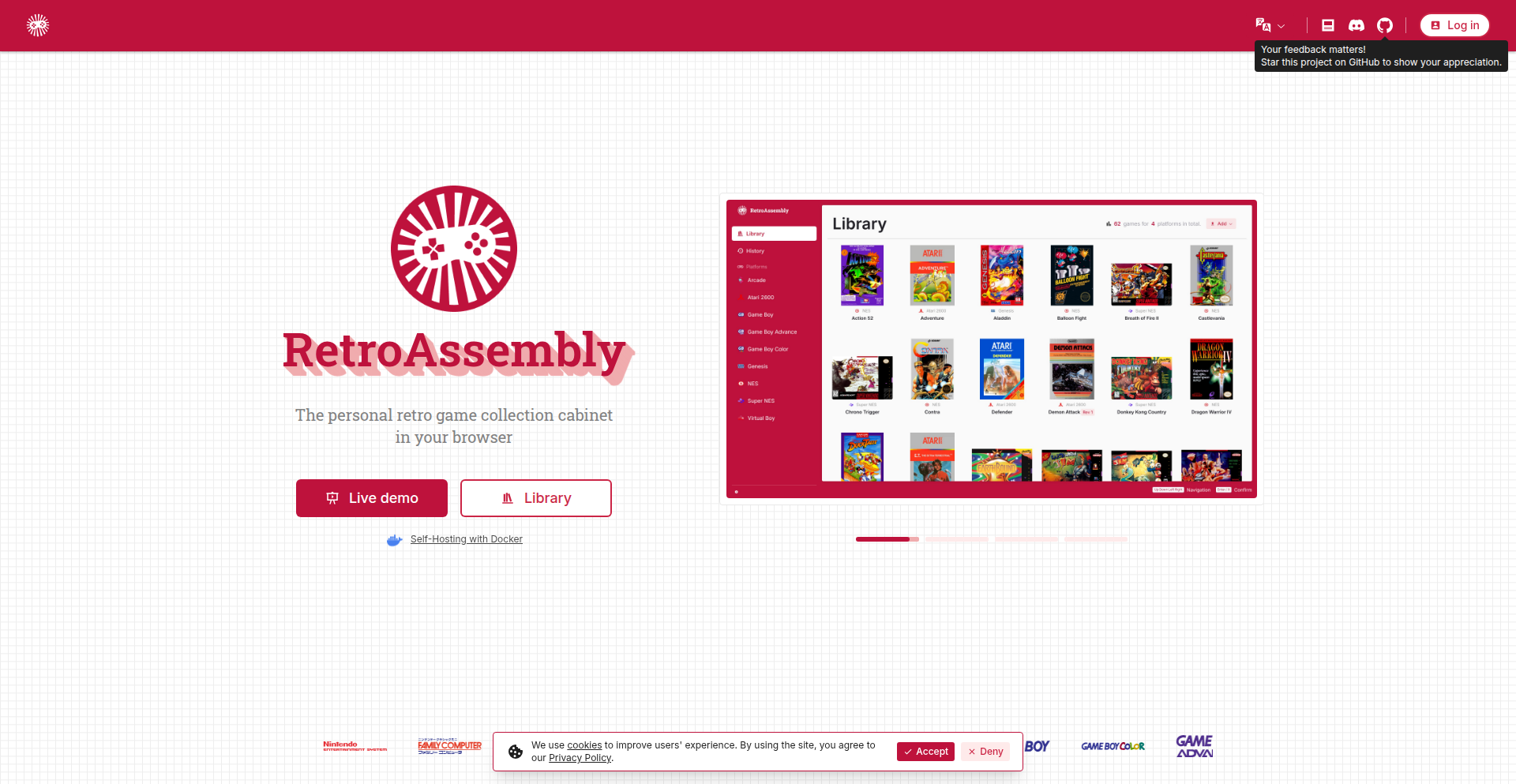
Author
arianrhodsand
Description
BrowserRetroHub is a web-based platform that brings a curated library of classic video games directly into your browser. It leverages open-source technology, offering a compact Docker deployment for self-hosting. The core innovation lies in its ability to seamlessly provide access to multiple classic gaming systems, enable cross-device play with progress saving, and offer intuitive controls with a rewind feature, all without requiring any installation.
Popularity
Points 2
Comments 0
What is this product?
BrowserRetroHub is a retro gaming console that exists entirely within your web browser. It allows you to browse and play games from iconic systems like Nintendo, Sega, and arcade machines right from your computer or mobile device. The key technical innovation is its ability to run these emulated games efficiently in the browser using web technologies, making them accessible without downloads. It also includes features like automatic game art fetching and a rewind function, enhancing the user experience.
How to use it?
Developers can use BrowserRetroHub in a few ways. For personal use, they can simply visit the website to play games. For those who want to host their own instance, a lightweight Docker image (~70 MB) is available, allowing for easy deployment on personal servers or cloud platforms. This is ideal for creating a shared retro gaming experience within a team or for personal projects. The project is open-source, so developers can also contribute to its development or fork it for custom modifications.
Product Core Function
· Cross-system emulation in browser: This allows playing games from various classic consoles (Nintendo, Sega, Arcade, etc.) directly in a web browser without needing to install separate emulators for each system. This offers convenience and broad accessibility for users.
· Cross-device progress saving: Users can start a game on one device, save their progress, and seamlessly continue playing on another device. This is achieved through web storage mechanisms, providing a flexible and uninterrupted gaming experience.
· Automatic game art fetching: The system automatically retrieves box art for games, significantly improving the visual appeal and organization of the game library. This enhances the overall user interface and makes browsing games more engaging.
· Rewind gameplay functionality: A simple shortcut allows users to rewind gameplay, enabling them to correct mistakes or re-experience moments. This is a powerful feature for learning game mechanics or overcoming challenging sections, making the gaming experience more forgiving and enjoyable.
· Smooth keyboard and gamepad navigation: The interface is optimized for both keyboard and gamepad input, ensuring a responsive and intuitive user experience across different control methods. This caters to a wide range of user preferences and playstyles.
Product Usage Case
· A developer wants to set up a fun, shared retro gaming station for their team's office. They can easily deploy BrowserRetroHub using Docker on a local server. This provides an instant, no-installation entertainment option for breaks, fostering team bonding without complex setup.
· A game developer is experimenting with web-based game emulation for archival purposes. They can use BrowserRetroHub as a base to explore efficient browser-based emulation techniques. The project's open-source nature allows them to inspect and adapt the code to understand how to run complex emulators in a web environment.
· A content creator wants to showcase retro games on their blog or website. They can embed or link to a self-hosted instance of BrowserRetroHub, allowing their audience to play classic games directly on the page without leaving the site. This enhances content engagement and provides an interactive experience.
· A user wants to revisit their childhood favorite games but doesn't have access to original hardware or emulators. They can use BrowserRetroHub through their browser on any device, pick up where they left off across their laptop and tablet, and even use the rewind feature to master difficult levels, all with a visually appealing and easy-to-navigate interface.
49
Gossipdle: Logic Grid Speedrunner

Author
Qpphello
Description
Gossipdle is a daily logic puzzle game that challenges players to deduce guilt or innocence among 20 characters in a 5x5 grid, guided solely by logical clues. It's like a digital 'whodunit' where every correct deduction unlocks more information, eliminating guesswork. The new Timed Challenge Mode adds a layer of pressure, pushing players to solve complex logic problems against the clock, offering a unique blend of rigorous thinking and speed. So, what's in it for you? It's a mentally stimulating daily challenge that sharpens your deductive reasoning skills and offers a fun, competitive twist with its timed mode, perfect for anyone who enjoys puzzles and a bit of a mental workout.
Popularity
Points 2
Comments 0
What is this product?
Gossipdle is a web-based logic puzzle game, similar to classic Einstein riddles or logic grid puzzles. The core technology involves a sophisticated clue generation and validation system. It dynamically creates intricate logic problems, ensuring that each clue is solvable and contributes to a unique solution. The game uses a constraint satisfaction approach, where each clue reduces the possibilities in the grid, guiding the player towards the correct answer without any random guessing. The new Timed Challenge Mode adds a real-time element, requiring players to apply their logical deduction skills under a time constraint, making it a test of both intellect and speed. What this means for you is a reliably challenging and fair puzzle experience that grows your problem-solving muscles, with an added thrill of racing against the clock.
How to use it?
Developers can integrate Gossipdle's core logic engine into their own applications for features requiring deductive reasoning or puzzle generation. For end-users, it's a simple web experience: visit the website, read the daily clues, and click on the grid to make deductions. The Timed Challenge Mode is accessed via a button on the site, presenting a separate, time-limited puzzle. You can use this as a daily brain exercise, a way to unwind with a mental challenge, or compete with friends to see who can solve the puzzles fastest in the timed mode. This offers you a readily accessible and engaging way to test and improve your critical thinking abilities.
Product Core Function
· Dynamic Logic Puzzle Generation: Creates unique, solvable logic problems daily, ensuring a fresh challenge each time. This means you always have a new mental puzzle to tackle, preventing boredom and keeping your brain engaged.
· Constraint-Based Deduction Engine: Guarantees solutions are found through pure logic, eliminating guesswork. For you, this translates to a fair and rewarding puzzle-solving experience where your reasoning skills are the key to success.
· Timed Challenge Mode: Introduces a time limit to solve puzzles, adding a competitive and exciting speed element. This offers you a way to test your problem-solving speed and accuracy under pressure, making it a more dynamic and engaging experience.
· State Persistence: Saves your progress across browser refreshes or closures, so you don't lose your work. This convenience means you can pick up where you left off, ensuring a seamless and uninterrupted puzzle-solving journey for you.
· Difficulty Scaling: Adjusts challenge and time limits based on the day of the week, providing a balanced experience. This ensures that the puzzles are challenging but not overwhelming, offering a suitable mental workout for you regardless of your skill level.
Product Usage Case
· A game developer could integrate Gossipdle's logic engine to create in-game puzzles for their adventure or mystery titles, offering players a deep and engaging deduction experience within the game world. This would provide players with a more immersive and intellectually stimulating gameplay loop.
· An educational platform could use Gossipdle's puzzle generation capabilities to create interactive logic exercises for students, helping them develop critical thinking and problem-solving skills in a fun and engaging way. This offers students a novel and effective method for learning and practicing logical reasoning.
· A mental wellness app could incorporate timed logic challenges from Gossipdle to offer users quick, engaging cognitive training sessions throughout the day, promoting mental agility and focus. This provides users with a readily available tool to maintain and improve their cognitive functions.
· A team-building event organizer could use the timed mode for a 'puzzle race' activity, fostering collaboration and friendly competition among participants. This offers a fun and engaging way to encourage teamwork and strategic thinking within a group setting.
50
WebGPU LLM Runner

Author
sdan
Description
A project that enables running Large Language Models (LLMs) directly in your web browser using WebGPU. It bypasses the need for powerful local hardware or cloud services by leveraging the GPU capabilities of everyday devices, making advanced AI accessible to more developers.
Popularity
Points 2
Comments 0
What is this product?
This project allows you to run sophisticated AI models, like those used for text generation and understanding, directly within your web browser. It achieves this by utilizing WebGPU, a modern web standard that gives web applications access to the graphics processing unit (GPU) of your computer. Traditionally, running large AI models requires significant computing power, often only available on high-end machines or cloud servers. This project's innovation lies in its ability to efficiently offload the heavy computational tasks of LLMs to the user's local GPU via the browser, making powerful AI capabilities available without complex setups or external dependencies. So, what does this mean for you? It means you can experiment with and integrate AI functionalities into your web applications without worrying about server costs or user hardware limitations.
How to use it?
Developers can integrate this project into their web applications by including the necessary JavaScript libraries. The core idea is to load a pre-trained LLM (often in a quantized format for efficiency) and then use the WebGPU API to perform inference directly in the browser. This typically involves setting up the WebGPU context, defining the computational shaders (small programs that run on the GPU) for the model's operations, and then feeding input data to the model for processing. The output is then returned to your web application. Think of it as a way to add 'smartness' to your website or web app locally. So, how can you use it? You can embed it into a customer support chatbot on your website, create interactive content generation tools, or build personalized user experiences, all running client-side. This dramatically reduces latency and ensures data privacy, as sensitive information doesn't need to leave the user's device.
Product Core Function
· WebGPU-accelerated LLM inference: Enables running complex AI models on the user's local GPU through the browser, providing a significant performance boost over CPU-based processing. This allows for real-time AI interactions without requiring powerful user hardware.
· Client-side AI processing: All AI computations happen directly within the user's browser, enhancing data privacy and security as sensitive user data never needs to be sent to a server. This is crucial for applications dealing with personal information or proprietary content.
· Cross-browser compatibility with WebGPU support: Leverages a modern web standard to ensure broader accessibility across different browsers that support WebGPU, making the AI features available to a wider audience without platform-specific installations.
· Model loading and management: Provides mechanisms to load and manage pre-trained LLMs within the web environment, often optimized for size and performance (e.g., using quantized models). This simplifies the integration process and reduces the footprint of AI features in web applications.
· Integration API for web applications: Offers a straightforward interface for developers to integrate LLM capabilities into their existing web projects, allowing for easy incorporation of AI-driven features like text generation, summarization, and question answering.
Product Usage Case
· Building an interactive storytelling application where users can co-create narratives with an AI model running directly in their browser. This tackles the problem of high server costs and latency associated with cloud-based AI, offering a seamless and immediate creative experience.
· Developing a privacy-focused customer support chatbot for an e-commerce website. The LLM handles user queries locally, ensuring that customer data remains private and reducing server load. This addresses concerns about data breaches and provides instant responses.
· Creating a web-based code assistant that offers real-time code suggestions and explanations to developers. By running inference locally, it provides instant feedback without the need for API calls, improving developer productivity and reducing development costs.
· Designing an educational tool that allows students to explore complex scientific concepts through AI-generated explanations and dialogues. This makes advanced AI learning resources accessible on any device with a modern browser, democratizing access to AI-powered education.
51
GeoAI Robots.txt Auditor

Author
franze
Description
This project is a web-based tool that leverages AI and geolocation to audit robots.txt files, identifying potential SEO issues that affect search engine crawling and indexing. It analyzes robots.txt directives based on simulated search engine behavior from different geographical locations, uncovering hidden crawlability problems. So, this is useful because it helps websites ensure search engines can access and index their content effectively, leading to better search rankings and visibility.
Popularity
Points 1
Comments 1
What is this product?
This project is an intelligent tool designed to examine your website's robots.txt file. Traditionally, robots.txt tells search engine crawlers which parts of your site they should or shouldn't visit. This tool goes a step further by simulating how different search engine bots, influenced by their geographical origin and AI-driven behavior patterns, would interpret your robots.txt. It identifies subtle issues, like rules that might inadvertently block legitimate crawling or cause indexing problems in specific regions, which a standard manual review might miss. So, what's innovative is its ability to predict how real-world, geographically diverse search engine bots will interact with your site's rules, offering a more nuanced and effective SEO audit. This helps you avoid costly SEO mistakes that could harm your site's performance. So, this is useful because it provides a more advanced and predictive analysis of your robots.txt, preventing potential SEO damage before it occurs.
How to use it?
Developers can use this tool by navigating to the project's web interface, entering their website's URL, and initiating an audit. The tool will then fetch the robots.txt file, perform the AI-driven and geo-simulated analysis, and present a report detailing any identified issues. For integration, it might offer an API that allows developers to programmatically trigger audits as part of their CI/CD pipelines or other automated SEO workflows. So, this is useful because it offers a straightforward way to check your SEO health and can be integrated into automated development processes for continuous monitoring.
Product Core Function
· Robots.txt parsing and analysis: The system reads and interprets the rules within a robots.txt file, which are crucial for controlling search engine crawler access. The value is in accurately understanding these directives. This is useful for ensuring you're communicating your crawling intentions correctly to search engines.
· AI-driven crawl simulation: The tool uses artificial intelligence to mimic how search engine bots might behave when accessing a website. This moves beyond simple rule checking to predictive analysis. This is useful because it helps identify potential problems that are not explicitly stated but arise from complex crawler logic.
· Geolocation-based crawling simulation: It simulates search engine access from various geographical locations to understand regional indexing and crawling differences. The value is in uncovering SEO issues that are specific to certain markets or user locations. This is useful for optimizing your site's performance for a global audience.
· SEO issue identification: The core output is a report flagging potential problems, such as disallowed URLs that should be allowed or unexpected blocking. This directly translates to actionable insights for improving search engine visibility. This is useful for pinpointing and fixing SEO errors that could be costing you traffic.
· User-friendly reporting: The results are presented in an understandable format, making it accessible to both technical and non-technical users. The value is in clear communication of complex technical findings. This is useful for making SEO audits easy to understand and act upon.
Product Usage Case
· A multinational e-commerce site experiencing lower traffic in its Asian markets might use this tool. They would input their website URL and run the audit to see if their robots.txt is inadvertently blocking or de-prioritizing access for search engines that primarily crawl from Asian regions. This helps them identify and fix the specific rule causing the regional disparity, improving their SEO in those markets. So, this is useful for diagnosing and resolving geo-specific SEO performance issues.
· A content-heavy blog that recently restructured its URL structure could use this tool. They would audit their robots.txt to ensure no old, disallow rules are accidentally preventing crawlers from indexing their new content. The AI simulation helps catch subtle errors that might be missed by manual review. So, this is useful for ensuring new content is discoverable by search engines after site changes.
· A SaaS company launching a new feature and wanting to ensure it's immediately discoverable by search engines could use this tool. By auditing their robots.txt, they can proactively confirm that the new feature's pages are not blocked and are accessible for indexing. The geo-simulation can ensure that users in all target regions can find the new feature. So, this is useful for guaranteeing new product features get indexed quickly and effectively across all target geographies.
· A developer managing a large WordPress site with many plugins that modify SEO settings could use this tool to verify that their robots.txt is behaving as intended and not conflicting with other SEO optimizations. The AI analysis helps identify potential unintended consequences of complex configurations. So, this is useful for maintaining SEO integrity in complex web environments.
52
Schema Weaver
Author
Punyakrit
Description
Schema Weaver is a visual database designer that translates a drag-and-drop interface into ready-to-use Prisma schemas and SQL. It tackles the common pain point of manually translating database designs into code, offering an intuitive way to build and manage database structures, saving developers significant time and reducing errors.
Popularity
Points 2
Comments 0
What is this product?
Schema Weaver is an open-source tool that acts as a visual blueprint for your databases. Instead of writing complex SQL code or Prisma schema definitions from scratch, you can simply drag and drop tables and define their relationships on a canvas. The magic happens behind the scenes: Schema Weaver automatically generates the corresponding Prisma schema (a modern ORM for Node.js and TypeScript) and SQL code. This means you can quickly visualize your database structure and get functional code without getting bogged down in syntax.
How to use it?
Developers can start by visiting the Schema Weaver GitHub repository to explore the project. For now, it's in its early stages, focusing on the core engine. The intended usage is to interact with a future graphical interface where you'll draw your database tables and define connections between them. Once your design is complete, you'll export the generated Prisma schema and SQL, which can then be integrated directly into your application's backend. This is ideal for rapid prototyping, quickly setting up new projects, or even documenting existing database structures visually.
Product Core Function
· Visual table creation: Allows developers to design database tables by simply dragging and dropping elements on a canvas, making database design accessible and less intimidating than writing raw SQL.
· Automated foreign key generation: Intelligently creates the necessary foreign key constraints between tables based on user-defined relationships, ensuring data integrity and reducing manual coding effort.
· Prisma schema export: Generates clean and accurate Prisma schema files, enabling seamless integration with Node.js and TypeScript applications using Prisma as their ORM.
· SQL export: Produces standard SQL code that can be directly used to create and manage your database in various SQL-compliant database systems.
· Future capability: Importing existing Prisma schemas, allowing developers to visualize and potentially refactor their current database configurations.
Product Usage Case
· Rapid Prototyping: A startup developer needs to quickly build a Minimum Viable Product (MVP). Instead of spending hours writing SQL and ORM code, they can use Schema Weaver to visually design their core data models and generate the initial database structure in minutes, accelerating their time to market.
· Learning Database Design: A junior developer is learning about relational databases and ORMs. Schema Weaver provides a visual aid to understand how tables, columns, and relationships translate into actual code, making the learning process more intuitive and engaging.
· Refactoring Existing Databases: A developer has a complex existing database and wants to document or migrate it. Schema Weaver can potentially import the existing Prisma schema (in the future), allowing them to visualize the current structure and make informed decisions about refactoring or modernization, all within a visual environment.
· Team Collaboration on Data Models: A team is working on a new application. Using Schema Weaver, all team members, regardless of their deep SQL expertise, can contribute to the database design process by visualizing and modifying the schema on a shared canvas, fostering better communication and consensus.
53
AI vs Real Instinct

Author
aliibnepasha
Description
A minimalist web application designed to test your intuition by presenting users with a pair of images, one AI-generated and one real, challenging them to identify the authentic image. Its core innovation lies in its simplicity and direct approach to a growing societal challenge: distinguishing synthetic media from reality. This product addresses the increasing difficulty in discerning AI-generated content, offering a playful yet insightful tool.
Popularity
Points 1
Comments 1
What is this product?
AI vs Real Instinct is a straightforward web-based game that pits your ability to distinguish between real photographs and AI-generated imagery. The underlying technology involves presenting two images side-by-side. Users tap on the image they believe is real. The system then reveals whether their guess was correct. The innovation here isn't in complex AI models, but in the application's direct and unadorned confrontation with a real-world problem – the proliferation of deceptive AI-generated content. It democratizes the challenge of AI detection by making it an accessible, engaging game, rather than a complex technical analysis. The value is in sharpening your visual discernment skills in an era where digital authenticity is increasingly in question.
How to use it?
Developers can integrate this concept or use it as a reference for building similar tools. For end-users, it's incredibly simple: navigate to the application's web address. You'll be presented with two images. Tap on the one you think is the real photograph. The application will instantly tell you if you're right. There are no logins, no complicated settings, just pure, instinct-driven interaction. This makes it ideal for a quick mental exercise, for educational purposes to demonstrate the nuances of AI image generation, or simply as a fun way to sharpen your visual perception in everyday online interactions.
Product Core Function
· Image Comparison: Presents two images, one AI-generated and one real, to the user. This allows users to directly confront the visual differences, or lack thereof, between synthetic and authentic media, improving their ability to spot anomalies.
· User Guessing Mechanism: Allows users to tap on their chosen image to make a selection. This simple interaction provides immediate feedback and makes the experience engaging, translating into a fun and educational way to hone visual discrimination skills.
· Correctness Feedback: Immediately informs the user if their guess was correct or incorrect. This instant feedback loop is crucial for learning and reinforces the user's ability to identify subtle visual cues that differentiate real images from AI creations.
Product Usage Case
· Educational Tool: Educators can use AI vs Real Instinct in classrooms to teach students about the capabilities and potential pitfalls of AI-generated content, helping them develop critical media literacy skills for a digital world.
· Media Literacy Awareness: Individuals can use this app to become more aware of the prevalence of AI-generated imagery online, making them more cautious and discerning consumers of digital media, thus safeguarding against misinformation.
· Developer Reference for Simple AI Detection Games: Developers looking to create engaging and educational tools around AI can take inspiration from the project's minimalist design and direct problem-solving approach, fostering a culture of building practical solutions with code.
54
PixelGhost
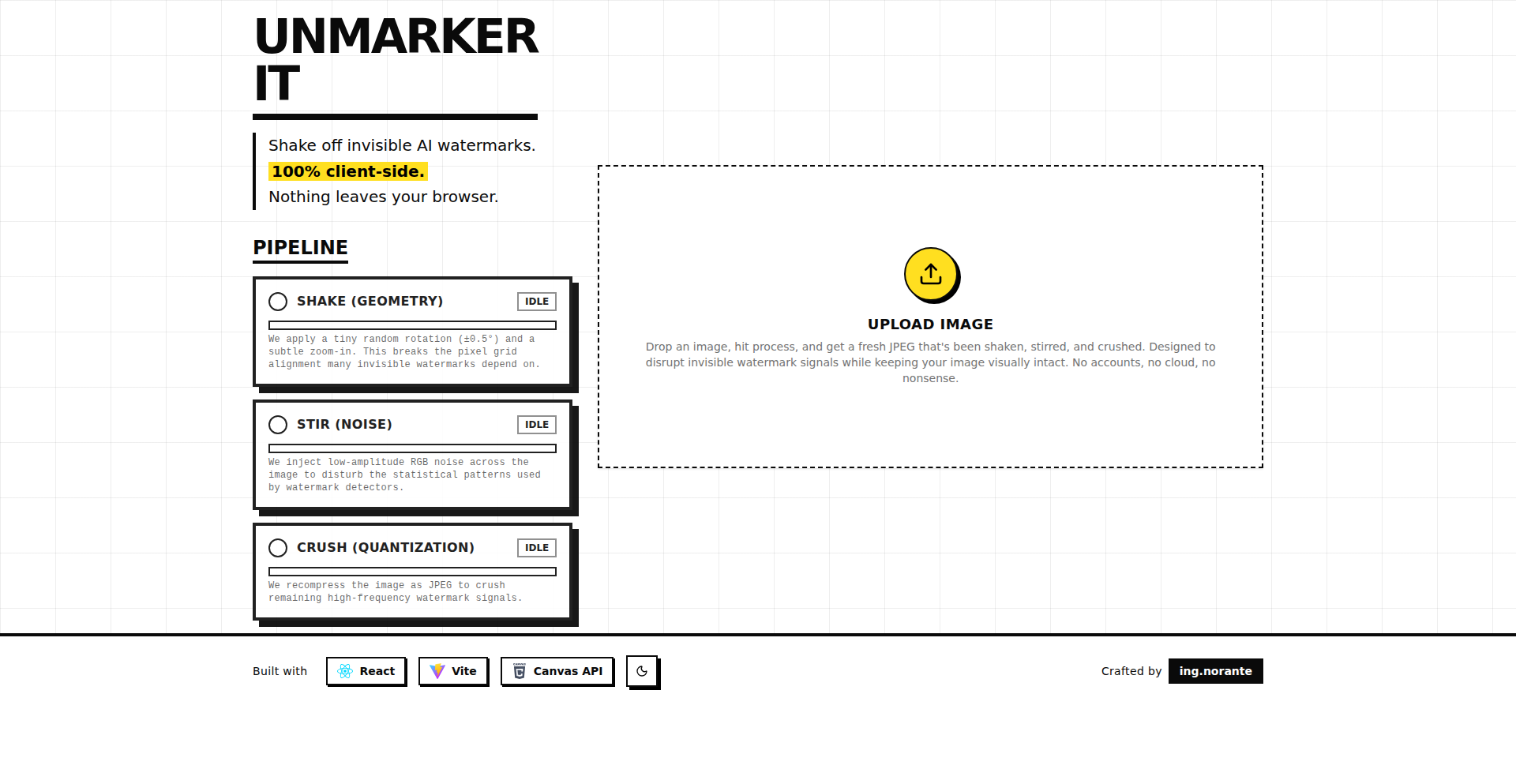
Author
ing-norante
Description
PixelGhost is a browser-only tool that uses a clever combination of image manipulations – canvas transformations, geometric distortion, subtle noise injection, and JPEG recompression – to disrupt invisible AI watermarks embedded in images. It operates entirely client-side, meaning your images never leave your device, ensuring privacy and eliminating the need for any backend infrastructure. This is a direct response to the challenge of verifying image authenticity in the age of AI-generated content.
Popularity
Points 2
Comments 0
What is this product?
PixelGhost is a web application that makes images resistant to AI watermarking. It works by applying a series of subtle, almost imperceptible changes to an image's pixels. Think of it like subtly shuffling and slightly blurring the pixels, then re-saving the image at a slightly lower quality. This process doesn't significantly alter the image's appearance to the human eye, but it breaks the specific patterns that AI watermarking algorithms look for. The core idea is to leverage the inherent properties of image formats and browser rendering to undo the effects of these invisible digital signatures. This is innovative because it tackles a growing problem – the difficulty in distinguishing human-created images from AI-generated ones, without relying on complex server-side processing or invasive data collection.
How to use it?
Developers can use PixelGhost directly within their web applications by integrating its JavaScript functions. Imagine a content management system where users upload images; you could add a 'de-watermark' button that processes the image through PixelGhost before it's stored or displayed. For individual use, users can visit the PixelGhost website, upload an image, and download the modified version. The technical integration involves using the browser's Canvas API to manipulate image data. For example, to 'shake' the image, you'd apply a slight rotation and zoom. To 'stir' it, you'd use `getImageData` to access pixel values, add random noise, and then `putImageData` to reapply them. Finally, the modified canvas content is exported as a JPEG with a controlled quality setting to achieve the 'crush' effect. The value here is a straightforward, privacy-preserving way to enhance image authenticity verification within your own applications.
Product Core Function
· Image Shaking: Applies random rotation and slight zoom to disrupt geometric watermark patterns. This is valuable for breaking AI's precise spatial analysis of images, making it harder for them to detect the watermark's original placement.
· Image Stirring: Injects low-amplitude RGB noise using `getImageData` to subtly alter pixel values. This function helps to scramble the exact color information that AI watermarks rely on, effectively making the watermark 'invisible' to detection algorithms.
· Image Crushing: Recompresses the image using JPEG at a quality setting of approximately 0.85. This step further degrades the watermark's integrity by introducing compression artifacts, making it difficult for AI to recognize the intended watermark signal.
· Client-Side Processing: All operations happen directly in the user's browser, meaning no images are uploaded to a server. This is a significant value for privacy-conscious applications and users concerned about data security.
Product Usage Case
· A photography website wanting to verify that uploaded images are not AI-generated. By processing uploaded images through PixelGhost, they can significantly reduce the likelihood of AI-generated content being mistaken for human-created work, thus maintaining the integrity of their platform.
· A news agency concerned about the authenticity of images submitted by contributors. Integrating PixelGhost into their submission pipeline allows them to add a layer of resilience against invisible AI watermarks, improving their ability to trust the visual content they publish.
· An artist who wants to ensure their original artwork is not easily mimicked or falsely attributed. By applying PixelGhost to their submitted images, they can make it more challenging for AI systems to replicate their style or claim ownership of AI-generated content that coincidentally resembles their work.
· A developer building a tool for content creators to combat AI-driven image plagiarism. PixelGhost can be a key component, offering a technical solution to make AI watermarks less effective and thus empowering creators to better protect their digital assets.
55
SiteOne Markdown Crawler

Author
janreges
Description
This project is a browser extension that transforms any webpage into clean, structured Markdown. It's designed to make web content easily digestible for Large Language Models (LLMs) and Retrieval-Augmented Generation (RAG) systems, effectively turning the dynamic web into a structured knowledge base. The innovation lies in its ability to extract and format content semantically, overcoming the typical noise and complexity of HTML.
Popularity
Points 2
Comments 0
What is this product?
SiteOne Markdown Crawler is a browser extension that acts as a sophisticated web content preprocessor. Instead of just copying and pasting text, it intelligently analyzes the HTML structure of a webpage and converts it into well-formatted Markdown. This is particularly useful because LLMs and RAG systems often struggle with raw HTML. By providing clean Markdown, it significantly improves the accuracy and efficiency of these AI models when processing web data for tasks like summarization, question answering, or knowledge extraction. The core innovation is its semantic understanding of web layouts, enabling it to differentiate between main content, navigation, ads, and footers, and present only the relevant information in a usable format.
How to use it?
Developers can use SiteOne Markdown Crawler as a browser extension. Once installed, they can navigate to any website, activate the extension, and it will automatically process the page, outputting the content as clean Markdown. This Markdown can then be copied and pasted directly into an LLM's input, saved as a file for batch processing, or integrated into a RAG pipeline. For RAG systems, this means that new, unstructured web documents can be easily transformed into a format suitable for indexing and retrieval, enhancing the system's knowledge base without manual intervention. It’s a simple, direct way to feed the web’s vast information into AI workflows.
Product Core Function
· Intelligent Content Extraction: Extracts the primary content of a webpage, filtering out navigation, advertisements, and other non-essential elements. This ensures that LLMs receive only the information they need, improving processing efficiency and reducing noise.
· Semantic Markdown Conversion: Transforms the extracted content into clean, structured Markdown, preserving headings, lists, tables, and other formatting. This structured format is ideal for AI models, making it easier for them to understand context and relationships within the text.
· LLM/RAG Optimization: Specifically designed to prepare web content for use with LLMs and RAG systems. This means the output is directly usable for building knowledge bases or providing context to AI, making your AI applications more informed.
· Browser Extension Integration: Seamlessly integrates into the user's browsing workflow, allowing for on-the-fly conversion of any webpage. This ease of use makes it practical for everyday data collection and AI training tasks.
Product Usage Case
· A researcher wants to build a knowledge base about a specific scientific field using recent articles from various online journals. By using SiteOne to convert articles into Markdown, they can then feed this clean data into a RAG system for efficient retrieval and summarization, significantly speeding up their research process.
· A developer is building a chatbot that needs to answer questions based on real-time web information. They can use SiteOne to extract relevant content from search results or news articles and then pass this Markdown to an LLM to generate accurate answers, making the chatbot more up-to-date and knowledgeable.
· A content curator wants to collect and archive information from blogs and news sites for later analysis. SiteOne allows them to quickly convert articles into a uniform Markdown format, which is easier to store, manage, and process programmatically than raw HTML.
· An AI enthusiast wants to experiment with fine-tuning an LLM on web-based data. SiteOne provides a straightforward method to gather and clean large volumes of web content, preparing it for the data preprocessing steps required for LLM training.
56
TeenArcade: Collaborative Hardware Playground

Author
devenj
Description
This project showcases a fascinating blend of hardware hacking and youth engagement, where 30 teenagers collaboratively built a handmade arcade in Tokyo. The innovation lies not just in the creation of the arcade itself, but in the *process* of empowering young individuals with hands-on engineering and problem-solving skills through a tangible, fun outcome. It demonstrates how complex projects can be broken down and managed through collective effort, fostering creativity and technical literacy.
Popularity
Points 2
Comments 0
What is this product?
TeenArcade is a hands-on initiative that mobilizes a group of teenagers to collectively design, build, and assemble a functional arcade cabinet. The core technical principle is project-based learning and distributed problem-solving. Instead of a single developer tackling a complex task, the project leverages the power of a team by assigning modular components and tasks. The innovation is in the *pedagogical approach* – using a fun, engaging product (an arcade) as a vehicle to teach practical skills in electronics, coding, design, and teamwork. It's about demystifying technology and making it accessible and collaborative for a young audience, proving that even ambitious hardware projects can be achievable through shared effort and creative division of labor. So, what's in it for you? It shows how complex technical undertakings can be approached through community and shared passion, inspiring new models for education and collaborative innovation.
How to use it?
For developers, TeenArcade offers a blueprint for initiating and managing large-scale, collaborative hardware projects, especially with less experienced participants. The 'how to use' isn't about a software API, but a methodological framework. Imagine using this approach to:
1. Organize a hackathon where teams build physical prototypes for a specific problem.
2. Develop educational workshops where students learn by building.
3. Foster community projects that require combined technical and creative input.
Integration involves defining clear project goals, breaking down the build into manageable modules (e.g., custom button interfaces, LED lighting systems, sound systems, display integration), assigning roles based on interest and aptitude, and establishing a feedback loop for iterative development. So, how can you use this? Think of it as a guide to orchestrating creative technical endeavors where the outcome is as much about the collaborative process and learned skills as it is about the final product.
Product Core Function
· Modular Project Design: Breaking down a complex hardware build into independent, manageable sub-projects (like button panels, marquee lighting, speaker integration). This allows for parallel development and reduces individual overwhelm, making the overall project achievable. The value is in scalable complexity and easier task delegation.
· Collaborative Problem-Solving Framework: Establishing clear communication channels and feedback mechanisms for the group to address challenges as they arise during the build. This fosters a team-based approach to debugging and design iteration, crucial for any complex technical project. The value is in efficient issue resolution and collective learning.
· Skill Democratization Through Tangible Output: Providing a concrete and exciting product (an arcade) as the focus for learning diverse technical skills, from basic electronics and soldering to simple programming for game logic and UI. This makes technical concepts relatable and engaging for newcomers. The value is in inspiring and educating future technologists.
· Community-Driven Innovation: Harnessing the collective creativity and diverse perspectives of a group to generate unique design choices and solutions that a single individual might not conceive. This leads to more inventive and personalized outcomes. The value is in amplified creativity and unique product development.
· Resourceful Engineering & Improvisation: Encouraging the use of readily available materials and creative repurposing to achieve project goals, reflecting a core hacker ethos of making do with what's available. This promotes cost-effectiveness and ingenuity. The value is in adaptable and efficient engineering.
Product Usage Case
· Education Workshops: Imagine a coding bootcamp or a maker space hosting a 'Build Your Own Retro Console' workshop. TeenArcade's methodology would guide instructors to divide students into teams responsible for different parts – one team for controller input, another for sound output, another for screen integration. This directly addresses the challenge of making abstract coding concepts tangible and exciting, leading to deeper understanding and engagement.
· Community Tech Projects: A neighborhood group wanting to build interactive art installations for a public space could use this model. They could assign different interactive elements (light sensors, motion detectors) to smaller teams, all contributing to a unified, functional installation. This solves the problem of how to mobilize a diverse group of community members, some with technical backgrounds and others without, towards a shared, complex technical goal.
· Hackathon with Physical Outcomes: A hackathon focused on creating interactive prototypes for accessibility could employ this. Teams would need to build not just software, but hardware interfaces. TeenArcade's framework helps structure how teams can collaborate on integrating physical components like custom joysticks or adaptive controllers with their software, tackling the challenge of rapid, multi-disciplinary prototyping.
· Youth Technology Clubs: A school's tech club could use this to build a more ambitious project than individual assignments, like a robot that performs a specific task or an interactive display for a school event. By breaking down the robot or display into sub-systems (e.g., navigation, sensor array, user interface), students learn specialized skills while contributing to a larger, more impressive final product. This solves the common issue of sustaining interest in tech clubs by offering a highly motivating, group-achieved outcome.
57
GlobalVoice API

Author
daolm
Description
GlobalVoice API is a service that allows users to make international calls from their browser or phone at exceptionally low rates, under $0.05/min for US numbers. It also offers the ability to purchase US virtual phone numbers for approximately $3/month. The core innovation lies in its accessibility and cost-effectiveness, enabling seamless global communication without long-term commitments or hidden fees. It's like having a super cheap, global phone service integrated directly into your digital life.
Popularity
Points 2
Comments 0
What is this product?
GlobalVoice API is a platform designed to democratize international calling. At its heart, it leverages Voice over IP (VoIP) technology and smart routing to connect calls across borders at a fraction of traditional carrier prices. Instead of relying on expensive infrastructure, it uses the internet to transmit voice data. The innovation is in simplifying this complex process into an easy-to-use service. Imagine a global switchboard that's always open, always cheap, and accessible from any internet-connected device. This means you can connect with anyone, anywhere, without worrying about exorbitant phone bills, making global connections practical and affordable for everyone.
How to use it?
Developers can integrate GlobalVoice API into their applications to add outbound international calling capabilities. This can be done via their web browser by visiting the GlobalVoice website or by integrating the API directly into their own software or mobile apps. For instance, a startup founder can use it to call potential clients overseas without incurring hefty roaming charges. An expat can use it to stay in touch with family back home at a fraction of the cost. Integration typically involves signing up, topping up an account, and then using provided API keys or a web interface to initiate calls. It's designed to be straightforward, meaning you can plug it into your existing workflow and start making calls immediately, essentially adding a powerful, budget-friendly communication tool to your digital arsenal.
Product Core Function
· Cheap International Calling: Enables users to make calls to any international number at significantly reduced rates, making global communication economically viable and accessible for everyday use. This is valuable for anyone needing to stay connected across borders affordably.
· Browser-Based Calling: Allows users to initiate calls directly from their web browser, eliminating the need for dedicated phone hardware and providing a convenient way to communicate from any internet-connected computer. This offers flexibility and ease of access for remote workers or frequent travelers.
· Virtual US Phone Numbers: Provides the option to purchase virtual US phone numbers at a low monthly cost, allowing businesses or individuals to have a local presence in the US for receiving calls or for clients to contact them. This is crucial for establishing credibility and simplifying communication for businesses operating internationally.
· Pay-as-you-go Model: Operates on a top-up system without subscriptions or signup fees, offering a flexible and transparent pricing structure that avoids commitment and allows users to control their spending. This is beneficial for users with fluctuating calling needs or those who prefer not to be locked into contracts.
Product Usage Case
· A startup founder attending a conference in Europe needs to frequently call potential investors in the US. By using GlobalVoice API via their laptop browser, they can make these calls for less than $0.05/min, saving hundreds of dollars compared to traditional roaming rates, enabling seamless business development without financial strain.
· An expatriate living in Southeast Asia wants to call their family in the United States every week. They can use GlobalVoice API from their smartphone app to make these calls at a low cost, maintaining strong family ties without the burden of expensive international phone bills, fostering personal connections affordably.
· A small e-commerce business wants to offer US customers a local point of contact. They can purchase a virtual US phone number from GlobalVoice API for $3/month, directing these calls to their overseas support team. This enhances customer trust and accessibility, facilitating easier communication and potential sales growth.
· A freelance developer working remotely needs to collaborate with clients in different countries. They can integrate GlobalVoice API into their project management tool to initiate client calls directly from their workspace, streamlining communication and reducing the overhead of switching between different calling applications, improving workflow efficiency.
58
CLI Storyboard Weaver
Author
kierangill
Description
This project is a command-line interface (CLI) tool that allows developers to generate storyboards from text descriptions. It leverages natural language processing (NLP) and potentially some form of generative AI to translate textual prompts into visual storyboard frames. The core innovation lies in making a typically visual and time-consuming design process accessible and automatable directly from the developer's workflow.
Popularity
Points 2
Comments 0
What is this product?
This is a command-line tool that acts as a bridge between text and visuals for storyboarding. Instead of manually drawing each frame, developers input a description of a scene or sequence, and the tool generates a visual representation. The underlying technology likely involves parsing the text to understand key elements like characters, actions, settings, and camera angles. It then uses this understanding to programmatically create images, possibly by combining pre-defined assets or employing generative image models. This means you can quickly prototype visual narratives without needing advanced design skills or dedicated design software.
How to use it?
Developers can integrate this tool into their existing command-line workflows. For example, a game developer could describe a cutscene in a text file and then run a command like `nanobanana generate --scene 'Player enters a dark cave, a faint light flickers in the distance.'` to get a visual storyboard. It could also be used in scripting for automated documentation or even for generating placeholder visuals during early-stage prototyping. The key is that it fits directly into the developer's coding environment, minimizing context switching.
Product Core Function
· Text-to-Storyboard Generation: Translates natural language descriptions into visual storyboard frames, enabling rapid visual concepting and reducing manual design effort.
· CLI Integration: Seamlessly fits into developer workflows, allowing for quick iteration and automation directly from the terminal.
· Scene Description Parsing: Interprets key elements from textual prompts to inform the visual output, making the generation process intelligent.
· Visual Asset Assembly: Programmatically creates visual elements, offering a way to quickly visualize sequences without requiring artistic expertise.
· Iterative Prototyping: Facilitates quick changes and refinements by allowing developers to modify text prompts and regenerate visuals on the fly.
Product Usage Case
· Game Development: A game designer describes a new level's opening sequence. The CLI tool generates a series of frames, allowing the team to quickly review the flow and camera perspectives, saving hours of manual storyboard creation.
· App Prototyping: A UX designer is outlining a new user flow. They can use the tool to generate visual representations of key screens and interactions, facilitating early feedback and design iteration without needing a dedicated UI/UX designer for initial mockups.
· Educational Content Creation: An educator is creating a tutorial or explainer video. They can use the tool to generate visual aids for complex concepts described in text, making the learning material more engaging and easier to understand.
· Creative Writing: A writer is developing a story and wants to visualize key scenes. They can input descriptions and get a visual interpretation, potentially sparking new ideas or clarifying plot points.
59
Aion Longevity Insight Engine

Author
nevenp
Description
Aion is an AI-powered longevity coach that breaks down data silos by integrating wearable device data (like sleep and heart rate variability), blood test results, and even simple phone-based facial scans. It translates this comprehensive data into actionable, personalized daily recommendations for sleep, caffeine intake, exercise intensity, and light exposure, moving beyond just presenting raw metrics. This offers users a clearer, holistic understanding of their body's energy, hormone balance, sleep quality, and recovery patterns over time.
Popularity
Points 2
Comments 0
What is this product?
Aion is a sophisticated AI system designed to act as your personal longevity coach. It ingeniously combines data that is typically kept separate: information from your smartwatches and fitness trackers (tracking things like how well you sleep and your heart rate fluctuations), results from your blood tests (checking hormone levels and other markers related to aging well), and even analyzes photos taken with your phone to assess certain physiological indicators. The core innovation lies in its ability to synthesize these diverse data streams, not just to show you a lot of numbers, but to intelligently interpret them and generate specific, easy-to-follow daily advice. Think of it as a smart advisor that understands your unique biology from multiple angles and tells you precisely what to do each day to improve your health and energy levels.
How to use it?
Developers can integrate Aion into their health and wellness applications or platforms. For end-users, the primary interaction is through the Aion web application or potentially a mobile app. Data can be connected via APIs from popular wearable services (e.g., Apple Health, Oura, Whoop) and blood test providers. Facial scan analysis is done directly through the phone's camera via a guided process. Once integrated, users receive personalized daily recommendations delivered through a dashboard or notifications. For developers looking to build upon this, Aion could serve as a powerful backend engine for advanced personalized health insights within their own products, enabling them to offer a deeper level of user-specific guidance without needing to build the complex data fusion and AI analysis from scratch.
Product Core Function
· Wearable Data Integration: Connects with major wearable health trackers to ingest data like sleep duration, sleep stages, heart rate variability (HRV), and daily activity strain. This provides developers with access to a rich stream of physiological data, enabling them to build applications that understand user's daily physical state and recovery.
· Biomarker Analysis: Processes blood test results, focusing on key longevity markers and hormone levels. This allows for the development of health insights that go beyond superficial tracking, tapping into deeper physiological indicators of health and aging. The value here is enabling applications to provide scientifically-grounded recommendations.
· Facial Scan Analysis: Utilizes computer vision and AI to analyze facial features from simple phone photos, identifying subtle indicators of stress, sleep deprivation, or hormonal imbalances. This adds a non-invasive, easily accessible data point for a more comprehensive health picture, offering developers a unique way to gather user data without requiring specialized hardware.
· Personalized Recommendation Engine: The core AI engine synthesizes all incoming data to generate tailored daily advice on sleep timing, optimal caffeine windows, appropriate training intensity, and light exposure schedules. For developers, this means offloading the complex task of interpreting multi-source data into actionable advice, allowing them to focus on user experience and engagement.
· Holistic Health Dashboard: Presents integrated data and recommendations in a clear, understandable format, moving beyond simple metric displays. This provides a unified view of a user's health status, enabling developers to create applications that offer meaningful progress tracking and user education.
Product Usage Case
· A fitness app developer could integrate Aion's API to offer personalized daily workout recommendations based on a user's real-time recovery scores (derived from wearables) and sleep quality. Instead of generic workout plans, users get guidance optimized for their current physical state, preventing overtraining and maximizing gains. This solves the problem of generic fitness advice by making it hyper-personalized.
· A wellness platform could use Aion to provide users with tailored advice on managing their circadian rhythm. By analyzing sleep data from wearables and blood test results indicating hormone cycles, Aion can recommend specific times for light exposure and sleep, helping users combat jet lag or improve sleep disorders. This addresses the challenge of understanding and optimizing sleep without relying solely on user self-reporting.
· A digital health provider could incorporate Aion's facial scan analysis to passively monitor early signs of stress or fatigue in users. Combined with other data, this could trigger timely interventions or suggest stress-reduction techniques. This offers a novel, low-friction method for gathering user health signals, enabling proactive health management.
· An individual looking to optimize their energy levels throughout the day could use Aion to determine the best times for caffeine consumption and intense workouts, based on their unique hormonal profile and daily recovery status. This provides a data-driven approach to energy management, moving beyond guesswork and subjective feelings.
60
Agentica: Open-Source AI Coding Co-pilot

Author
GenLabs-AI
Description
Agentica is a groundbreaking AI coding assistant that democratizes access to powerful coding intelligence. It leverages a blend of free, open-source models like Deca and allows seamless integration with premium APIs like GPT-5 and Claude, offering developers a flexible and cost-effective solution. The core innovation lies in its ability to provide substantial AI coding assistance with its free tier, handling up to 70% of daily coding tasks, thus significantly reducing the financial barrier for developers to utilize advanced AI in their workflow.
Popularity
Points 2
Comments 0
What is this product?
Agentica is an AI-powered coding assistant designed to make advanced AI coding tools accessible and affordable. It's built on the principle that AI-driven development shouldn't come with a hefty monthly price tag. Technically, it acts as an interface that can route your coding requests to different AI models. It smartly utilizes powerful open-source models such as Deca for everyday tasks, which are free to run. For more complex or specialized needs, it can optionally connect to commercial APIs like GPT-5 or Claude. A key innovation is its cost-tracking feature, allowing you to monitor usage and expenses, especially when you opt for the premium models. This hybrid approach ensures that you get high-quality AI assistance without breaking the bank, making advanced AI capabilities a practical reality for all developers.
How to use it?
Developers can integrate Agentica into their workflow in several ways. The primary method is by downloading and running the Agentica application, which then allows you to select which AI models to use for your coding tasks. You can set it up to default to the free, open-source models for most of your work. For instance, when writing boilerplate code, debugging common errors, or generating test cases, Agentica can utilize Deca models. If you encounter a more complex problem that requires the advanced reasoning of a GPT-5 or Claude model, Agentica can seamlessly switch to these paid services. The project provides a demo login (demo: [email protected] / agentica@123) for easy testing. The goal is to provide a unified interface where developers can experiment with and utilize various AI coding models without the friction of managing multiple accounts or complex API integrations.
Product Core Function
· Free AI Coding Assistance: Leverages open-source models like Deca to provide free AI-powered code generation, completion, and suggestion for a significant portion of daily coding tasks, reducing reliance on costly proprietary models. This means you can get help writing code without paying for every line generated.
· Hybrid Model Support: Seamlessly integrates with both free, open-source AI models and commercial APIs like GPT-5 and Claude, offering flexibility to choose the best tool for the job. This allows you to use the most suitable AI for your specific needs, from quick suggestions to in-depth problem-solving.
· Cost Tracking for Premium Models: Implements a cost-tracking mechanism to monitor usage and expenses when utilizing paid AI models, ensuring transparency and control over development budgets. This feature helps you understand how much you're spending on AI services, preventing unexpected bills.
· Developer-Focused Interface: Designed with developers in mind, offering a streamlined experience for accessing and managing AI coding tools. This makes it easier for developers to incorporate AI into their workflow without a steep learning curve.
· Open-Source Foundation: Built with open-source principles, fostering community contribution and transparency in AI development. This means the project is open for others to inspect, improve, and adapt, driving innovation within the developer community.
Product Usage Case
· A junior developer struggling with complex algorithms can use Agentica to get AI-generated explanations and code snippets from a powerful model like GPT-5, without incurring high costs if the problem is solved efficiently using free models first. This helps them learn faster and overcome technical hurdles.
· A startup team looking to rapidly prototype a new feature can leverage Agentica's free tier to generate bulk code, such as API integrations or UI components, significantly speeding up their development cycle and saving on AI service fees.
· An individual developer working on a personal project with a limited budget can rely on Agentica's open-source models for code autocompletion, debugging assistance, and generating unit tests, making advanced AI tools accessible for passion projects.
· A developer needs to refactor a large codebase and wants to explore different approaches. Agentica allows them to experiment with code suggestions from various models, compare the outputs, and make informed decisions without per-request charges for initial exploration.
61
WuxiaTranslate-LLM

Author
venkii
Description
WuxiaTranslate-LLM is a novel approach to improving the translation of Chinese Wuxia novels. It leverages Large Language Models (LLMs) to address the nuances and cultural specificities often lost in direct translation, offering a more authentic and engaging reading experience for global audiences.
Popularity
Points 1
Comments 1
What is this product?
This project is a smart translation tool specifically designed for Chinese Wuxia novels. Instead of just doing word-for-word translation, it uses the advanced capabilities of Large Language Models (LLMs) – think of them as very sophisticated AI brains – to understand the context, cultural idioms, and unique literary style of Wuxia stories. This means it can translate concepts like martial arts techniques, philosophical undertones, and character relationships more accurately, preserving the original spirit of the novel. The innovation lies in its specialized training and prompt engineering focused on the Wuxia genre, allowing LLMs to go beyond generic translation and capture the essence of this rich literary tradition.
How to use it?
Developers can integrate WuxiaTranslate-LLM into their content creation pipelines or translation platforms. This might involve using its API to process translated text segments, allowing the LLM to refine existing translations. For example, a translator could feed a draft translation into the system, and the LLM would suggest more culturally appropriate phrasing or better capture the flow of action sequences typical in Wuxia. It could also be used to analyze source text and provide contextual notes for human translators, aiding them in making better decisions. The practical application is to significantly reduce the effort and improve the quality of translating Wuxia novels, making them more accessible and enjoyable for a wider, non-Chinese speaking audience.
Product Core Function
· LLM-powered Wuxia nuance translation: Uses advanced AI to understand and translate genre-specific terms and concepts (e.g., specific martial arts moves, philosophical ideas) that are hard for standard translators to grasp. This makes the translated content feel more authentic and less like a literal, clunky rendition, improving reader immersion.
· Contextual idiom and phrase refinement: Identifies and replaces literal translations of Chinese idioms with their closest culturally equivalent expressions in the target language, ensuring the intended meaning and emotional impact are conveyed. This prevents misunderstandings and makes the narrative flow naturally.
· Style preservation of Wuxia narrative: Analyzes the distinct narrative style of Wuxia novels (e.g., pacing, descriptive language for action) and attempts to maintain it in the translation. This results in a more engaging and faithful rendition of the original literary work, appealing to fans of the genre.
· Improved character voice and dialogue: Leverages LLM's understanding of dialogue and character archetypes to translate conversations in a way that reflects the personalities and relationships accurately, making the characters more believable. This enhances the storytelling and emotional connection for the reader.
Product Usage Case
· Scenario: A publishing house wants to translate a popular Wuxia novel into English. Problem: Direct translation results in awkward phrasing for martial arts techniques and mystical concepts, alienating potential readers. Solution: WuxiaTranslate-LLM is used to process the draft translation, automatically suggesting more appropriate and evocative terms for combat moves and spiritual cultivation, resulting in a more engaging and authentic reading experience that captures the original novel's spirit. This increases market appeal and reader satisfaction.
· Scenario: A fan community is working on translating a classic Wuxia series for a global audience. Problem: Maintaining the poetic and philosophical undertones of the original text is challenging, leading to translations that feel dry and superficial. Solution: The LLM-powered tool is employed to refine complex dialogues and descriptive passages, ensuring that the profound cultural and philosophical elements are conveyed effectively. This allows a wider audience to appreciate the depth of the Wuxia genre.
· Scenario: An independent game developer is creating a Wuxia-themed RPG and needs to translate in-game lore and character backstories. Problem: Standard translation tools fail to capture the specific terminology and lore unique to the Wuxia universe, impacting the game's immersion. Solution: WuxiaTranslate-LLM is used as a specialized glossary and translation assistant, providing contextually accurate translations for in-game terms and narratives. This ensures the game's world-building is consistent and immersive for players worldwide.
62
Scrappy CLI AI Coder
Author
UmGuys
Description
Scrappy is a command-line interface (CLI) tool designed to act as an AI code assistant, running entirely on free-tier cloud services. It aims to boost developer productivity by offering AI-powered code generation, explanation, and debugging directly within the terminal, making advanced AI assistance accessible without incurring significant costs.
Popularity
Points 2
Comments 0
What is this product?
Scrappy is an AI-powered code assistant that operates from your terminal. Its core innovation lies in its architecture, which is meticulously designed to leverage the capabilities of free-tier cloud services, such as serverless functions or limited compute instances. This means you get sophisticated AI code help without the usual subscription fees or infrastructure setup. Technically, it likely involves a local CLI client that communicates with a backend service hosted on these free tiers. This backend service then interfaces with AI models (potentially open-source or accessed via free API tiers) to process code-related requests. The value here is democratizing AI coding assistance, making it available to individual developers and small teams regardless of budget.
How to use it?
Developers can use Scrappy by installing it as a command-line tool. Once installed, they can invoke Scrappy from their terminal in any project directory. For instance, a developer might type `scrappy generate component react` to ask Scrappy to create a React component, or `scrappy explain this code` while their cursor is on a block of code to get a natural language explanation. Integration can be as simple as running Scrappy commands directly in their workflow or potentially setting up shell aliases for even quicker access. The key use case is speeding up repetitive coding tasks and understanding complex codebases more efficiently.
Product Core Function
· AI-powered code generation: Scrappy can create code snippets, functions, or even entire components based on natural language prompts, saving developers time on boilerplate code. This is valuable because it reduces the effort needed for common coding patterns.
· Code explanation: Developers can point Scrappy to a piece of code and ask for an explanation in plain English, making it easier to understand unfamiliar codebases or complex logic. This is useful for learning and onboarding new team members.
· Debugging assistance: Scrappy can analyze error messages or problematic code sections and suggest potential fixes or root causes. This helps developers resolve bugs faster.
· Free-tier operational model: The entire system runs on free-tier cloud providers, making advanced AI coding assistance accessible without ongoing costs. This provides significant economic value for individual developers and startups.
Product Usage Case
· A junior developer struggling to implement a specific UI element in React can use Scrappy to generate a starting point for the component, significantly reducing their initial hurdle and learning curve.
· A seasoned developer encountering a legacy codebase with unfamiliar syntax can use Scrappy to quickly get natural language explanations of complex functions, enabling them to understand and modify the code more effectively.
· When faced with a cryptic error message, a developer can paste the error into Scrappy and ask for potential causes, receiving quick suggestions that accelerate the debugging process compared to manual searching.
· A freelance developer building a small web application can leverage Scrappy for code generation and explanation without incurring the expense of paid AI coding tools, maintaining profitability on tight budgets.
63
Zig-FastLanes

Author
ozgrakkurt
Description
A demonstration of integer compression using the FastLanes algorithm implemented in Zig. This project showcases a novel approach to efficiently reducing the storage size of integer data, a common challenge in data storage and transmission.
Popularity
Points 2
Comments 0
What is this product?
This project is a practical implementation of the FastLanes algorithm for integer compression written in the Zig programming language. The core innovation lies in its aggressive, bit-level manipulation of integer sequences to find and exploit patterns, thereby significantly reducing the amount of data needed to represent them. Think of it like finding a clever shorthand for your numbers. Instead of storing each number individually with its full byte representation, FastLanes identifies sequences where numbers share common high-order bits or follow predictable patterns. It then stores only the differing parts and a description of the pattern. This results in a smaller footprint for your data. This is valuable because less data means faster loading, quicker transfers over networks, and more efficient use of storage space, all critical for performance in many software applications.
How to use it?
Developers can use Zig-FastLanes as a library or a reference implementation to integrate efficient integer compression into their own Zig projects. This could involve saving large datasets, serializing complex structures, or preparing data for network transfer. The typical use case would be to compress a slice or array of integers before writing it to disk or sending it over a network. You would then use the decompression part of the library to retrieve the original numbers. For example, in a data-intensive application, you might compress a large array of sensor readings before storing them to save disk space. Or, if you're building a real-time system that sends a lot of numerical data, compressing it first can reduce latency and bandwidth costs. The Zig language's focus on low-level control and performance makes it an ideal fit for an algorithm like FastLanes, allowing for highly optimized compression and decompression routines.
Product Core Function
· Integer sequence compression: Leverages the FastLanes algorithm to identify and exploit patterns in integer data, reducing storage size by encoding common prefixes and structures. This is useful for reducing the memory footprint of datasets and speeding up I/O operations by minimizing the amount of data to read or write.
· Integer sequence decompression: Reconstructs the original integer data from the compressed representation, ensuring data integrity and providing access to the full numerical values. This is essential for retrieving and using the data after it has been stored or transmitted in its compressed form.
· Zig language implementation: A clean and efficient implementation within the Zig programming language, highlighting its capabilities for low-level optimization and systems programming. This provides developers with a performant and modern codebase for integrating compression, potentially leading to faster execution times compared to implementations in higher-level languages.
· Demonstration of bit manipulation techniques: Showcases advanced bitwise operations and data encoding strategies. This is valuable for developers looking to learn about efficient data representation and low-level programming techniques, inspiring new approaches to data handling in their own projects.
Product Usage Case
· Compressing historical time-series data for IoT devices: Imagine storing millions of timestamped sensor readings. Instead of storing each timestamp and value individually, FastLanes can compress consecutive timestamps that are close together and values that follow a trend, significantly reducing storage needs. This means your IoT gateway can store more data locally or transmit it more efficiently, saving costs.
· Optimizing data serialization for game state: In video games, saving or sending the game state can involve large amounts of numerical data. Compressing this data with FastLanes before serialization can lead to faster save times and lower network traffic when sending game state updates between players or to a server, improving the overall gaming experience.
· Reducing memory usage for large numerical simulations: Scientific simulations often generate massive arrays of floating-point or integer numbers. By compressing these intermediate results using FastLanes, researchers can reduce memory requirements, allowing them to run larger or more complex simulations on available hardware, accelerating scientific discovery.
· Efficiently transferring large datasets over limited bandwidth networks: For applications that need to transfer substantial numerical datasets, such as scientific imaging or large-scale data analysis, FastLanes compression can dramatically reduce transfer times and bandwidth consumption. This is critical for remote data access or applications operating in environments with poor network connectivity.
64
GitHub-to-Slack Notify

Author
zlwaterfield
Description
An open-source project that bridges GitHub and Slack, sending real-time notifications for your GitHub events directly into your Slack channels. It's a simple yet powerful way to keep your team informed about code changes, pull requests, and issues without constantly switching contexts. The innovation lies in its efficient webhook processing and customizable filtering, allowing developers to focus on what truly matters.
Popularity
Points 1
Comments 1
What is this product?
This is an open-source system designed to automatically send notifications from GitHub to your Slack workspace. It works by listening to webhooks that GitHub sends out whenever specific events happen (like a new commit, a pull request being opened, or an issue being commented on). The system then processes these events and sends a formatted message to a designated Slack channel. The core innovation is in its lightweight design and flexibility, allowing developers to choose which GitHub events trigger notifications and how those notifications are displayed in Slack, thus reducing noise and enhancing team communication around code development.
How to use it?
Developers can integrate this project by setting up a webhook in their GitHub repository that points to the deployed instance of this notification system. You'll need to configure which Slack channel the notifications should be sent to. The system offers configuration options to filter events, so you can decide if you want notifications for every commit or only for important actions like pull request merges. This means your Slack channel stays relevant and doesn't get flooded with unnecessary information. It's ideal for teams practicing agile development and CI/CD, ensuring everyone is aware of project status changes.
Product Core Function
· Real-time GitHub event monitoring: Captures key GitHub activities like pushes, pull requests, and issue updates as they happen. This provides immediate awareness of code changes, so your team can react quickly to new developments.
· Customizable notification filtering: Allows users to select which specific GitHub events they want to be notified about. This reduces alert fatigue by ensuring only relevant information reaches your Slack, making it easier to focus on critical updates.
· Slack channel integration: Seamlessly sends formatted notifications to specified Slack channels. This consolidates communication and keeps your development team in sync by delivering updates directly where they collaborate.
· Open-source and extensible: Provides the source code for developers to understand, modify, and extend its functionality. This empowers the community to adapt the tool to their unique workflows and contribute improvements, fostering innovation.
Product Usage Case
· In a software development team using Git for version control, this tool can be used to notify a dedicated #dev-updates Slack channel whenever a pull request is opened for review. This helps maintain visibility and ensures reviewers are aware of incoming work promptly, speeding up the code review process.
· For a project utilizing Continuous Integration/Continuous Deployment (CI/CD) pipelines, the system can be configured to send notifications to a #build-status channel on Slack whenever a build fails. This allows developers to immediately identify and address broken builds, minimizing downtime and maintaining project stability.
· A project manager can use this to monitor key milestones by setting up notifications for when specific tags are pushed to the repository, indicating a new release. This helps in tracking progress and communicating important release events to stakeholders via a shared Slack channel.
65
QuantumCode Synthesizer
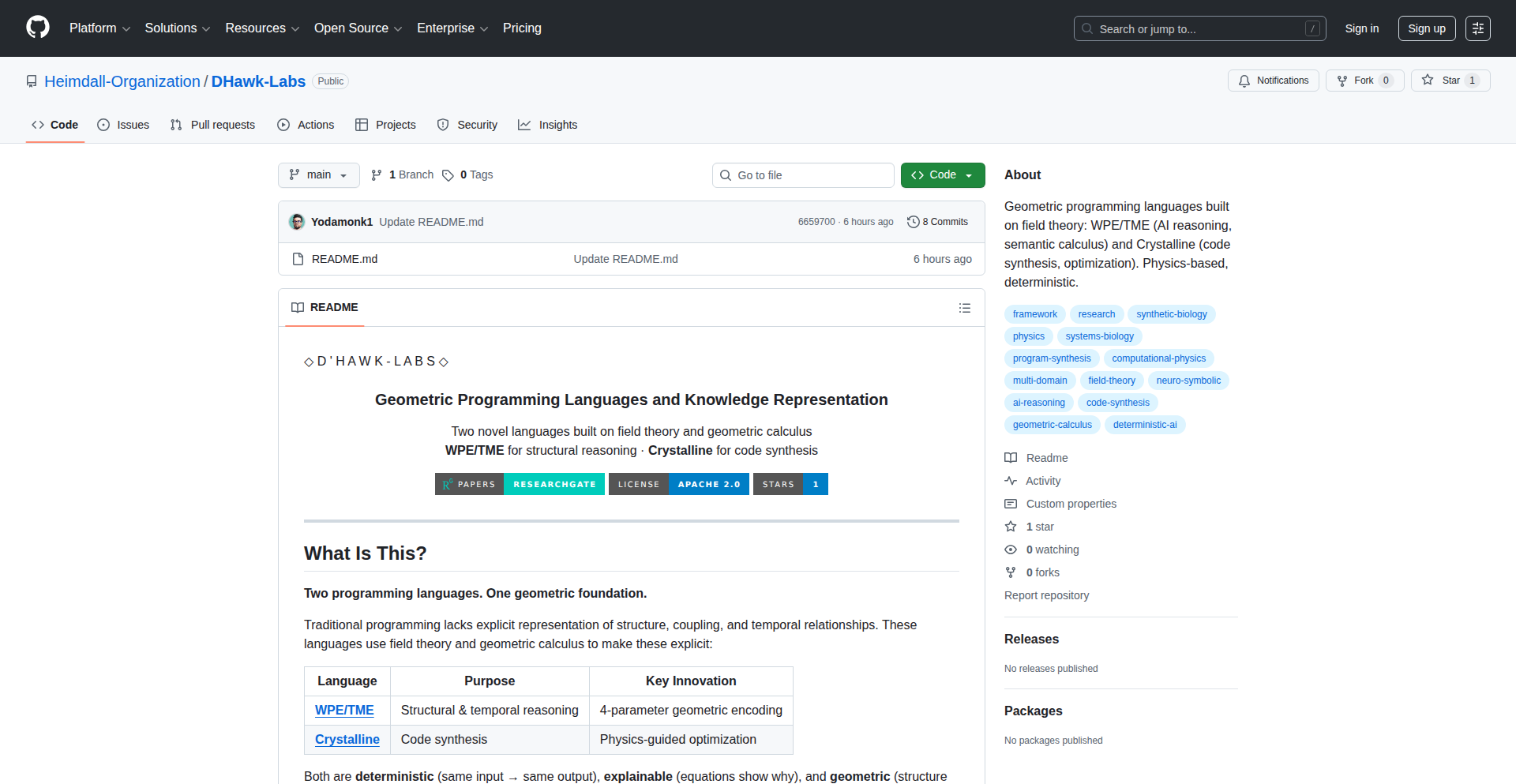
Author
yodamonk1
Description
This project introduces two innovative programming languages, WPE/TME and Crystalline, built upon the principles of field theory from superconductor research. WPE/TME is designed for geometric calculus, enabling precise representation of structural and temporal relationships, ideal for semantic reasoning and LLM scaffolding. Crystalline is a code synthesis language that leverages physics-guided evolution to generate provably optimal code, discovering novel optimizations for significant performance gains. Both languages offer deterministic, explainable, and mathematically guaranteed results.
Popularity
Points 2
Comments 0
What is this product?
This project presents two novel programming languages, WPE/TME and Crystalline, grounded in advanced physics concepts. WPE/TME uses a geometric calculus approach, where concepts like domain, shell, phase, and curvature are parameters. This allows for a rigorous and explicit definition of how different components interact, influence each other hierarchically, and change over time. Think of it as a mathematical language for describing the meaning and relationships within data or systems. Crystalline takes a different path: it's a code synthesis language that employs a physics-inspired evolutionary process. Instead of simply using predefined templates, it 'discovers' the most efficient way to write code by minimizing an 'energy' function, much like physical systems seeking their lowest energy state. This process can uncover sophisticated optimizations like asynchronous I/O, streaming, parallelization, and loop fusion, leading to substantial performance improvements. The core innovation lies in applying fundamental physics principles to software design and generation, offering deterministic outputs, clear explanations for decisions (via energy equations), and genuine discovery of optimizations.
How to use it?
Developers can integrate these languages into their workflows in distinct ways. For WPE/TME, its application is primarily in defining and reasoning about complex semantic structures. This could be used to scaffold Large Language Models (LLMs) by providing a precise, structured way to represent knowledge and relationships, making LLM outputs more reliable and predictable. For example, you could use WPE/TME to precisely define the relationships between entities in a knowledge graph that an LLM needs to process. Crystalline is designed for high-performance code generation. Developers would feed their problem specifications into Crystalline, which then generates optimized code. This is particularly useful for performance-critical applications, computationally intensive tasks, or when seeking to push the boundaries of hardware capabilities. A Python implementation is available for Crystalline, and a reference implementation exists for WPE/TME, suggesting integration into existing Python-based development environments.
Product Core Function
· Geometric Calculus for Semantic Reasoning: Explicitly encodes relationships, hierarchy, and temporal evolution of components, enabling precise and structured representation of information. This is valuable for building more robust and understandable AI systems by providing a clear framework for knowledge representation.
· Physics-Guided Code Synthesis: Automatically generates highly optimized code by discovering novel performance improvements through an energy minimization process. This allows developers to achieve significant speedups (3-4x) without manual intricate optimization efforts, making applications faster and more efficient.
· Deterministic and Explainable Outputs: Ensures that the same input always produces the same output, and the reasoning behind optimization decisions (through energy equations) is transparent. This is crucial for debugging, verification, and building trust in complex software systems.
· Provable Performance Guarantees: Offers mathematical assurances on the performance of the generated code. This provides a high degree of confidence in the efficiency and predictability of the software, which is essential for critical systems and competitive performance.
· Novel Optimization Discovery: Goes beyond standard optimization techniques to find unique and effective ways to improve code performance, such as advanced parallelization and data streaming strategies. This can unlock performance potentials that might be missed by traditional methods.
Product Usage Case
· Building more reliable and interpretable AI assistants: Using WPE/TME to structure the knowledge base an LLM interacts with, ensuring the AI understands and responds to queries with greater accuracy and less hallucination, thus providing more trustworthy AI-driven insights.
· Accelerating scientific simulations: Employing Crystalline to generate highly optimized code for complex physics simulations, reducing computation time and enabling researchers to explore more scenarios or larger datasets in fields like climate modeling or particle physics.
· Developing ultra-fast game engines or rendering pipelines: Utilizing Crystalline's ability to generate peak-performance code for graphics-intensive tasks, leading to smoother frame rates and more visually rich experiences in video games or professional visualization tools.
· Creating efficient data processing pipelines for large datasets: Applying Crystalline to optimize the code for data ingestion, transformation, and analysis in big data scenarios, making insights obtainable faster and more cost-effectively.
· Formalizing and verifying complex system designs: Using WPE/TME to create a precise, mathematical model of a system's architecture and behavior, aiding in early detection of design flaws and ensuring that the system adheres to its intended specifications.
66
LLM Newsletter Fabric

Author
hongyeon
Description
A production-ready TypeScript framework for building AI-powered newsletter pipelines. It automates the entire process, from gathering information and analyzing it with Large Language Models (LLMs) to generating engaging content and delivering it to subscribers. This tool is designed for developers who want fine-grained control over cost and quality in their AI-driven content creation.
Popularity
Points 1
Comments 0
What is this product?
LLM Newsletter Fabric is a toolkit for developers to automatically create newsletters using AI. It breaks down the complex process into manageable steps: first, it gathers information from various sources ('crawling'); then, it uses AI to understand and summarize this information ('analysis'); next, it crafts unique newsletter content based on the analysis ('generation'); and finally, it sends out the newsletter to subscribers ('delivery'). The innovation lies in its flexible architecture, allowing developers to plug in their preferred tools for each step, ensuring optimal cost-efficiency and quality control, especially for advanced AI workflows like self-reflection loops, which are hard to achieve with simple no-code solutions. So, this gives you the power to build sophisticated, automated newsletters that are tailored precisely to your needs and budget.
How to use it?
Developers can integrate LLM Newsletter Fabric into their existing projects by leveraging its TypeScript modules. You can define your data sources and choose specific tools for crawling (like web scraping libraries such as Cheerio or Puppeteer, or even other LLM-based parsers). The framework uses a dependency injection pattern, meaning you can easily swap out components like the AI analysis engine or the storage mechanism without rewriting large parts of your code. It's designed for production environments, featuring built-in error handling, retry mechanisms, and cost management features. For example, you could use it to build a daily digest of industry news, automatically summarizing key articles and sending them out to your team. This saves significant manual effort and ensures timely information delivery.
Product Core Function
· Customizable Data Ingestion: Allows developers to bring their own scraping logic using tools like Cheerio or Puppeteer, providing flexibility without framework lock-in. This is valuable for ensuring that the newsletter content is sourced from precisely where you want it, leading to more relevant and targeted newsletters.
· Modular AI Pipeline: Enables swapping of crawling, analysis, and storage components through clean interfaces, facilitating easy experimentation with different AI models and data handling strategies. This means you can adapt your newsletter's AI capabilities as new technologies emerge or as your needs evolve, ensuring your content remains cutting-edge.
· Production-Grade Reliability: Includes features like comprehensive test coverage, automatic retries, and cost controls, ensuring the newsletter generation process is robust and predictable. This translates to less downtime and fewer unexpected expenses, making your AI newsletter a reliable communication channel.
· Structured AI Outputs: Leverages tools like Vercel AI SDK to ensure that the AI-generated content is in a predictable and usable format, simplifying downstream processing and integration. This guarantees that the AI-generated text can be easily formatted and used in your newsletter layout, saving you formatting headaches.
· Cost Optimization: Designed with cost control in mind, allowing granular management of context windows and token limits, crucial for keeping AI operational expenses low. This is important because using AI can become expensive; this feature helps you manage those costs effectively, making AI newsletters financially viable.
· Observability: Built-in features for monitoring the pipeline's performance and health, enabling quick identification and resolution of issues. This helps you understand how your AI newsletter system is performing and allows you to fix any problems before they impact your subscribers.
Product Usage Case
· Automating a daily research digest for cultural heritage enthusiasts: The creator used this kit to build a newsletter that crawls academic papers and news, analyzes them with AI, and generates summaries with a high click-through rate at a low cost. This demonstrates how to apply the kit to a niche interest area, providing curated and valuable content efficiently.
· Building a personalized news aggregator for a specific industry: A developer could use this to monitor industry news websites, analyze trends, and then generate a weekly summary tailored to specific roles within that industry. This showcases its utility for enterprise internal communications or specialized industry publications.
· Creating a tool to track and summarize open-source project updates: Developers could feed GitHub repositories into the pipeline, and the AI could generate a newsletter highlighting new features, bug fixes, and community discussions. This highlights its potential for developer communities and project maintainers to stay informed.
· Developing an automated content curation service for bloggers: This kit could power a service that finds relevant articles, summarizes them, and helps bloggers create weekly digest newsletters for their audience, saving them time and effort in content discovery and creation.
67
Tacopy: Python Tail Call Optimization Engine
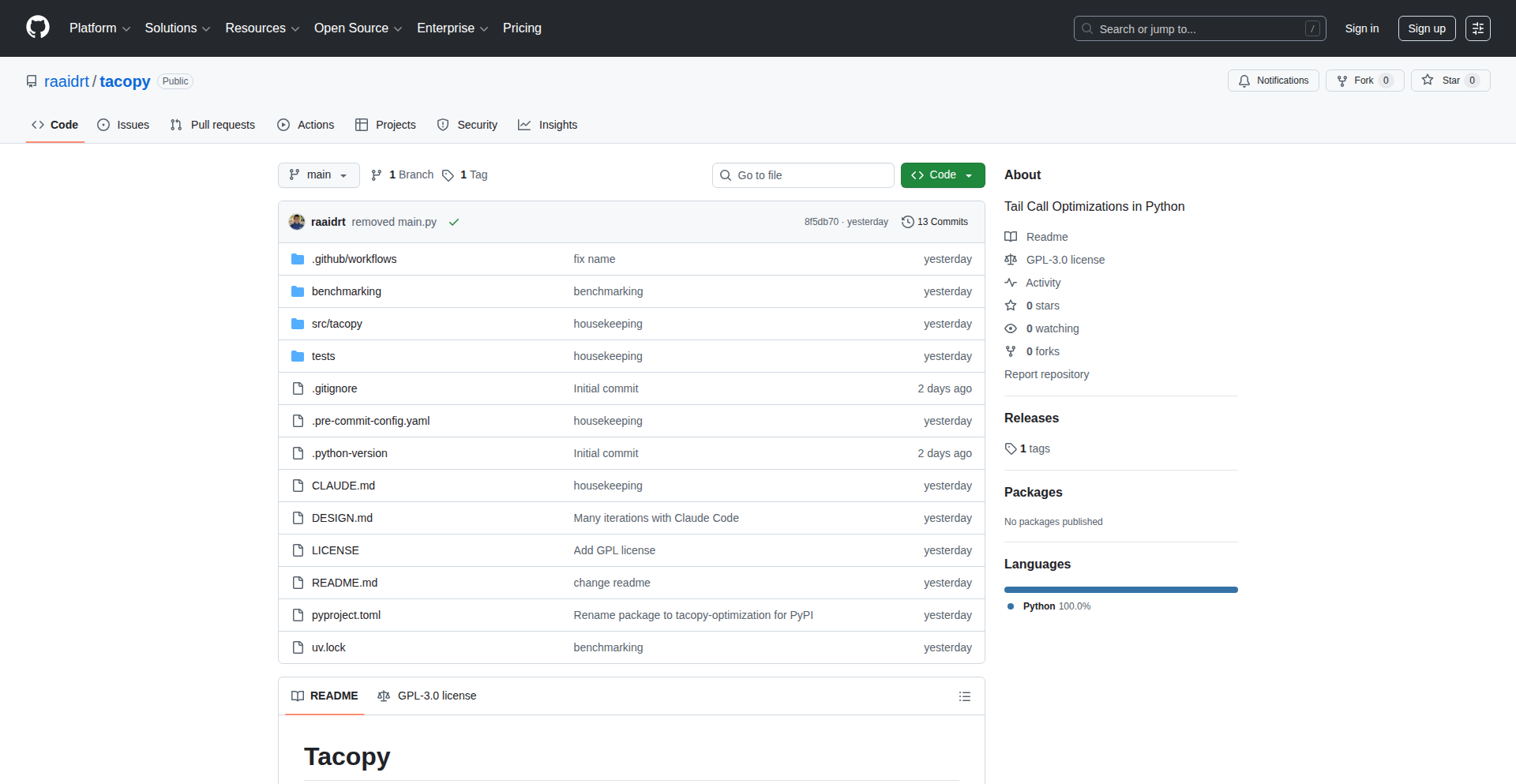
Author
raaid-rt
Description
Tacopy is a Python project that brings Tail Call Optimization (TCO) to Python, a feature usually missing in dynamic languages. It allows for more efficient recursive function calls, preventing stack overflow errors and enabling the implementation of more complex recursive algorithms. The core innovation lies in how it translates recursive calls into iterative loops at runtime, effectively managing the call stack.
Popularity
Points 1
Comments 0
What is this product?
Tacopy is a Python library that implements Tail Call Optimization (TCO). Normally, when a function calls itself (recursion), each call adds a new frame to the program's call stack. If the recursion goes too deep, this stack can overflow, crashing the program. TCO, as implemented in Tacopy, transforms certain types of recursive calls, known as tail calls, into iterative operations. Instead of adding a new stack frame, it reuses the current one. This is achieved by analyzing the function's structure at runtime and converting the recursive tail call into a loop. This is a significant technical feat for Python, which doesn't natively support TCO, and it unlocks the potential for cleaner and more performant recursive code. So, for you, it means you can write recursive Python code without fear of crashing due to stack overflows for deeply recursive functions.
How to use it?
Developers can integrate Tacopy into their Python projects by importing the library and decorating their recursive functions with the `@tacopy.optimize` decorator. The decorator automatically analyzes the decorated function for tail calls. If a tail call is detected, Tacopy rewrites the execution flow to be iterative, thus preventing stack overflows. This is a straightforward, non-intrusive way to enhance existing recursive Python code. You'd use it by adding a single line of code above your recursive function definition. So, for you, it means you can quickly apply this optimization to your recursive functions with minimal code changes, making your code more robust and efficient.
Product Core Function
· Tail Call Detection and Transformation: Identifies tail calls within Python functions and transforms them into iterative control flow. This directly addresses the stack overflow limitation in deep recursion, making it valuable for algorithms like tree traversals or functional programming patterns.
· Runtime Optimization: Applies optimization at runtime without requiring significant changes to the Python interpreter itself. This is a novel approach for a dynamic language like Python, offering a practical solution without a full language rewrite. This means you can use it with standard Python installations.
· Decorator-based Integration: Provides an easy-to-use decorator (`@tacopy.optimize`) for applying TCO to specific functions. This simplifies the adoption process for developers, allowing them to selectively optimize critical recursive parts of their codebase. This is valuable for you as it makes implementing advanced recursive patterns much simpler and less error-prone.
Product Usage Case
· Implementing deep recursive algorithms in Python, such as complex data structure traversals (e.g., large binary trees) or functional programming constructs like recursive list processing, that would otherwise lead to stack overflows. Tacopy enables these algorithms to run efficiently and without crashing. This is useful for you when dealing with large datasets or complex computations where recursion is a natural fit but stack limits are a concern.
· Refactoring existing recursive Python codebases to improve performance and prevent crashes. Developers can apply the `@tacopy.optimize` decorator to functions that are known to cause stack issues, thereby improving the stability and efficiency of their applications without a complete rewrite. This is beneficial for you when you need to quickly fix bugs related to recursion depth in production code.
· Exploring functional programming paradigms in Python. By enabling TCO, Tacopy makes it more feasible and practical to write recursive functions in a more declarative and elegant style, akin to languages that natively support TCO. This is valuable for you if you want to leverage the benefits of functional programming concepts in your Python projects.
68
HMPL: Semantic Versioning Enhancer

Author
aanthonymax
Description
HMPL is a command-line tool that intelligently manages and updates semantic versioning for your projects. It goes beyond simple incrementing by analyzing code changes and Git history to suggest the most appropriate version bump (major, minor, or patch), reducing the risk of introducing breaking changes. This addresses the common pain point of developers struggling to maintain accurate versioning, especially in collaborative environments, by leveraging code semantics.
Popularity
Points 1
Comments 0
What is this product?
HMPL is a smart tool that helps you manage software versions. Think of software versions like '1.2.3'. HMPL understands the meaning behind these numbers: '1' is a big, potentially breaking change, '2' is a new feature that doesn't break old stuff, and '3' is a small fix. HMPL analyzes your code changes and how you've used version control (like Git) to suggest the right number to increase. This means you're less likely to accidentally release something that breaks other people's code. It uses a combination of static code analysis and Git commit message parsing to infer semantic meaning, offering a more robust approach than manual versioning or simple increment scripts.
How to use it?
Developers can integrate HMPL into their workflow by installing it as a command-line tool. After installation, you can run HMPL in your project's root directory. It can be used before committing code to preview potential version bumps, or as part of a CI/CD pipeline to automate version updates. For example, you might run `hmpl suggest` to see the recommended version bump, or `hmpl bump --type minor` to manually set a minor version update based on its analysis. It often works by analyzing diffs between branches or against a baseline version tag.
Product Core Function
· Semantic Version Analysis: HMPL analyzes code changes and commit history to understand the impact of your updates. It identifies if a change introduces new features, bug fixes, or breaking changes, automatically suggesting the correct version increment (e.g., major, minor, patch). This is valuable because it ensures your version numbers accurately reflect the nature of your software updates, making it easier for others to understand compatibility.
· Git Integration: The tool integrates seamlessly with Git, reading commit messages and diffs to inform its versioning suggestions. This allows HMPL to leverage the rich context provided by your version control system, leading to more accurate and context-aware version management.
· Automated Version Bumping: HMPL can automate the process of updating your project's version file (e.g., package.json, VERSION file). This saves developers time and reduces the manual effort involved in version control, allowing them to focus more on development.
· Breaking Change Detection: A key benefit is its ability to flag potential breaking changes before they are released. By understanding the semantic implications of code modifications, HMPL helps prevent unintended regressions and improves the overall stability of your software ecosystem.
Product Usage Case
· Collaborative Development: In a team environment, HMPL helps maintain consistent and accurate versioning across multiple developers' contributions. When merging code, HMPL can analyze the combined changes to suggest a consolidated version bump, preventing conflicts and ensuring that the project's version accurately reflects its current state.
· API Development: For developers building APIs, precise versioning is crucial. HMPL can help ensure that new API versions clearly indicate whether they are backward-compatible or introduce breaking changes, allowing consumers of the API to update with confidence.
· Library Maintenance: When maintaining open-source libraries, developers need to communicate clearly about the impact of updates. HMPL assists in generating version numbers that accurately convey whether a new release introduces new features or requires users to adapt their code.
· CI/CD Pipeline Integration: HMPL can be integrated into continuous integration and continuous deployment pipelines to automatically tag releases with the correct semantic version. This automates a critical part of the release process, reducing human error and accelerating deployment cycles.
69
AIDictation: Swiftly Transcribe & Command AI

Author
vood
Description
AIDictation is a voice-to-text application built with Swift that leverages a cloud-based pipeline featuring Whisper V3 Turbo and OpenAI GPT OSS 120B for highly accurate transcriptions. Its innovation lies in its flexible cloud architecture, allowing for dynamic model switching and fine-tuned context rules, and a seamless 'share to AI chat' feature that empowers users to directly interact with AI models like ChatGPT and Claude. It solves the problem of efficiently converting spoken words into structured text tailored for specific AI interactions, offering a practical solution for content creators, developers, and anyone looking to streamline their workflow with AI.
Popularity
Points 1
Comments 0
What is this product?
AIDictation is a sophisticated voice-to-text (dictation) application. It works by capturing your audio on your device and sending it to a powerful cloud-based backend. This backend employs cutting-edge AI models: Whisper V3 Turbo for initial speech-to-text conversion and then OpenAI GPT OSS 120B to further refine and structure the text. The innovation here is the cloud-centric approach. Instead of relying on models that run directly on your phone (which can be limited and harder to update), AIDictation uses a flexible cloud setup. This means the developer can easily swap out different AI models or providers (like using Groq API for speed) and tune the transcription process without needing to release a new app version. A key feature is its 'context rules' system. This allows users to define how the transcription should adapt based on the situation – for example, keeping speaker names and timestamps for meetings, preserving technical jargon for coding, or making text more conversational for journaling. This intelligent customization makes the output much more useful for specific AI tasks. The value for you is getting highly accurate, contextually relevant text from your voice, ready to be used by other AI tools, with minimal effort.
How to use it?
As a developer, you can use AIDictation in several ways. The most straightforward is as an end-user application for your own productivity. Simply record your voice, and AIDictation will process it. The transcribed text can then be easily shared with other AI chat applications like ChatGPT or Claude with a single tap. Technically, if you're interested in integrating voice input into your own applications, you can look at AIDictation's architecture for inspiration. It demonstrates a robust client-server model for handling audio and leveraging powerful cloud AI services. For instance, you could imagine using AIDictation's output to:
1. Feed user feedback directly into a customer support AI.
2. Dictate notes into a project management tool.
3. Generate initial drafts for blog posts or reports.
4. Provide voice commands for your custom AI assistants.
The Swift client app handles audio recording and sending, while the Node.js backend manages the Whisper and GPT processing. This separation allows for scalability and easy updates to the AI pipeline. The free tier offers around 2,000 words per month without requiring registration, making it accessible for initial testing and personal use.
Product Core Function
· High-accuracy audio transcription leveraging Whisper V3 Turbo and OpenAI GPT OSS 120B: This provides a precise conversion of spoken words to text, ensuring that your meaning is captured accurately, which is crucial for any subsequent AI processing or data analysis.
· Cloud-based, flexible AI pipeline: This allows for better performance, easier updates, and the ability to switch between different AI models and providers (e.g., Groq API for speed). This means you benefit from the latest advancements and optimized performance without needing app updates.
· Configurable context rules for tailored transcriptions: This feature customizes the transcription output based on your specific needs (e.g., meetings, coding, journaling). This ensures the text is formatted and contains the relevant information for the intended purpose, saving you editing time.
· One-tap 'share to AI chat' functionality: This seamlessly integrates the transcribed text with popular AI chatbots like ChatGPT and Claude. This allows you to immediately act on your transcribed audio by using it as input for further AI-driven tasks or conversations.
· Zero data retention and no registration required for free tier: This ensures your privacy and provides immediate access to the service for up to 2,000 words per month. This makes it easy and safe to try out the service and use it for sensitive dictation tasks.
Product Usage Case
· A content creator can record a podcast segment and instantly have a transcribed script ready for editing and posting, with speaker names and timestamps preserved for easier review, directly from their phone.
· A developer can dictate code snippets or technical notes, and AIDictation will intelligently preserve programming keywords and formatting, making it easy to paste into an IDE or documentation, solving the problem of inaccurate transcription of technical terms.
· A student attending a lecture can record the session and receive a detailed transcription with speaker identification, which can then be fed into a study AI to summarize key points, improving learning efficiency.
· A remote worker can record meeting notes and have them automatically formatted with participant names and timestamps, then directly send the summary to their project management tool's AI for task creation, streamlining project workflows.
· Anyone can use it for personal journaling by voice, where the AI makes the text more readable and forgiving of minor speech errors, making the process of capturing thoughts more fluid and less tedious.
70
YOLO11-JavaCV-ObjectDetector
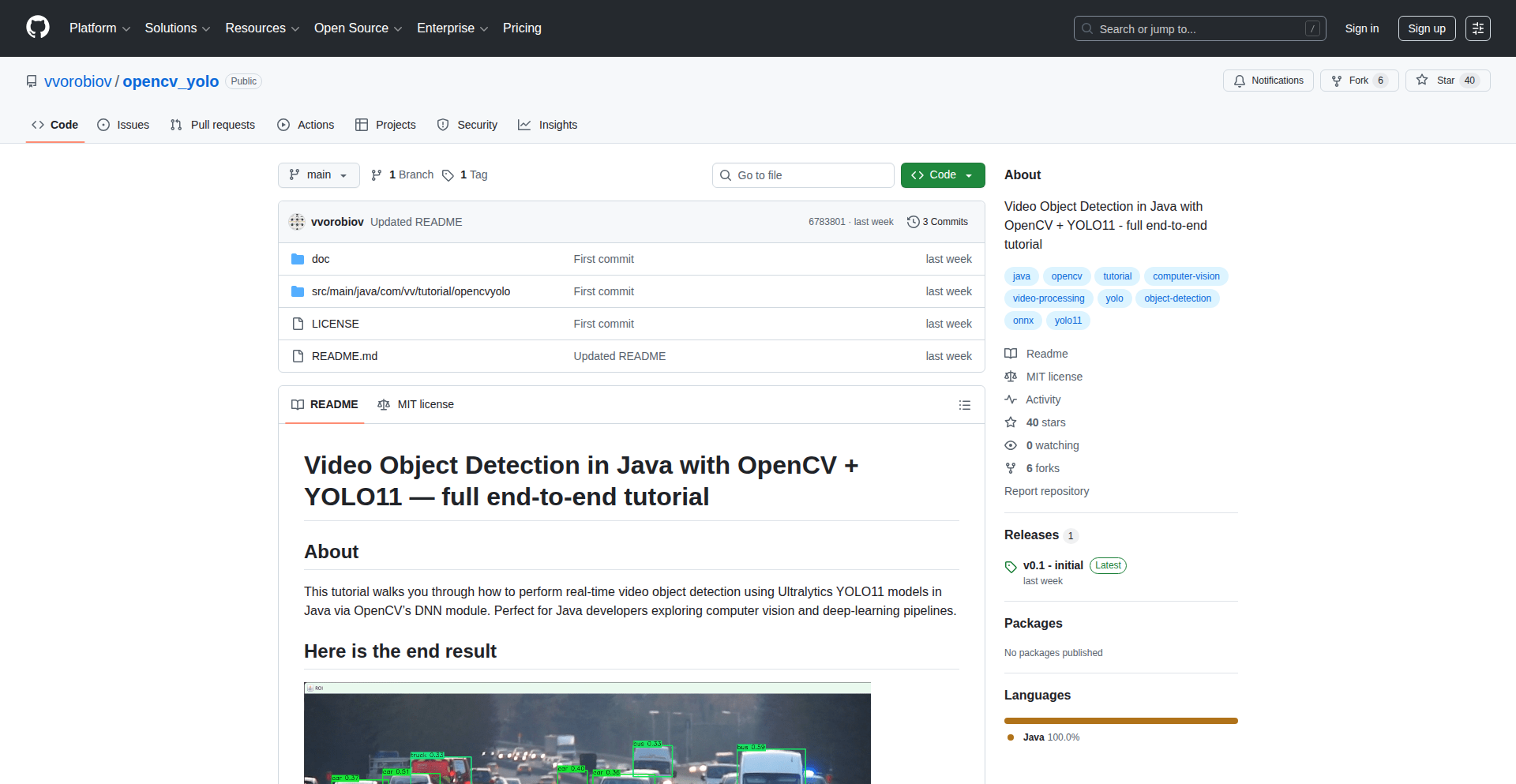
Author
ffly3r
Description
This project demonstrates a full end-to-end object detection pipeline using YOLOv11 and OpenCV within a Java environment. It addresses the challenge of integrating advanced deep learning models for real-time object recognition into Java applications, offering a practical blueprint for developers looking to add computer vision capabilities. The innovation lies in providing a complete, runnable tutorial that bridges the gap between cutting-edge object detection research and readily usable Java code.
Popularity
Points 1
Comments 0
What is this product?
This project is a comprehensive tutorial that guides developers through setting up and running YOLOv11, a powerful object detection model, directly within a Java application using JavaCV (a Java wrapper for OpenCV and other computer vision libraries). The core technical insight is how to effectively load and infer with a pre-trained YOLOv11 model within the Java Virtual Machine, leveraging the extensive image processing capabilities of OpenCV. This bypasses the need for separate Python environments or complex API integrations for many common object detection tasks. Its innovation is making state-of-the-art object detection accessible and practical for Java developers without deep machine learning framework expertise.
How to use it?
Developers can use this project by following the provided tutorial to clone the repository, set up their Java development environment, and download the necessary pre-trained YOLOv11 weights and configuration files. The project offers runnable Java code that demonstrates how to: 1. Load an image or video stream. 2. Preprocess the input for the YOLOv11 model. 3. Perform inference to detect objects. 4. Draw bounding boxes and class labels on the original image/video. This can be integrated into existing Java applications for tasks like image analysis, surveillance systems, or robotics.
Product Core Function
· YOLOv11 model integration: Enables loading and running a state-of-the-art object detection model directly within Java, allowing for accurate identification and localization of multiple objects in images or video. This is valuable for applications needing to understand visual content.
· OpenCV image processing: Leverages OpenCV for essential pre-processing steps like image resizing, normalization, and drawing bounding boxes. This ensures compatibility with the YOLOv11 model and provides a visual output of detected objects, useful for visualization and debugging.
· End-to-end tutorial: Provides a complete, step-by-step guide from setup to execution, making it easy for developers to replicate the object detection functionality. This significantly reduces the barrier to entry for implementing computer vision in Java projects.
· JavaCV wrapper utilization: Acts as a bridge between powerful C++ computer vision libraries (like OpenCV) and the Java ecosystem, simplifying complex native library calls. This allows Java developers to harness the power of these libraries without writing C++ code.
Product Usage Case
· Real-time object tracking in surveillance systems: A Java-based security system could use this to detect and track people or vehicles in live camera feeds, alerting operators to suspicious activity. This solves the problem of analyzing video streams for specific objects without relying on external services.
· Image analysis for e-commerce product tagging: An e-commerce platform could integrate this into its backend to automatically identify and tag products in user-uploaded images, improving searchability and product categorization. This provides an automated way to enrich product data.
· Robotics and autonomous systems: A Java-programmed robot could use this to 'see' and identify objects in its environment, enabling it to navigate, pick up items, or avoid obstacles. This allows robots to interact with the physical world more intelligently.
· Content moderation for user-generated media: A social media platform could implement this to automatically scan uploaded images for prohibited objects or content, helping to maintain community standards. This offers an automated solution for content safety.
71
TweetToVideo Forge

Author
bosschow
Description
TweetToVideo Forge is an automated content repurposing tool that instantly transforms a Tweet into a shareable vertical short video. It addresses the pain point of time-consuming video editing by leveraging AI to generate engaging video content with auto-generated subtitles and stylistic options, effectively amplifying content reach with zero manual effort.
Popularity
Points 1
Comments 0
What is this product?
TweetToVideo Forge is a cutting-edge tool that uses AI to take any Tweet you provide and automatically create a short, vertical video optimized for platforms like TikTok and Instagram Reels. The innovation lies in its ability to understand the essence of a Tweet and visually represent it, adding auto-generated subtitles and offering different visual styles. This bypasses the need for complex video editing software and skills, making content creation accessible to everyone. Think of it as a smart assistant that turns your thoughts on Twitter into ready-to-share video stories.
How to use it?
Developers can use TweetToVideo Forge by simply pasting the URL of any Tweet they want to convert into a video. The system then processes the Tweet's text and content, and in moments, provides a downloadable vertical video file. This can be directly uploaded to social media platforms. For integration, one could imagine using its API (if available) within content management systems or social media scheduling tools to streamline the workflow of social media managers or content creators. The primary use case is to quickly and effortlessly generate short-form video content from existing text-based posts.
Product Core Function
· Tweet to Video Conversion: Automatically transforms a Tweet's text and linked media into a vertical video format, allowing users to quickly leverage existing content for new platforms. This saves significant time and resources compared to manual video creation.
· Auto Subtitle Generation: Creates subtitles directly from the Tweet's text, improving video accessibility and engagement for viewers who watch with sound off. This ensures the message is conveyed effectively regardless of viewing environment.
· Style Options: Offers multiple visual styles for the generated videos, providing creative flexibility and allowing users to match content to their brand aesthetic. This adds a layer of personalization and professional polish without requiring design expertise.
· Content Repurposing Automation: Streamlines the process of reusing high-performing content across different platforms, maximizing the impact of valuable Tweets. This leads to increased visibility and audience engagement with minimal additional effort.
Product Usage Case
· Social Media Marketers: A marketer wants to promote a successful Tweet about a new product launch on TikTok. By using TweetToVideo Forge, they can instantly turn that Tweet into an eye-catching video with subtitles, reaching a wider audience on a platform that favors video content. This solves the problem of needing to manually create and edit a video from scratch, saving hours of work.
· Content Creators: A blogger who frequently shares insightful threads on Twitter can use TweetToVideo Forge to quickly create short videos summarizing key points from those threads for Instagram Reels. This allows them to repurpose their valuable written content into a more engaging video format, driving more traffic back to their blog. The 'zero editing time' aspect is crucial for creators with demanding content schedules.
· Individuals Building a Personal Brand: Someone active on Twitter and looking to build their presence on video-first platforms like TikTok can use TweetToVideo Forge to easily share their thoughts and expertise in a visually appealing video format. This democratizes video creation, enabling individuals without video editing experience to participate in the short-form video trend effectively.
72
MetaManifest Forge
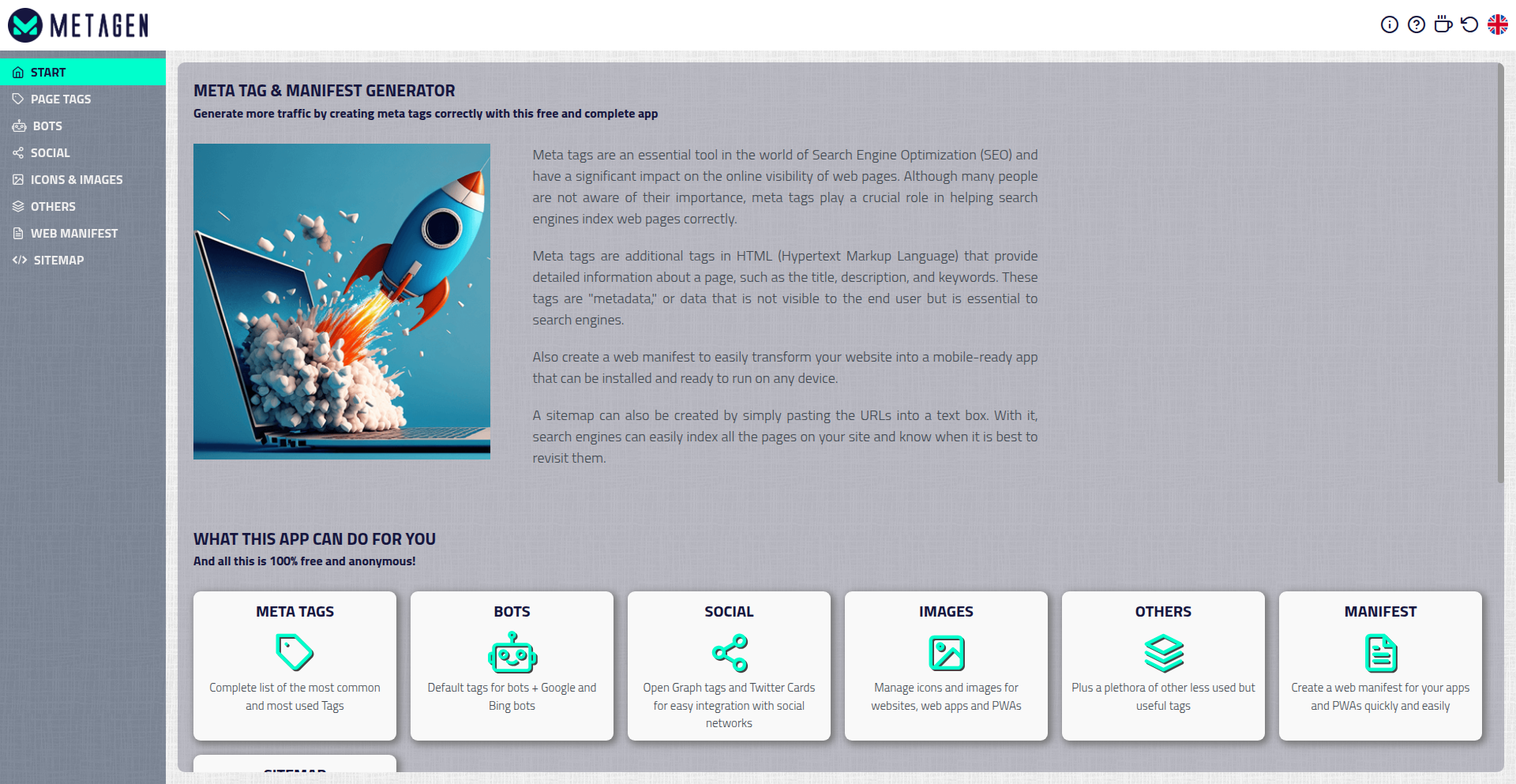
Author
wstaeblein
Description
A free, web-based generator for essential SEO and PWA meta tags, sitemaps, and web manifests. It tackles the common developer pain point of manually creating these configuration files, which are crucial for search engine visibility and progressive web app functionality. The innovation lies in its accessibility and ease of use, abstracting away the complexity of these technical specifications.
Popularity
Points 1
Comments 0
What is this product?
This project is a web application that automatically generates key metadata files for websites. These files include: meta tags (like descriptions and keywords) for search engine optimization (SEO), sitemaps (XML files that help search engines discover and index your web pages), and web manifests (JSON files that enable progressive web app features like home screen icons and offline capabilities). The core technical innovation is in simplifying the process by providing a user-friendly interface that translates developer input into the correct, structured output for these technical documents, saving significant manual effort and potential errors.
How to use it?
Developers can use this tool by visiting the provided web URL. They will be guided through input fields where they can specify details about their website, such as the site title, description, keywords, and favicon URL. Based on this input, the generator will produce the necessary meta tags, a sitemap.xml file, and a manifest.json file. These generated files can then be downloaded and integrated into their website's project. For instance, the meta tags would be placed within the <head> section of an HTML page, the sitemap.xml would be placed in the root directory of the web server, and the manifest.json would also be placed in the root directory, with a link to it in the HTML's <head>.
Product Core Function
· Meta Tag Generation: Creates essential HTML meta tags (like description, keywords, author) that improve search engine understanding of your content, thereby enhancing your website's discoverability. The value is in automating this SEO fundamental.
· Sitemap XML Generation: Produces a sitemap.xml file that guides search engine crawlers on how to best index your website's pages, leading to better search rankings. The value is in simplifying a critical SEO task.
· Web Manifest Generation: Generates a manifest.json file enabling progressive web app (PWA) functionalities, such as adding your site to a mobile device's home screen and enabling offline access. The value is in making PWA adoption more accessible.
· User-Friendly Interface: Provides an intuitive web interface to input site details, abstracting away the complex syntax of these technical files. The value is in reducing the learning curve and development time for these crucial assets.
· Free and Accessible: Offers these generation capabilities without cost, making essential web development tools available to a wider range of developers. The value is in democratizing access to important web technologies.
Product Usage Case
· A freelance web developer building a new e-commerce site needs to ensure it's easily discoverable on Google. They use MetaManifest Forge to quickly generate accurate meta descriptions and a sitemap.xml, which they then integrate into their site's backend. This saves them hours of manual configuration and ensures better SEO from launch.
· A startup is developing a mobile-first web application and wants to offer a PWA experience. They use MetaManifest Forge to create the necessary manifest.json file with app icons and display settings. This allows their users to 'install' the web app to their home screen, improving user engagement and retention without needing to build a native app.
· A content creator managing a personal blog wants to improve its visibility on search engines. They use MetaManifest Forge to generate a sitemap and relevant meta tags for their blog posts. By submitting the sitemap to search consoles and ensuring meta tags are present, their content is more likely to be found by readers searching online, increasing traffic to their blog.
73
OgBlocks: Animated UI Components for React Developers

Author
thekarank
Description
OgBlocks is a React UI library that simplifies the creation of beautiful, animated user interfaces. It addresses the common developer pain point of tedious and time-consuming CSS styling by providing pre-built, production-ready components with integrated animations. This allows developers, regardless of their CSS expertise, to easily add premium-looking elements and animations to their web applications, significantly speeding up the UI development process and enhancing user experience.
Popularity
Points 1
Comments 0
What is this product?
OgBlocks is a collection of pre-designed and animated UI components specifically for React applications. The core innovation lies in abstracting away complex CSS and animation logic. Instead of writing intricate CSS to achieve smooth transitions and visually appealing elements, developers can simply copy and paste these pre-built components into their React codebase. The library leverages modern frontend techniques to ensure these animations are performant and responsive, making it accessible for developers who may not have extensive CSS design skills but still want their projects to have a polished, professional, and engaging look. So, what does this mean for you? It means you can build stunning user interfaces faster and with less effort, resulting in a better-looking and more interactive application for your users.
How to use it?
Developers can integrate OgBlocks into their React projects by installing it via npm or yarn. Once installed, they can import individual components (like animated navbars, modals, buttons, or carousels) directly into their React components and use them like any other React component. The library is designed for easy customization through standard React props. For example, to use an animated button, a developer would import `AnimatedButton` and pass relevant props to control its behavior and appearance. This approach allows for rapid prototyping and development, enabling quick iteration on UI designs. So, how does this benefit you? You can quickly add eye-catching animations and sophisticated UI elements to your existing or new React projects without diving deep into animation libraries or CSS frameworks.
Product Core Function
· Animated Navigation Bars: Provides pre-built navigation components with smooth transitions and interactive effects, making website navigation more engaging and modern. This is valuable for improving user guidance and brand presentation.
· Interactive Modals: Offers dynamic modal windows with various entrance and exit animations, enhancing user feedback and form interactions without complex JavaScript or CSS. This improves the user experience for crucial dialogues and confirmations.
· Animated Buttons: Includes buttons with subtle hover effects, click animations, and state changes, adding a layer of visual feedback and polish to user interactions. This makes interactive elements more intuitive and satisfying to use.
· Feature Section Components: Delivers visually rich sections for showcasing product features or benefits, often with scroll-triggered animations and dynamic content loading. This helps in effectively communicating value propositions and engaging visitors.
· Text Animations: Offers diverse text animation effects, such as typing effects, fade-ins, and kinetic typography, to make content more dynamic and captivating. This can significantly boost content engagement and memorability.
· Carousels and Sliders: Provides responsive and animated carousels for displaying images, testimonials, or other content, with smooth transitions and touch support. This is essential for showcasing galleries or dynamic content collections efficiently.
Product Usage Case
· A startup building a new SaaS product needs to quickly create a compelling landing page with animated feature highlights and a sleek signup form. Using OgBlocks, the developer can integrate pre-built animated sections and buttons to create a professional and engaging presentation without spending days on custom CSS animations, thus accelerating their go-to-market strategy.
· A freelance developer is tasked with updating the UI for an e-commerce website to make it more modern and interactive. They can use OgBlocks' animated modals for product quick views and animated carousels for product galleries, significantly improving the user experience and perceived quality of the site with minimal additional coding effort.
· A frontend team is developing a complex dashboard application where user interaction and visual feedback are critical. By employing OgBlocks' animated components, they can ensure that interactive elements like tooltips and form feedback animations are consistent, polished, and performant across the application, leading to a more intuitive and enjoyable user experience for their power users.
74
RewardHarvest

Author
hg30
Description
A free and open-source platform designed to automate micro-investing by leveraging credit card rewards and other consistent small-sum investment strategies. It aims to make investing more accessible and educational by turning everyday financial activities into opportunities for wealth accumulation.
Popularity
Points 1
Comments 0
What is this product?
RewardHarvest is a novel investment platform that democratizes investing through micro-investing. Its core innovation lies in its ability to automatically invest small, consistent amounts, often derived from everyday financial actions. For example, it can 'round up' your purchases to the nearest dollar and invest the difference, or directly invest the rewards earned from your credit card spending. It also supports scheduled investments, allowing users to invest a fixed amount at regular intervals. This approach makes investing less intimidating and more habitual, transforming passive financial gains into active wealth building.
How to use it?
Developers can integrate RewardHarvest into their personal finance workflows or build custom investment tools on top of its open-source foundation. It's designed for easy setup, allowing users to define their preferred investment strategies. For instance, a user could link their credit card activity to automatically invest their cashback rewards. Alternatively, they could set up a weekly investment of a small sum, like $10, directly from their bank account. The platform's open-source nature encourages customization, enabling developers to extend its functionality or connect it to other financial services.
Product Core Function
· Credit Card Rewards Investment: Automatically invests the cashback or points earned from credit card transactions, turning passive rewards into active investments. This provides a direct financial benefit by capitalizing on existing spending habits.
· Round-Up Investing: Invests the spare change from daily purchases by rounding up transactions to the nearest whole dollar. This makes investing effortless and integrates it seamlessly into everyday life, allowing users to invest without noticing.
· Timed Investment Automation: Enables users to schedule regular, small investments (e.g., weekly or monthly) with a predetermined amount. This fosters a consistent investment habit, which is a key principle for long-term wealth growth.
· Strategy Customization: Allows users to choose and configure different micro-investing strategies tailored to their financial behavior and goals. This empowers users to personalize their investment journey and align it with their unique circumstances.
· Open-Source Platform: Provides full access to the source code, enabling developers to audit, customize, and extend the platform's capabilities. This fosters transparency, security, and community-driven innovation.
Product Usage Case
· Scenario: A user wants to start investing but finds lump sums daunting. How it solves the problem: RewardHarvest can be configured to 'round up' every purchase. If a user buys a coffee for $3.50, RewardHarvest invests $0.50. This makes investing feel like pocket change, not a burden.
· Scenario: A user frequently uses a credit card with a 2% cashback reward. How it solves the problem: RewardHarvest can be set up to automatically invest that 2% cashback directly. If the user spends $500 in a month, they earn $10 cashback, which RewardHarvest then invests, compounding their returns without manual effort.
· Scenario: A user wants to build an investment habit but struggles with consistency. How it solves the problem: RewardHarvest allows setting up a weekly $10 investment. This consistent, small commitment helps build discipline and a portfolio over time, leveraging the power of dollar-cost averaging.
· Scenario: A developer wants to build a personalized finance app that integrates micro-investing. How it solves the problem: The open-source nature of RewardHarvest allows the developer to fork the project and integrate its core micro-investing logic into their own application, saving significant development time and effort.
75
Pinakes: Self-Hosted Book Catalog & Management

Author
fabiodalez
Description
Pinakes is an open-source, self-hosted library management system designed to help individuals or small organizations catalog and manage their book collections. It streamlines the process of adding books through automatic metadata scraping from various online sources, offers robust circulation features like lending and overdue reminders, and provides a public-facing catalog for patrons. This project embodies the hacker spirit by providing a powerful, customizable tool for managing information, built with readily available technologies.
Popularity
Points 1
Comments 0
What is this product?
Pinakes is a software system that you can install on your own web server (any PHP/MySQL compatible host) to create and manage your personal or institutional library. Its core innovation lies in its automated metadata retrieval. When you input an ISBN, it intelligently fetches book details like title, author, cover image, and description from major online book databases (Open Library, Google Books, etc.). This eliminates the tedious manual data entry typically associated with cataloging. Beyond just storage, it offers full library circulation management, allowing you to track loans, returns, and reservations, complete with automated email notifications to prevent books from being overdue. It also supports features like multi-copy tracking with barcodes and even provides built-in streaming for digital books.
How to use it?
Developers can use Pinakes by cloning the project repository and setting up a local development environment. The project recommends using PHP 8.1+ and MySQL 5.7+. To get started locally, you can clone the repo, navigate to the project directory in your terminal, and run the command `php -S localhost:8000 router.php`. Then, simply open your web browser to `http://localhost:8000` to access the installer and begin setting up your library. For a live deployment, you would upload these files to your web hosting and configure your MySQL database.
Product Core Function
· Automated ISBN Scraping: Quickly adds books by automatically fetching metadata from Open Library, Google Books, and other catalogs. This saves significant time compared to manual entry, making cataloging efficient.
· Full Circulation Management: Tracks book loans, returns, and renewals, with features like reservation queues and automated email reminders for due dates. This ensures that borrowed items are managed effectively and reduces instances of lost or overdue books.
· Multi-Copy Support with Barcodes: Allows tracking of multiple copies of the same book using barcodes. This is crucial for larger collections or lending scenarios where precise tracking of each physical copy is necessary.
· Public Catalog with Patron Self-Service: Provides a searchable online catalog accessible to others, allowing patrons to view available books, renew loans, place reservations, and manage wishlists. This enhances accessibility and user engagement for a library.
· Interactive Calendar with ICS Export: Generates an interactive calendar of loan due dates and offers ICS export for syncing with popular calendar applications like Google Calendar and Outlook. This helps users stay organized and remember upcoming returns.
· CMS Features: Includes a homepage editor, customizable themes, and the ability to create custom pages. This allows for personalization and branding of the library's online presence.
· eBook/Audiobook Streaming: Supports digital formats by offering a built-in streaming player. This expands the library's offerings beyond physical media.
· SRU Protocol for Interoperability: Implements the SRU protocol, enabling seamless integration and data exchange with other library systems. This promotes collaboration and data sharing within the broader library ecosystem.
· Plugin Architecture: Designed with a plugin system for custom integrations. This allows developers to extend the functionality of Pinakes to meet specific or unique needs.
Product Usage Case
· Personal Book Collection Management: A book enthusiast can use Pinakes to catalog their extensive personal library, automatically filling in details and making it easy to find any book. This solves the problem of scattered book data and makes discovering reading history simple.
· Small Community Library Setup: A small community or club can deploy Pinakes on a shared hosting account to manage borrowed books, track membership, and allow members to browse available titles online. This provides a functional and affordable library system without needing expensive proprietary software.
· Educational Institution's Resource Catalog: A school or a small department could use Pinakes to manage textbooks or supplementary reading materials, ensuring efficient lending and returns for students. This helps in keeping track of valuable educational resources.
· Digital Media Library with Streaming: An individual or group with a collection of eBooks and audiobooks can use Pinakes to organize and stream these directly from the system. This offers a convenient way to access and enjoy digital content.
· Developer wanting to contribute to library science software: A developer interested in library systems can clone Pinakes, experiment with its code, and contribute new features or improvements, fostering a collaborative development environment.
76
ChatSurvey AI

Author
heshiebee
Description
A conversational survey tool that uses AI to interact with users naturally, making surveys more engaging and data collection more efficient. It overcomes the limitations of traditional static surveys by employing natural language processing to create dynamic, question-answering dialogues.
Popularity
Points 1
Comments 0
What is this product?
ChatSurvey AI is an innovative tool that transforms traditional surveys into interactive conversations. Instead of a list of questions, users chat with an AI that understands their responses and asks follow-up questions dynamically, much like a human interviewer. This is achieved through advanced Natural Language Processing (NLP) and Natural Language Understanding (NLU) models, allowing the AI to interpret user input, maintain context, and adapt the survey flow in real-time. This makes data collection feel less like a chore and more like a natural interaction, leading to higher completion rates and richer, more nuanced data. So, what's in it for you? You get more accurate and complete survey responses because people are more likely to finish and engage with a conversation than a boring form.
How to use it?
Developers can integrate ChatSurvey AI into their applications or websites by using its API. You can define the core topics and desired information for your survey, and the AI will construct the conversational flow. For instance, you could embed it in a customer feedback portal to understand user experience, or within a marketing campaign to gather demographic information. The API allows for customization of the AI's persona and the survey's objectives. So, how can you use it? You can seamlessly add a highly interactive data collection module to your existing platform, making it easier and more effective to gather insights from your users.
Product Core Function
· AI-powered conversational interface: Leverages NLP/NLU to understand free-text responses and engage in dynamic dialogue, making surveys feel natural. This means you get responses that are more in-depth and less constrained by multiple-choice options.
· Dynamic survey flow adaptation: The AI adjusts follow-up questions based on user input, ensuring relevance and deeper exploration of topics. This allows for a more personalized experience for each respondent, uncovering insights that static surveys might miss.
· Contextual understanding and memory: The AI remembers previous answers to maintain conversational coherence, leading to a more fluid and less repetitive user experience. This results in respondents feeling understood and valued, improving their willingness to provide feedback.
· API for seamless integration: Provides developers with an easy way to embed the conversational survey functionality into web or mobile applications. This enables you to quickly add advanced feedback mechanisms to your product without building complex AI from scratch.
· Data richness and engagement analytics: Collects qualitative data alongside structured responses and provides insights into user engagement with the conversation. This gives you not just answers, but also a better understanding of how people interact with your questions.
Product Usage Case
· Customer feedback gathering: Integrate into a SaaS product's help section to ask users about their experience, pain points, and feature requests in a conversational manner. This solves the problem of low completion rates for traditional feedback forms and provides richer qualitative data on user sentiment.
· Market research interviews: Use to conduct preliminary market research by asking potential customers about their needs and preferences. Instead of a long questionnaire, users chat with an AI that can probe deeper into their motivations, offering a more efficient way to gather initial market intelligence.
· User onboarding refinement: Embed in a user onboarding flow to ask new users about their initial impressions and any difficulties they encounter. This helps identify friction points in the onboarding process by collecting immediate, conversational feedback, leading to a smoother user experience.
· Event attendee feedback: Deploy after a virtual or in-person event to collect feedback on sessions and overall experience. The conversational format makes it more engaging for attendees to share their thoughts, leading to higher participation and more actionable feedback for future events.
77
ConceptViz: Prompt-to-Diagram Science Visualizer
Author
zane0924
Description
ConceptViz is a tool that transforms simple text descriptions into clear, high-contrast science and math diagrams. It's designed for educators who often spend significant time searching for or manually creating visual aids for lessons, saving them valuable time and ensuring consistency in their teaching materials. The innovation lies in its focused approach to generating educational visuals, offering grade-level specific detail and prioritizing clarity over artistic flair.
Popularity
Points 1
Comments 0
What is this product?
ConceptViz is an AI-powered diagram generator specifically for STEM education. Instead of spending hours searching for or drawing complex scientific illustrations, teachers can simply type a description, such as 'ray diagram for a convex lens' or 'cell mitosis stages'. ConceptViz then generates a clean, easy-to-understand diagram with a white background, ready for immediate use in presentations, worksheets, or exams. The core technology uses natural language processing to understand the request and a specialized rendering engine to produce accurate and visually consistent diagrams. A key differentiator is its focus on educational clarity, allowing users to select an approximate grade level to tailor the diagram's complexity.
How to use it?
Educators can use ConceptViz directly through its web application. A teacher would navigate to the ConceptViz website, type their diagram request into a designated prompt area, and optionally select a grade level. After submission, the tool will generate the visual. The resulting diagram can be easily downloaded and integrated into various educational contexts. For example, a biology teacher preparing a lesson on photosynthesis could type 'photosynthesis process diagram' and immediately receive a visual aid to embed in their PowerPoint slides. Developers could potentially integrate this functionality into learning management systems or educational platforms via an API if it becomes available, allowing for dynamic diagram generation within their own applications.
Product Core Function
· Text-to-Diagram Generation: Translates natural language prompts into visual STEM diagrams. This saves educators time searching or drawing, offering an immediate solution for lesson planning and material creation.
· High-Contrast, Clear Visuals: Produces diagrams optimized for educational clarity, with a clean white background and high contrast, making them easy for students to understand and focus on the core concepts.
· Grade-Level Specificity: Allows users to select an approximate grade level, ensuring the generated diagram's complexity is appropriate for the target audience, thus enhancing pedagogical effectiveness.
· Seamless Integration: Generates diagrams suitable for direct import into slides, worksheets, and exams, streamlining the process of creating teaching materials and assessments.
· Free to Try: Offers a no-cost entry point for educators to experiment with and benefit from the tool, lowering the barrier to adoption and encouraging feedback.
Product Usage Case
· A physics teacher needing a diagram of 'parallel vs. series circuits for grade 10' for a homework assignment. Instead of sketching it, they input the prompt and get a clear, accurate diagram instantly, saving them 30 minutes of preparation time.
· A science curriculum developer creating a new unit on 'phases of the moon'. They use ConceptViz to generate consistent, professional-looking diagrams for all the lunar phases, ensuring uniformity across their educational materials.
· An elementary school teacher preparing a lesson on 'parts of a plant cell'. They input the description and receive a simple, age-appropriate diagram that they can project during class, making the lesson more engaging for young learners.
· A university professor looking for a quick illustration of 'DNA replication steps' for a lecture slide. ConceptViz provides a concise visual representation, allowing the professor to quickly enrich their presentation with a relevant and accurate diagram.
78
Phi-Engine: Exact Rational Calculus

Author
purrplexia
Description
This project introduces Phi-Engine, a novel approach to calculus that allows for exact, arbitrary-precision computation of derivatives and integrals for any analytic function. It bypasses traditional methods like grids, step sizes, and symbolic manipulation, instead relying on a 'beta-stream' operator derived from factorial moment laws and golden-ratio scheduling. This operator is function-agnostic and can be synthesized on-the-fly or loaded from verifiable 'phi-certificates' for reuse. The core innovation lies in its constructive continuum and gridless analytic calculus, backed by a rigorous mathematical proof.
Popularity
Points 1
Comments 0
What is this product?
Phi-Engine is a groundbreaking calculus engine that provides exact, arbitrary-precision derivatives and integrals for analytic functions. Unlike conventional methods that approximate results using grids and step sizes, or rely on complex symbolic manipulation, Phi-Engine employs a unique mathematical theory. It constructs a 'beta-stream' – a frozen, function-agnostic operator composed of precise rational numbers. This operator, once synthesized, can be applied to any analytic function to compute its derivative or integral with extreme accuracy. The innovation is in its creation of a 'constructive continuum' and a 'gridless analytic calculus' based on original mathematics, proven in detail. The project also introduces 'phi-certificates,' which are verifiable JSON/GZ files containing these calculus operators, ensuring reproducibility and tamper-proofing. So, for you, this means reliable, high-accuracy calculus without the usual approximations or computational headaches.
How to use it?
Developers can integrate Phi-Engine into their projects by installing it via pip: `pip install phi-engine`. Once installed, the engine can be used to synthesize beta-streams for specific precision levels, or load pre-existing phi-certificates. These synthesized or loaded operators can then be applied to analytic functions to perform exact derivative or integral computations. The project provides extensive examples demonstrating the synthesis and usage of these operators, as well as loading and verifying phi-certificates. For instance, you can compute the derivative of a complex function to thousands of digits in milliseconds. This allows for highly accurate mathematical operations in scientific computing, simulations, or any application requiring precise calculus without performance degradation from iterative approximations. So, for you, this translates to a powerful, accurate, and verifiable calculus tool that can be easily dropped into your Python workflows.
Product Core Function
· Exact Rational Contraction Engine: This is the core of Phi-Engine, capable of performing calculus operations using precise rational numbers, eliminating approximation errors. Its value is in delivering mathematically exact results for derivatives and integrals, crucial for scientific accuracy.
· Beta-Stream Synthesis: The engine can generate 'beta-stream' operators on-the-fly with high precision (e.g., thousands of digits) in milliseconds. This offers a dynamic and efficient way to obtain calculus operators tailored to specific accuracy needs, saving computational time and resources.
· Function-Agnostic Operators: Once synthesized, a beta-stream can be applied to any analytic function without needing recomputation or modification. This reusability significantly speeds up subsequent calculations and simplifies workflow by decoupling the calculus operator from the specific function.
· Phi-Certificates: These are verifiable, canonical JSON/GZ files that store global calculus operators as exact rationals, sealed with SHA-256 hashes. They ensure reproducibility and trustworthiness by allowing anyone to load, verify, and use operators. This is valuable for collaborative projects and critical applications where mathematical integrity is paramount.
· Arbitrary-Precision Arithmetic: The engine supports computations with arbitrary precision, enabling calculations with a 'comical scale' of digits. This capability is essential for fields requiring extremely high accuracy, such as cryptography, advanced physics simulations, or financial modeling.
Product Usage Case
· High-Precision Scientific Simulation: A researcher simulating complex physical phenomena might use Phi-Engine to compute exact derivatives of physical laws, leading to more accurate and reliable simulation results compared to methods using numerical approximations.
· Real-time Financial Modeling: A quantitative analyst could leverage Phi-Engine for exact pricing of complex derivatives or for risk analysis that requires highly precise calculus, enabling faster and more accurate decision-making in trading.
· Verifiable Mathematical Libraries: Developers building mathematical libraries can integrate Phi-Engine and its phi-certificates to provide users with provably exact calculus functions, fostering trust and reproducibility in their tools.
· Educational Tools for Calculus: An educator could use Phi-Engine to demonstrate exact calculus computations, providing students with a clearer understanding of mathematical principles beyond numerical approximations, making abstract concepts more tangible.
· Generative Art with Extreme Precision: An artist exploring generative algorithms might use Phi-Engine to compute derivatives of complex functions with extreme precision, leading to novel and intricate visual patterns that would be impossible to achieve with approximate methods.
79
MGCoupon Aggregator

Author
RobertChin
Description
This project is an experimental web tool that aims to consolidate coupon codes and cashback offers for major brands onto a single page. The core innovation lies in its ability to present both types of savings simultaneously, eliminating the need for users to open multiple browser tabs to find and apply the best deals. It tackles the fragmentation of online shopping incentives, making deal stacking more efficient and user-friendly.
Popularity
Points 1
Comments 0
What is this product?
MGCoupon Aggregator is a web-based tool designed to streamline the process of finding online savings. Instead of visiting separate coupon sites and cashback portals, it intelligently pulls and displays both coupon codes and cashback rates for a given brand or product on one convenient page. The technical innovation is in its data aggregation and presentation logic, allowing users to see potential savings from different sources at a glance, fostering informed purchasing decisions without the hassle of extensive manual searching. This is valuable because it saves you time and potentially money by making it easier to discover and combine discounts.
How to use it?
Developers can conceptually integrate this approach into their own platforms or use it as a reference for building similar deal-finding tools. For end-users, the anticipated usage is to visit the MGCoupon Aggregator website, search for a desired brand (e.g., Expedia, Temu), and then be presented with available coupon codes and their corresponding cashback percentages. The integration point for users is as a browser extension or a standalone website that simplifies their online shopping workflow.
Product Core Function
· Coupon Code Display: Fetches and shows active coupon codes for specific retailers, allowing users to easily copy them. This adds direct discount value to your purchase.
· Cashback Rate Presentation: Retrieves and displays the current cashback percentages offered by various cashback platforms for the same retailers. This allows you to see potential future rebates on your spending.
· Dual Offer Aggregation: Combines both coupon and cashback information on a single interface, enabling users to compare and stack savings opportunities without switching tabs. This maximizes your savings potential.
· Brand/Product Search: Enables users to search for specific brands or products to find relevant deals. This makes it easy to find savings for what you actually want to buy.
· Deal Stacking Guidance (Conceptual): While not explicitly detailed, the design implies facilitating the understanding of how coupons and cashback can be combined, leading to more significant overall savings. This helps you get the most bang for your buck.
Product Usage Case
· Online Travel Booking: A user planning a trip can search for 'Expedia' and see available flight/hotel coupons alongside a 5% cashback offer, allowing them to book with combined savings. This saves money on travel expenses.
· E-commerce Shopping: When considering a purchase on 'Temu', a shopper can see a 10% off coupon code and a 2% cashback offer, helping them decide if it's the best time to buy. This helps you get the best price for your online purchases.
· Electronics Purchase: A buyer looking for a 'Foreo' product can find a limited-time coupon and a 3% cashback rate, informing their purchase decision and leading to a more economical acquisition. This makes expensive electronics more affordable.
80
MobileWeb Showcase
Author
admtal
Description
A mobile app designed to effortlessly record or stream your mobile website demos, integrating your facecam and showing touch indicators. It simplifies the process of showcasing mobile web projects by eliminating the need for complex desktop streaming setups like OBS.
Popularity
Points 1
Comments 0
What is this product?
This is a mobile application that allows you to record or stream live demonstrations of mobile websites directly from your device. Its core innovation lies in its integrated approach: it captures your screen, your face (via the front camera), and crucially, visualizes every touch interaction on the screen. This means when a user taps, swipes, or pinches, the app records these actions as on-screen indicators. This solves the common problem of explaining user interaction during mobile demos, making them much clearer and more effective. The technical approach involves leveraging native mobile APIs for screen recording, camera access, and overlaying touch event information directly onto the video feed.
How to use it?
Developers can use this app by first loading their mobile website within the app's integrated browser. Once the site is ready, they can start recording a video of their demo, which will include their face in a picture-in-picture style and the touch indicators. Alternatively, they can stream their demo live to platforms like Twitch or YouTube. The app simplifies the workflow by being an all-in-one solution directly on the mobile device, perfect for quick demos or on-the-go presentations. Integration into a developer's workflow means replacing clunky desktop setups with a streamlined mobile experience for showcasing web apps and sites.
Product Core Function
· Mobile Screen Recording with Facecam Overlay: Captures the device's screen and overlays the user's face from the front camera, creating a personal and engaging demo. This is valuable for explaining context and adding personality to demos, making them more relatable than a sterile screen recording.
· Interactive Touch Indicators: Visually highlights every tap, swipe, and pinch gesture on the screen. This is crucial for mobile demos as it clearly communicates user interaction, eliminating confusion about where and how users are navigating the app or website.
· Live Streaming Capabilities: Enables direct streaming of mobile web demos to popular platforms like Twitch and YouTube. This provides immediate reach and engagement with a wider audience, allowing for real-time feedback and interaction during presentations.
· Simplified Demo Workflow: Consolidates recording, facecam integration, and touch visualization into a single, easy-to-use mobile application. This saves developers significant setup time and complexity compared to using multiple desktop applications, allowing for faster and more efficient showcasing of work.
Product Usage Case
· Showcasing a new mobile-first web application feature: A developer can use Demo Scope to record a walkthrough of a new feature, clearly showing users how to interact with it thanks to the touch indicators, and adding their own commentary with the facecam. This helps users understand new functionality quickly and effectively.
· Bug reporting and user testing: A tester can record a session where they encounter a bug in a mobile website. The combination of screen recording, facecam reaction, and touch indicators provides rich context for developers to understand the exact steps that led to the bug and how the user interacted with the interface.
· Live Q&A sessions for mobile websites: A developer can go live on Twitch using Demo Scope to answer audience questions about their mobile website. They can demonstrate solutions or explain concepts live, with their audience seeing exactly where they are tapping and how they are navigating.
· Creating quick tutorials for mobile web components: A developer can quickly record a short tutorial on how to use a specific interactive element on a mobile website, such as a custom slider or a complex form. The touch indicators make it immediately obvious how to operate the element, making the tutorial concise and easy to follow.
81
Solarm: SunriseSync Alarm
Author
nktskr
Description
Solarm is an innovative iOS alarm app that dynamically adjusts your wake-up time to align with the local sunrise. Developed out of a personal struggle with groggy mornings, it leverages precise astronomical calculations to offer a more natural and less abrupt awakening experience. Its core innovation lies in its proactive adjustment of alarm times based on real-time sunrise data, moving beyond fixed schedules.
Popularity
Points 1
Comments 0
What is this product?
Solarm is a minimalist iOS application that reimagines the alarm clock by synchronizing your wake-up call with the natural cycle of the sun. Instead of setting a rigid alarm time, Solarm calculates the exact sunrise time for your geographical location each day and intelligently sets your alarm to go off around that time. This approach is rooted in the understanding of circadian rhythms and the disruptive nature of abrupt, fixed-time alarms. The app utilizes on-device location services and astronomical algorithms to pinpoint the sunrise, ensuring a personalized and context-aware wake-up. It even offers an optional offset, allowing users to wake up 'sunrise plus X minutes' for a gentler transition into the day. A key technical insight is its ability to work seamlessly with iOS's Do Not Disturb mode, ensuring you're woken up even when other notifications are silenced. Crucially, it operates entirely on-device, meaning no accounts or backend servers are required, emphasizing privacy and simplicity.
How to use it?
Developers can integrate the core concept of sunrise-based scheduling into their own applications or simply use Solarm as a standalone solution for a more natural wake-up experience. For personal use, users download Solarm from the App Store. Upon launching, the app requests location permissions to determine the user's city. It then automatically calculates the daily sunrise time. Users can set a preferred wake-up offset (e.g., wake up 15 minutes after sunrise). The alarm is then managed by the app, ensuring it triggers at the calculated time, even if Do Not Disturb is active. For developers looking to implement similar logic, the core principle involves using device location and an astronomical library to calculate sunrise times. This can be integrated into custom wellness apps, smart home systems, or even productivity tools that aim to optimize daily routines.
Product Core Function
· Sunrise Calculation: Leverages device location and astronomical data to compute the precise sunrise time for the user's current city each day. This offers a tangible benefit by providing a wake-up time that aligns with natural light cycles, potentially improving mood and reducing grogginess.
· Automatic Wake-up Time Adjustment: Dynamically shifts the alarm time daily based on the calculated sunrise. The value here is eliminating the mental overhead of constantly resetting alarms and ensuring a consistent, biologically appropriate wake-up window.
· Sunrise Offset Customization: Allows users to set a specific duration after sunrise to be woken up. This provides granular control for users who prefer a slightly later wake-up, fine-tuning the transition into the day for optimal alertness.
· Do Not Disturb Compatibility: Ensures the alarm functions even when the device's Do Not Disturb mode is enabled. This is a critical practical advantage, guaranteeing that important wake-up calls are not missed due to silent mode settings.
· On-Device Operation: Processes all calculations and settings locally on the user's device without requiring an internet connection or user accounts. This offers a significant privacy benefit and ensures consistent performance regardless of network availability.
Product Usage Case
· Wellness and Sleep Tracking Apps: Developers could integrate Solarm's sunrise calculation logic into wellness apps to provide users with sleep schedule recommendations that are harmonized with their natural sleep-wake cycles, promoting better sleep hygiene and overall well-being.
· Smart Home Automation: Imagine a smart home system that automatically adjusts your bedroom lights and blinds to gradually illuminate your room shortly before your Solarm-calculated wake-up time, creating a truly immersive and natural waking experience.
· Productivity and Time Management Tools: For individuals who struggle with consistent morning routines, Solarm can serve as the foundation for productivity apps by ensuring a consistent and gentle start to the day, thereby enhancing focus and efficiency throughout the morning hours.
· Travel and Chronotype Adjustment: Travelers could use Solarm to help their bodies adjust to new time zones by setting their alarm to align with local sunrise, facilitating a smoother transition and mitigating jet lag symptoms.
82
Sportfoli: Athlete's Digital Showcase Engine

Author
ethjdev
Description
Sportfoli is a minimalist profile builder designed to solve the problem of athletes struggling to present themselves effectively to coaches and scouts. Instead of juggling messy documents, it allows athletes to create a clean, shareable public profile page in minutes. The core innovation lies in its streamlined input-to-output process, removing the need for design skills or template selection, powered by modern web technologies like Next.js, Tailwind CSS, and Supabase for a fast and robust user experience.
Popularity
Points 1
Comments 0
What is this product?
Sportfoli is a web-based tool that empowers athletes to quickly create a professional-looking online profile. It works by taking your personal details, athletic achievements, and media links as input, and then automatically generates a beautifully designed, public web page. The innovation is in its simplicity: it bypasses the complexities of traditional website building, focusing solely on presenting athlete information in a clear, organized, and easily shareable format. This means you don't need to be a designer or a web developer to have a polished online presence. It leverages technologies like Next.js for server-side rendering and fast loading, Tailwind CSS for its utility-first styling making it easy to create a clean look without manual CSS, and Supabase as a backend-as-a-service for data storage and authentication, ensuring it's reliable and scalable. So, this is for you if you want a professional way to showcase your skills without the technical hassle.
How to use it?
As an athlete, you simply visit the Sportfoli website, enter your personal information (name, contact, sport, position), your key athletic stats and achievements, and optionally link to relevant media like highlight videos or performance data. The system then processes this information and generates a unique, shareable URL for your profile page. You can then share this link with coaches, recruiters, or anyone you want to impress. Developers could potentially integrate this concept into larger sports platforms or use the underlying technologies (Next.js, Tailwind, Supabase) to build similar, custom solutions for their own niche audiences, benefiting from a pre-built structure for data input and profile generation. This means you can get your profile online in minutes, not days, and coaches can easily access all your important information in one place.
Product Core Function
· Minimalist Profile Input: Allows athletes to enter core details and achievements with ease, reducing cognitive load and time spent on data entry. This is valuable because it ensures that even with limited time or technical skills, athletes can provide the essential information needed for their profile.
· Automatic Public Profile Generation: Instantly creates a clean, shareable web page from the provided data. This is valuable as it eliminates the need for design work or coding, making a professional online presence accessible to everyone.
· Shareable URL: Provides a unique link for each athlete's profile that can be easily distributed. This is valuable for quick and efficient sharing with coaches and recruiters, ensuring your information reaches the right people without hassle.
· Modern Tech Stack (Next.js, Tailwind, Supabase): Ensures a fast, responsive, and reliable user experience. This is valuable because it means your profile page will load quickly, look good on any device, and be securely managed, providing a professional impression.
· Focus on Clarity and Simplicity: Removes clutter and complex features to present information effectively. This is valuable because it ensures coaches and recruiters can quickly find the most important details about an athlete, improving the chances of them getting noticed.
Product Usage Case
· A high school basketball player needs to share their stats and highlight reel with college scouts. They use Sportfoli to input their key performance metrics, academic achievements, and a link to their game footage. Sportfoli then generates a clean profile page that the player shares via email, allowing scouts to easily review their qualifications without sifting through multiple documents. This solves the problem of disorganized information and ensures key details are immediately visible.
· A young soccer player wants to create a digital resume for potential scholarships. They input their playing history, team roles, and any awards received. Sportfoli creates a professional-looking page they can link to from their social media or send directly to university recruitment departments. This provides a standardized and accessible way to present their athletic journey, increasing their visibility to opportunities.
· A coach looking to recruit athletes for a university team needs an efficient way to review incoming prospects. While Sportfoli is for athletes, coaches benefit from athletes using it because they receive clean, consistent profiles. This simplifies the review process by having all crucial information in one organized location, making talent identification more streamlined.
· A developer or entrepreneur wants to quickly launch a simple personal portfolio site for their projects without extensive coding. They could adapt the Sportfoli model to input project details, descriptions, and links, generating a basic public showcase. This demonstrates how the core input-to-output concept can be generalized for various personal branding needs, solving the problem of needing a quick, functional online presence.
83
CuratedQuestionEngine
Author
juliakzl_
Description
A minimalist platform for human-curated, high-quality questions, built with a focus on discoverability and thoughtful engagement. It addresses the challenge of wading through noise to find truly insightful prompts for discussion or problem-solving.
Popularity
Points 1
Comments 0
What is this product?
This project is a small website designed to collect and showcase genuinely good questions. Instead of relying on algorithms, it uses human curation, meaning people select the best questions. The technical innovation lies in its simplicity and focus on human judgment. It's like a highly selective Q&A forum where quality trumps quantity. The value is in providing a source of thoughtful prompts that can spark genuine discussion or lead to solutions for complex problems, cutting through the clutter of automated or mass-generated content. So, what's in it for you? You get access to a curated pool of interesting and insightful questions without having to sift through mountains of low-quality ones, saving you time and mental energy.
How to use it?
Developers can use this project as a source of inspiration for building similar platforms or integrating a question-curation feature into their own applications. It can be used to gather prompts for community forums, brainstorming sessions, or even for generating content ideas. The core idea is to leverage the power of human selection to ensure the quality of questions. Integration could involve API access to the curated questions or using the project as a blueprint for building a proprietary system. The technical implementation is likely straightforward, focusing on a clean database and a user-friendly interface for submission and curation. So, what's in it for you? You can easily embed a high-quality question-answering or idea-generation component into your existing tools or build new ones that benefit from expert-vetted inquiries.
Product Core Function
· Human-driven question curation: Allows community members or administrators to select and highlight the most valuable questions, ensuring quality and relevance. This adds a layer of trust and intelligence to the content. So, what's in it for you? You can rely on the quality of the questions for meaningful engagement or problem-solving.
· Simple, clean interface: Designed for ease of use for both question submitters and curators, minimizing friction and encouraging participation. This focuses on user experience and accessibility. So, what's in it for you? It's easy for anyone to contribute or find good questions without a steep learning curve.
· Focus on genuine inquiry: Prioritizes questions that encourage deep thinking, discussion, or lead to innovative solutions, rather than superficial queries. This drives deeper value. So, what's in it for you? You get access to prompts that truly challenge and inspire.
· Minimalist technical architecture: Emphasizes efficiency and maintainability, making it easy to understand, adapt, and potentially scale. This ensures reliability and future potential. So, what's in it for you? A robust and easy-to-manage system that can grow with your needs.
Product Usage Case
· A developer building a niche community forum could use this to ensure that only well-phrased and relevant questions are surfaced to the top, fostering a more productive discussion environment. The problem solved is the 'noise' problem in large forums. So, what's in it for you? A more focused and valuable community experience.
· A content creator looking for unique interview questions or discussion topics could leverage this platform as a source of inspiration, tapping into a pre-vetted selection of thought-provoking inquiries. This addresses the challenge of generating fresh content ideas. So, what's in it for you? A ready supply of engaging and original questions for your content.
· A team leader implementing a 'ask me anything' session or a brainstorming initiative could use the curated questions to kickstart a productive session, ensuring the conversation starts with meaningful prompts. This solves the problem of weak starting points for meetings. So, what's in it for you? More effective and impactful team discussions and idea generation.
84
CSS Advent Calendar 2025

Author
steveharrison
Description
A dynamic CSS Advent Calendar where each day unveils a new, creative CSS technique or snippet. This year's innovation lies in leveraging AI (Claude Code) to generate and verify content, ensuring all links and code examples are functional and up-to-date, solving the common problem of broken resources in past iterations.
Popularity
Points 1
Comments 0
What is this product?
This project is an interactive online calendar, specifically designed for web developers and designers interested in CSS. Unlike static calendars, this one dynamically presents a new CSS challenge or technique each day leading up to a specific event (like Christmas). The core innovation this year is the use of AI coding assistants like Claude Code. This AI was instrumental in not only generating the descriptive content for each day but also in rigorously testing and ensuring the integrity of the provided CSS code snippets and all associated links. This tackles a significant pain point: the common occurrence of broken links and non-functional code in similar projects, making it a reliable learning resource.
How to use it?
Developers and designers can use this advent calendar as a daily dose of CSS learning and inspiration. Simply visit the website each day to discover a new CSS technique, code snippet, or design concept. The provided code examples are often copy-paste ready and can be directly integrated into your own web development projects. It's a fantastic way to explore new CSS features, improve your styling skills, and stay updated with the latest trends in a practical, hands-on manner. Think of it as a daily coding challenge that enhances your CSS toolkit.
Product Core Function
· Daily CSS Technique Revelation: Presents a new, practical CSS concept or trick each day, offering developers fresh ideas and learning opportunities.
· AI-Verified Code Snippets: All CSS code examples are generated and validated by an AI model, ensuring they are functional and error-free, saving developers debugging time and frustration.
· Guaranteed Working Links: AI assistance ensures that all external links within the calendar are active and relevant, providing seamless access to further resources and avoiding dead ends.
· Interactive Learning Experience: Encourages active engagement with CSS by providing ready-to-use code that can be directly applied to real-world projects, fostering skill development.
· Content Generation with AI: Leverages advanced AI for creating engaging and accurate daily content, demonstrating a forward-thinking approach to content curation and development.
Product Usage Case
· A frontend developer looking to learn a new animation technique can visit the calendar on a specific day and find a well-explained example with functional code to implement directly into their website's hero section, improving user engagement.
· A designer seeking to master responsive layouts can encounter a daily challenge focusing on a specific media query or flexbox trick, providing them with the exact code to make their designs look perfect on any device.
· A junior developer struggling with CSS specificity issues can find a daily tip with clear code demonstrating how to manage cascading styles effectively, leading to cleaner and more maintainable stylesheets.
· A web design team can use the calendar as a shared learning resource, with team members exploring and sharing the daily CSS discoveries, fostering collective skill enhancement and innovative design approaches within the team.
85
ReporterMatch AI

Author
qwikhost
Description
Reporters.io is a tool designed to help journalists and PR professionals quickly find and connect with the most relevant journalists for their stories. It leverages AI to analyze vast amounts of journalistic content, identifying experts in specific niches and facilitating targeted outreach. This innovation dramatically cuts down research time and improves the effectiveness of pitching stories.
Popularity
Points 1
Comments 0
What is this product?
Reporters.io is an AI-powered platform that acts as a sophisticated matchmaker between those who have news to share (like journalists or PR professionals) and the journalists who are most likely to be interested in covering it. It works by ingesting and analyzing large volumes of published articles from top media outlets. Using Natural Language Processing (NLP) and machine learning, it identifies patterns in journalists' reporting, understanding their areas of expertise, preferred topics, and even their writing style. This allows the system to accurately pinpoint which journalists are the best fit for a particular story or pitch. The core innovation lies in its ability to go beyond simple keyword matching, offering a deeper semantic understanding of journalistic focus and thereby providing highly accurate recommendations. So, what this means for you is a significant reduction in the time spent manually searching for the right contacts, leading to more successful pitches and better media coverage.
How to use it?
Developers can integrate Reporters.io into their existing media outreach workflows or build custom applications that leverage its core functionality. The platform likely offers an API (Application Programming Interface) that allows developers to programmatically query for journalists based on specific keywords, industries, or even sentiment analysis of past articles. For example, a PR team could use the API to automatically generate a list of journalists specializing in renewable energy technology whenever a new product in that space is launched. This can be integrated into CRM systems or dedicated pitching tools. So, for developers, this means you can automate and enhance your media outreach processes, saving your organization significant manual effort and improving the precision of your journalist targeting.
Product Core Function
· Journalist Expertise Matching: Identifies journalists based on their historical reporting on specific topics, ensuring pitches reach individuals with genuine interest and knowledge. This reduces the noise of irrelevant outreach and increases the chance of your story being picked up.
· Media Outlet Analysis: Analyzes content from top-tier media outlets to understand their editorial focus and identify key reporters within those publications. This helps you understand which publications are most relevant for your story and who to target within them.
· Targeted Outreach Facilitation: Provides contact information and insights into journalists' preferences, enabling more personalized and effective communication. This allows you to craft pitches that resonate with individual reporters, increasing your success rate.
· Automated Research: Automates the time-consuming process of manually researching journalists and their work, freeing up valuable time for content creation and strategy. This means you spend less time on administrative tasks and more time on what matters.
· Niche Topic Identification: Capable of identifying journalists who cover very specific or emerging niches, even if they are not immediately obvious through simple keyword searches. This is crucial for cutting-edge or specialized stories where finding the right expert is critical.
Product Usage Case
· A startup launching a new AI-powered healthcare solution can use Reporters.io to find journalists who have recently covered AI in medicine, telehealth, or health tech startups. Instead of manually sifting through thousands of articles, the platform can instantly provide a curated list of relevant contacts, leading to more informed and effective pitches to health and technology publications.
· A non-profit organization advocating for climate change action can leverage Reporters.io to identify journalists who consistently report on environmental policy, renewable energy, or climate science from various reputable news sources. This allows them to reach out to reporters who are already deeply engaged with their cause, increasing the likelihood of their message being amplified.
· A game developer preparing for a major game release can use Reporters.io to find gaming journalists who have covered similar genres, indie game development, or specific console platforms. The tool can help them identify key influencers and reviewers who are likely to be interested in their new title, ensuring their announcement reaches the right audience within the gaming press.
86
PlagiarismGuard AI

Author
Pratte_Haza
Description
A free online tool that uses advanced algorithms to detect plagiarism, correct grammar, and enhance content quality. It aims to provide a comprehensive solution for writers and students to ensure originality and improve their written work.
Popularity
Points 1
Comments 0
What is this product?
PlagiarismGuard AI is an AI-powered service designed to help users identify copied content and refine their writing. It works by breaking down submitted text into smaller pieces (like sentences or phrases) and then comparing these pieces against a vast database of online content. Think of it like a super-fast detective searching for matches. Beyond just spotting plagiarism, its innovative approach also involves natural language processing (NLP) to analyze sentence structure, word choice, and overall flow, allowing it to offer intelligent grammar corrections and suggestions for improvement. So, what's the magic behind it? It's the sophisticated pattern matching and linguistic analysis that goes beyond simple word-for-word checks, giving you a more nuanced understanding of your content's originality and quality. This means you get a more accurate assessment and actionable advice to make your writing shine.
How to use it?
Developers can integrate PlagiarismGuard AI into their applications or workflows via its API (Application Programming Interface). This allows them to programmatically submit text for analysis and receive results directly within their own systems. For instance, a learning management system could use it to automatically check student submissions for originality. A content management system could leverage it to ensure that newly published articles are not duplicates. Essentially, if you have a process where you need to verify the uniqueness and quality of written text, you can connect your system to PlagiarismGuard AI's API to automate these checks. This saves time and ensures consistency in your content validation processes.
Product Core Function
· Plagiarism Detection: Utilizes advanced text comparison algorithms to scan for instances of duplicated content from the web and other sources. Value: Ensures academic integrity, protects intellectual property, and maintains content originality. Application: Academic institutions, content creators, publishers.
· Grammar Correction: Employs natural language processing (NLP) to identify and suggest corrections for grammatical errors, punctuation mistakes, and spelling inaccuracies. Value: Improves the clarity, professionalism, and readability of written documents. Application: Students, bloggers, business professionals, anyone who writes.
· Content Quality Enhancement: Analyzes sentence structure, word choice, and overall coherence to provide suggestions for improving the flow and impact of the writing. Value: Helps users communicate their ideas more effectively and persuasively. Application: Authors, marketers, technical writers.
· API Integration: Offers a robust API for developers to integrate plagiarism checking and content analysis capabilities into their own applications and platforms. Value: Enables automated workflows and custom content validation solutions. Application: Software developers building educational tools, content platforms, or productivity apps.
Product Usage Case
· A university professor uses PlagiarismGuard AI to automatically scan student essays submitted through their online course platform, instantly flagging potential cases of plagiarism for further review. This dramatically reduces the manual effort of checking each paper and ensures a fair assessment of student work.
· A freelance writer integrates PlagiarismGuard AI into their writing workflow. Before submitting a client's article, they run it through the tool to catch any accidental similarities and improve grammar, ensuring they deliver polished and original content, thus building trust and repeat business.
· A website owner uses PlagiarismGuard AI's API to periodically scan newly published blog posts. If any content is found to be too similar to existing online material, it triggers an alert, allowing them to quickly address potential SEO penalties or copyright issues.
· A student uses PlagiarismGuard AI to proofread their thesis before submission. The tool not only finds grammatical errors they missed but also provides suggestions for making their arguments more clear and concise, leading to a higher quality final submission.
87
AI Narrative Weaver

Author
superfa
Description
This project is an AI-powered story generator and video maker that transforms textual prompts into engaging visual narratives. Its core innovation lies in its ability to synthesize natural language processing (NLP) and generative AI models to understand user input, craft coherent storylines, and then translate these stories into dynamic video content, effectively bridging the gap between idea and visual realization. It solves the problem of quickly and creatively prototyping video concepts or generating short-form content from simple text descriptions.
Popularity
Points 1
Comments 0
What is this product?
AI Narrative Weaver is a platform that leverages advanced artificial intelligence to generate stories and then create videos from those stories. At its heart, it uses sophisticated AI models, similar to those that can write text and generate images, but with a crucial focus on narrative structure and visual storytelling. It takes your written ideas, understands the plot, characters, and setting through Natural Language Processing (NLP), and then uses generative AI to script and animate a video sequence. This means it can take a prompt like 'a brave knight fighting a dragon in a mystical forest' and not only write a story about it but also create a visual representation of that story.
How to use it?
Developers can use AI Narrative Weaver by providing text-based prompts or even uploading existing text documents as story seeds. The platform then processes this input, allowing for potential refinement of the generated story before initiating the video creation process. Integration can be achieved through its API, enabling developers to embed story generation and video creation capabilities directly into their applications, content management systems, or interactive platforms. For instance, a game developer could use it to quickly generate cutscenes based on game lore, or a marketing team could prototype explainer videos from product descriptions.
Product Core Function
· AI Story Generation: Translates user prompts into structured narrative content, understanding plot, characters, and setting. This is valuable for overcoming writer's block and quickly ideating story concepts for any creative project.
· Automated Video Synthesis: Transforms generated or provided text into visual video sequences, including scene composition, character animation (within AI's current capabilities), and basic editing. This saves significant time and resources in video production, especially for rapid prototyping.
· Prompt-Based Control: Allows users to guide the creative process through detailed text inputs, offering a degree of artistic direction over the AI's output. This provides a user-friendly way to steer the AI towards desired outcomes without needing complex coding.
· API Integration: Offers programmatic access for developers to integrate story and video generation into their own software and workflows. This empowers developers to build AI-driven storytelling features into their products, enhancing user engagement and content creation capabilities.
Product Usage Case
· A game developer could input game lore and character descriptions to automatically generate short animated intro sequences for new game levels, significantly speeding up asset creation.
· A content creator could provide a blog post outline and have the AI generate a script and a corresponding short video summary, perfect for social media promotion.
· An educator could use the tool to create engaging animated explanations of complex historical events or scientific concepts from textual summaries, making learning more dynamic.
· A marketing team could rapidly prototype video advertisements by simply describing the product's benefits and target audience, getting visual concepts back in minutes.
88
AWAS: Action Manifest for AI Web Interaction

Author
pp10
Description
AWAS (Action Manifest for AI Web Interaction) is an open standard designed to enable AI browsers and agents to interact with websites in a structured, efficient way. Instead of mimicking human clicks, AWAS allows websites to expose their interactive elements (like forms, buttons, and links) as a clean JSON action manifest. This dramatically simplifies AI navigation, reduces computational waste, and improves the reliability of AI-driven web interactions, all without altering the existing user experience.
Popularity
Points 1
Comments 0
What is this product?
AWAS is a specification, think of it as a universal language for websites to talk to AI agents. Currently, AI tries to act like a human user on a website, clicking buttons and filling forms, which is slow and often error-prone. AWAS proposes that websites can declare their interactive capabilities in a simple JSON file. This file acts like a menu for the AI, clearly listing all available actions and how to perform them. The innovation lies in creating a standardized, declarative way for AI to understand and control web interfaces, moving beyond the current imperative approach of mimicking human behavior. This means AI can 'read' a website's functionality directly, rather than having to 'guess' it through trial and error.
How to use it?
Developers can integrate AWAS by adding a JSON manifest file to their website, typically linked in the HTML header. This manifest describes the available actions (e.g., 'login', 'search', 'submitForm') and their corresponding parameters or elements. AI browsers and agents that understand the AWAS spec can then read this manifest to know exactly how to interact with the website. This can be used for automated testing, data scraping, building AI-powered assistants that interact with specific web services, or enhancing accessibility for AI-driven applications.
Product Core Function
· Declarative Action Definitions: Websites define available actions (like submitting a form or clicking a button) in a structured JSON format, allowing AI to understand website functionality without guesswork. This is valuable for creating predictable and reliable AI-driven interactions.
· Standardized Interaction Schema: Provides a consistent way for AI agents to discover and execute actions across different websites, reducing the need for custom parsing and integration for each site.
· Non-Disruptive Integration: The manifest can be added to existing websites without altering the user-facing browsing experience. This makes adoption easy for legacy systems and ensures current human users are unaffected.
· Resource Efficiency: By providing direct action pathways, AWAS significantly reduces the computational resources AI agents need to spend on navigation and discovery, making AI-driven web tasks faster and cheaper.
· Improved AI Agent Reliability: Clear action definitions lead to fewer errors in AI interactions, making AI-driven processes more robust and dependable.
Product Usage Case
· Automated Web Testing: An AI agent can use the AWAS manifest to systematically test all interactive elements of a web application, ensuring functionality across various scenarios without manual intervention.
· AI-Powered Customer Support Bots: A customer support AI can use AWAS to navigate a company's help portal, find relevant articles, or initiate support requests on behalf of the user, directly interacting with the site's defined actions.
· Intelligent Data Scraping: An AI can leverage the AWAS manifest to efficiently extract specific data points from a website by understanding the structure and available data entry points, rather than relying on brittle DOM scraping.
· Personalized AI Browsing Assistants: Users can have AI agents that browse websites on their behalf to perform specific tasks, like booking appointments or filling out forms, by following the precise instructions provided in the AWAS manifest.
89
Notionfile: Founder-Focused Notion Template Engine
Author
tuhel
Description
Notionfile is a project that provides pre-designed, high-quality Notion templates specifically for founders. Instead of spending time building complex organizational systems from scratch, founders can leverage these ready-made solutions. The innovation lies in the curated selection and structured design of these templates, aiming to significantly reduce the initial setup friction for new ventures.
Popularity
Points 1
Comments 0
What is this product?
Notionfile is a curated collection of Notion templates designed to streamline common founder workflows. It addresses the problem of founders wasting valuable time and energy on setting up internal documentation, project management, and CRM systems within Notion. The core technical insight is realizing that many founders face similar organizational challenges and that providing well-structured, pre-built solutions can be a massive time-saver. The innovation is in the thoughtful design and organization of the templates themselves, ensuring they are intuitive and immediately actionable for a business context, rather than just generic Notion pages. So, what does this mean for you? It means you get a head start on organizing your business, without the headache of building it all from the ground up.
How to use it?
Developers and founders can use Notionfile by browsing the available templates on the Notionfile platform. Once a template is chosen, users can typically duplicate it directly into their own Notion workspace. The templates are designed for easy customization, allowing users to adapt them to their specific business needs. Integration with Notion is seamless as it leverages Notion's native duplication feature. Think of it as picking up a pre-built, high-quality software component that you can then easily tweak to fit your project. This saves you from having to code that component yourself. So, how can you benefit? You can quickly implement robust organizational tools for your startup, freeing up your development time for core product features.
Product Core Function
· Pre-built Notion Template Library: Provides ready-to-use templates for common founder needs like CRM, project management, and product roadmapping. The technical value is in the curated structure and pre-configured databases and linked pages, saving users hours of manual setup. Application: Accelerating startup operations and team onboarding.
· Founder-Centric Design: Templates are specifically tailored to the challenges and workflows of early-stage companies. The innovation is in understanding founder pain points and translating them into actionable Notion structures. Application: Ensuring the tools directly address the needs of a growing business.
· Intuitive Navigation and Structure: Templates are organized for ease of use and quick comprehension. The technical aspect is in how the pages, databases, and relations are interconnected to create a logical flow. Application: Reducing the learning curve for team members and improving overall team efficiency.
Product Usage Case
· A new SaaS startup needs to track their sales leads and customer interactions. Instead of building a CRM from scratch in Notion, they use a Notionfile CRM template. This template is pre-configured with properties for lead status, contact information, deal stage, and automated workflows. This solves the problem of significant development time and the risk of an unoptimized custom CRM. The result is immediate visibility into their sales pipeline and better lead management.
· A solo founder is launching a new app and needs to manage their product roadmap, tasks, and bug tracking. They integrate a Notionfile product management template. This template includes linked databases for features, user stories, sprints, and bugs, with pre-defined views and filters. This eliminates the need to design and connect these elements, allowing the founder to focus on product development and strategic planning. They can quickly visualize their progress and prioritize tasks effectively.